


[Dec 18, 2024] New Real NSE5_FSM-6.3 Exam Dumps Questions
Pass Your NSE5_FSM-6.3 Exam Easily with Accurate Fortinet NSE 5 - FortiSIEM 6.3 PDF Questions
Fortinet NSE5_FSM-6.3 certification exam is designed for IT professionals who want to validate their skills in managing and operating Fortinet's FortiSIEM solution. FortiSIEM is an all-in-one platform that provides real-time monitoring, event correlation, and network infrastructure management. The NSE5_FSM-6.3 exam is a vendor-specific certification that is offered by Fortinet, a leading cybersecurity company that offers a wide range of network security solutions.
NEW QUESTION # 21
To determine whether or not syslog is being received from a network device, which is the best command from the backend?
- A. phSyslogRecorder
- B. phDeviceTest
- C. tcpdump
- D. netcat
Answer: C
NEW QUESTION # 22
If a performance rule is triggered repeatedly due to high CPU use. what occurs m the incident table?
- A. The Incident Count value increases, and the First Seen and Last Seen tomes update
- B. The incident status changes to Repeated and the First Seen and Last Seen times are updated
- C. A new incident is created each time the rule is triggered, and the First Seen and Last Seen times are updated.
- D. A new incident is created based an the Rule Frequency value, and the First Seen and Last Seen times are updated
Answer: A
NEW QUESTION # 23
In FortiSIEM enterprise licensing mode, it the link between the collector and data center FortiSlEM cluster is down, what happens?
- A. The collector buffers events
- B. The collector continues performance collection of devices, but slops receiving syslog.
- C. The collector processes stop, and events ate dropped.
- D. The collector drops incoming events like syslog. but stops performance collection.
Answer: B
NEW QUESTION # 24
What is a prerequisite for FortiSIEM Linux agent installation?
- A. The Linux agent manager server must be installed
- B. Both the web server and the audit service must be installed on the Linux server being monitored
- C. The auditd service must be installed an the Linux server being monitored
- D. The web server must be installed an the Linux server being monitored
Answer: C
NEW QUESTION # 25
When configuring collectors located in geographically separated sites, what ports must be open on a front end firewall?
- A. HTTPS, from the Internet to the collector and from the collector to the FortiSIEM cluster
- B. HTTPS, from the Internet to the collector
- C. HTTPS, from the collector to the supervisor and worker upload settings addresses
- D. HTTPS, from the collector to the worker upload settings address only
Answer: C
Explanation:
FortiSIEM Architecture: In FortiSIEM, collectors gather data from various sources and send this data to supervisors and workers within the FortiSIEM architecture.
Communication Requirements: For collectors to effectively send data to the FortiSIEM system, specific communication channels must be open.
Port Usage: The primary port used for secure communication between the collectors and the FortiSIEM infrastructure is HTTPS (port 443).
Network Configuration: When configuring collectors in geographically separated sites, the HTTPS port must be open for the collectors to communicate with both the supervisor and the worker upload settings addresses. This ensures that the collected data can be securely transmitted to the appropriate processing and analysis components.
References: FortiSIEM 6.3 Administration Guide, Network Ports section details the necessary ports for communication within the FortiSIEM architecture.
NEW QUESTION # 26
Which is a requirement for implementing FortiSIEM disaster recovery?
- A. The two supervisor nodes must have layer 2 connectivity.
- B. DNS names must be used for the worker upload addresses.
- C. All worker nodes must access both supervisor nodes using IP.
- D. SNMP, and WMI ports must be open between the two supervisor nodes.
Answer: A
Explanation:
Disaster Recovery (DR) Implementation: For FortiSIEM to effectively support disaster recovery, specific requirements must be met to ensure seamless failover and data integrity.
Layer 2 Connectivity: One of the critical requirements for implementing FortiSIEM DR is that the two supervisor nodes must have layer 2 connectivity.
* Layer 2 Connectivity: This ensures that the supervisors can communicate directly at the data link layer, which is necessary for synchronous data replication and other DR processes.
Importance of Connectivity: Layer 2 connectivity between the supervisor nodes ensures that they can maintain consistent and up-to-date state information, which is essential for a smooth failover in the event of a disaster.
References: FortiSIEM 6.3 Administration Guide, Disaster Recovery section, which details the requirements and configurations needed for setting up disaster recovery, including the necessity for layer 2 connectivity between supervisor nodes.
NEW QUESTION # 27
An administrator is using SNMP and WMI credentials to discover a Windows device. How will the WMI method handle this?
- A. WMI method will collect only DHCP logs.
- B. WMI method will collect only DNS logs.
- C. WMI method will collect only traffic and IIS logs.
- D. WMI method will collect security, application, and system events logs.
Answer: C
Explanation:
WMI Method: Windows Management Instrumentation (WMI) is a set of specifications from Microsoft for consolidating the management of devices and applications in a network.
Log Collection: WMI is used to collect various types of logs from Windows devices.
* Security Logs: Contains records of security-related events such as login attempts and resource access.
* Application Logs: Contains logs generated by applications running on the system.
* System Logs: Contains logs related to the operating system and its components.
Comprehensive Data Collection: By using WMI, FortiSIEM can gather a wide range of event logs that are crucial for monitoring and analyzing the security and performance of Windows devices.
References: FortiSIEM 6.3 User Guide, Data Collection Methods section, which details the use of WMI for collecting event logs from Windows devices.
NEW QUESTION # 28
Refer to the exhibit.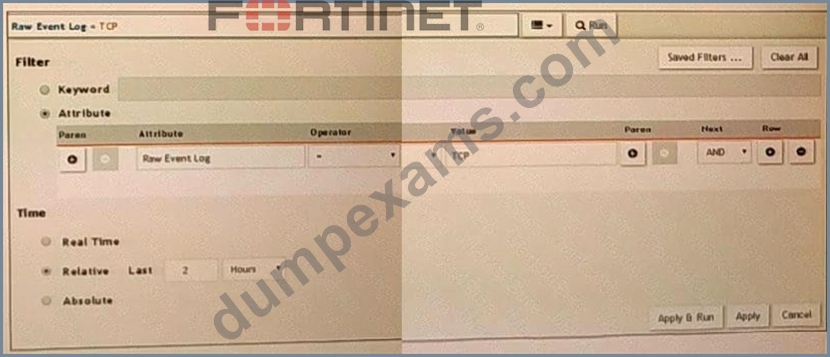
A FortiSIEM is continuously receiving syslog events from a FortiGate firewall The FortiSlfcM administrator is trying to search the raw event logs for the last two hours that contain the keyword tcp . However, the administrator is getting no results from the search.
Based on the selected filters shown in the exhibit, why are there no search results?
- A. The keyword is case sensitive Instead of typing TCP in the Value field. the administrator should type tcp.
- B. In the Time section, the administrator selected the Relative Last option, and in the drop-down lists, selected 2 and Hours as the lime period The time period should be 24 hours.
- C. The administrator selected AND in the Next drop-down list. This is the wrong boolean operator.
- D. The administrator selected - in the Operator column That a the wrong operator.
Answer: A
Explanation:
Case Sensitivity in Searches: In FortiSIEM, search queries, including those for raw event logs, are case sensitive. This means that keywords must be entered exactly as they appear in the logs.
Keyword Mismatch: The exhibit shows the keyword "TCP" in the Value field. If the actual events use "tcp" (lowercase), the search will return no results because of the case mismatch.
Correct Keyword: To match the keyword correctly, the administrator should enter "tcp" in the Value field.
References: FortiSIEM 6.3 User Guide, Search and Filtering section, which discusses the importance of case sensitivity in search queries.
NEW QUESTION # 29
In the advanced analytical rules engine in FortiSIEM, multiple subpatterms can be referenced using which three operation? (Choose three.)
- A. AND
- B. OR
- C. NOT
- D. ELSE
- E. FOLLOWED_BY
Answer: A,B,E
NEW QUESTION # 30
Refer to the exhibit.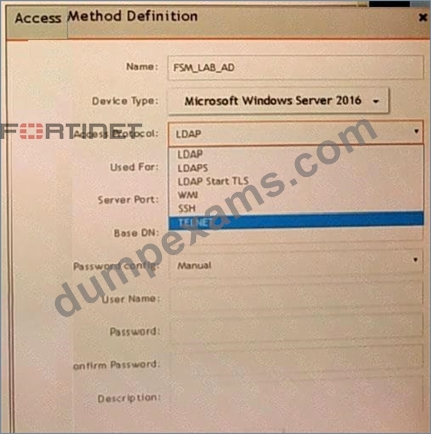
A FortiSIEM administrator wants to collect both SIEM event logs and performance and availability metrics (PAM) events from a Microsoft Windows server Which protocol should the administrator select in the Access Protocol drop-down list so that FortiSIEM will collect both SIEM and PAM events?
- A. WMI
- B. LDAPS
- C. TELNET
- D. LDAP start TLS
Answer: A
Explanation:
Collecting SIEM and PAM Events: To collect both SIEM event logs and Performance and Availability Monitoring (PAM) events from a Microsoft Windows server, a suitable protocol must be selected.
WMI Protocol: Windows Management Instrumentation (WMI) is the appropriate protocol for this task.
* SIEM Event Logs: WMI can collect security, application, and system logs from Windows devices.
* PAM Events: WMI can also gather performance metrics, such as CPU usage, memory utilization, and disk activity.
Comprehensive Data Collection: Using WMI ensures that both types of data are collected efficiently from the Windows server.
References: FortiSIEM 6.3 User Guide, Data Collection Methods section, which details the use of WMI for collecting various types of logs and performance metrics.
NEW QUESTION # 31
Refer to the exhibit.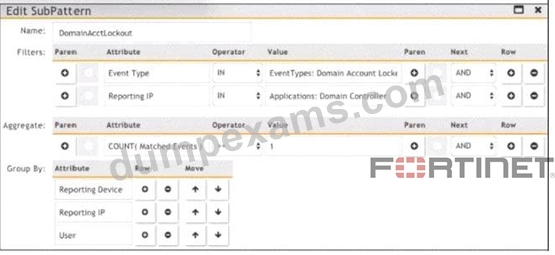
Which section contains the sortings that determine how many incidents are created?
- A. Filters
- B. Aggregate
- C. Actions
- D. Group By
Answer: B
Explanation:
Incident Creation in FortiSIEM: Incidents in FortiSIEM are created based on specific patterns and conditions defined within the system.
Group By Function: The "Group By" section in the "Edit SubPattern" window specifies how the data should be grouped for analysis and incident creation.
Impact of Grouping: The way data is grouped affects the number of incidents generated. Each unique combination of the grouped attributes results in a separate incident.
Exhibit Analysis: In the provided exhibit, the "Group By" section lists "Reporting Device," "Reporting IP," and "User." This means incidents will be created for each unique combination of these attributes.
References: FortiSIEM 6.3 User Guide, Rule and Pattern Creation section, which details how grouping impacts incident generation.
NEW QUESTION # 32
Refer to the exhibit.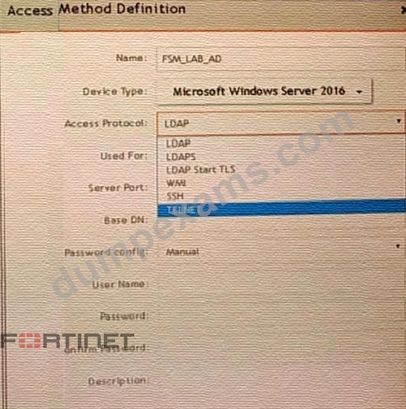
A FortiSIEM administrator wants to collect both SIEM event logs and performance and availability metrics (PAM) events from a Microsoft Windows server Which protocol should the administrator select in the Access Protocol drop-down list so that FortiSIEM will collect both SIEM and PAM events?
- A. WMI
- B. LDAPS
- C. TELNET
- D. LDAP start TLS
Answer: A
Explanation:
Collecting SIEM and PAM Events: To collect both SIEM event logs and Performance and Availability Monitoring (PAM) events from a Microsoft Windows server, a suitable protocol must be selected.
WMI Protocol: Windows Management Instrumentation (WMI) is the appropriate protocol for this task.
* SIEM Event Logs: WMI can collect security, application, and system logs from Windows devices.
* PAM Events: WMI can also gather performance metrics, such as CPU usage, memory utilization, and disk activity.
Comprehensive Data Collection: Using WMI ensures that both types of data are collected efficiently from the Windows server.
References: FortiSIEM 6.3 User Guide, Data Collection Methods section, which details the use of WMI for collecting various types of logs and performance metrics.
NEW QUESTION # 33
In the rules engine, which condition instructs FortiSIEM to summarize and count the matching evaluated data?
- A. Filters
- B. Aggregation
- C. Time Window
- D. Group By
Answer: B
Explanation:
Rules Engine in FortiSIEM: The rules engine evaluates incoming events based on defined conditions to detect incidents and anomalies.
Aggregation Condition: The aggregation condition instructs FortiSIEM to summarize and count the matching evaluated data.
* Function: Aggregation is used to group events based on specified criteria and then perform operations such as counting the number of occurrences within a defined time window.
Purpose: This allows for the detection of patterns and anomalies, such as a high number of failed login attempts within a short period.
References: FortiSIEM 6.3 User Guide, Rules Engine section, which explains how aggregation is used to summarize and count matching data.
NEW QUESTION # 34
An administrator defines SMTP as a critical process on a Linux server.
If the SMTP process is stopped, FortiSIEM would generate a critical event with which event type?
- A. PH_DEV_MON_SMTP_STOP
- B. Postfix-Mail-Slop
- C. PH_DEV_MON_PROC_STOP
- D. Generic SMTP Process Exit
Answer: C
NEW QUESTION # 35
An administrator defines SMTP as a critical process on a Linux server.
It the SMTP process is stopped. FortiSIEM will generate a critical event with which event type?
- A. PH_DEV_MON_SMTP_STOP
- B. Generic_SMTP_Procoss_Exit
- C. PH_DEV_MON_PROC_STOP
- D. Postfix-Mail-Stop
Answer: C
Explanation:
Process Monitoring in FortiSIEM: FortiSIEM can monitor critical processes on managed devices, such as an SMTP process on a Linux server.
Event Generation: When a critical process stops, FortiSIEM generates an event to alert administrators.
Event Types: Specific event types correspond to different monitored conditions. For a stopped process, the event typePH_DEV_MON_PROC_STOPis used.
Reasoning: The namePH_DEV_MON_PROC_STOP(Device Monitoring Process Stop) is a generic event type used by FortiSIEM to indicate that any monitored process, including SMTP, has stopped.
References: FortiSIEM 6.3 User Guide, Event Types section, explains the predefined event types and their usage in different monitoring scenarios.
NEW QUESTION # 36
An administrator is in the process ofrenewing a FortiSIEM license. Which two commands will provide thesystem ID? (Choose two.)
- A. phgetHWID
- B. ./phLicenseTool-show
- C. phgetUUID
- D. ./phLicenseTool - support
Answer: A,C
Explanation:
License Renewal Process: When renewing a FortiSIEM license, it is essential to provide the system ID, which uniquely identifies the FortiSIEM instance.
Commands to Retrieve System ID:
* phgetHWID: This command retrieves the hardware ID of the FortiSIEM appliance.
* Usage: Run the commandphgetHWIDin the CLI to obtain the hardware ID.
* phgetUUID: This command retrieves the universally unique identifier (UUID) for the FortiSIEM system.
* Usage: Run the commandphgetUUIDin the CLI to obtain the UUID.
Verification: BothphgetHWIDandphgetUUIDare valid commands for retrieving the necessary system IDs required for license renewal.
References: FortiSIEM 6.3 Administration Guide, Licensing section details the commands and procedures for obtaining system identification information necessary for license renewal.
NEW QUESTION # 37
An administrator is configuring FortiSIEM to discover network devices and receive syslog from network devices. Which statement is correct?
- A. FortiSIEM uses privileged credentials to tog in to devices and make network configuration changes.
- B. FortiSIEM automatically configures network devices to send syslog using the auto log discovery process.
- C. FortiSIEM automatically configures network devices to send syslog using the GUI discovery process
- D. Syslog configuration must be done manually on devices by the network administrator.
Answer: D
Explanation:
Syslog Configuration in FortiSIEM: For FortiSIEM to receive syslog messages from network devices, those devices need to be properly configured to send syslog data to FortiSIEM.
Manual Configuration Requirement: FortiSIEM does not automatically configure network devices to send syslog messages. Instead, this configuration must be performed manually by the network administrator.
Process Overview: The network administrator must access each device and set up the syslog parameters to direct log data to the FortiSIEM collector's IP address.
Discovery Process: While FortiSIEM can discover network devices using SNMP, WMI, and other protocols, the configuration of syslog on these devices is beyond its scope and requires manual intervention.
References: FortiSIEM 6.3 User Guide, Device Configuration and Syslog Integration sections, which explain the requirements and steps for setting up syslog forwarding on network devices.
NEW QUESTION # 38
Refer to the exhibit.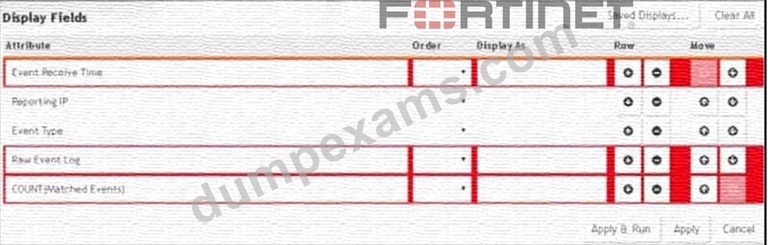
A FortiSIEM administrator wants to group some attributes for a report, but is not able to do so successfully.
As shown in the exhibit, why are some of the fields highlighted in red?
- A. No RAW Event Log attribute is available for devices.
- B. The attribute COUNT(Matched events) is an invalid expression.
- C. Unique attributes cannot be grouped.
- D. The Event Receive Time attribute is not available for logs.
Answer: C
Explanation:
Grouping Attributes in Reports: When creating reports in FortiSIEM, certain attributes can be grouped to summarize and organize the data.
Unique Attributes: Attributes that are unique for each event cannot be grouped because they do not provide a meaningful aggregation or summary.
Red Highlighting Explanation: The red highlighting in the exhibit indicates attributes that cannot be grouped together due to their unique nature. These unique attributes includeEvent Receive Time,Reporting IP,Event Type,Raw Event Log, andCOUNT(Matched Events).
Attribute Characteristics:
* Event Receive Timeis unique for each event.
* Reporting IPandEvent Typecan vary greatly, making grouping them impractical in this context.
* Raw Event Logrepresents the unprocessed log data, which is also unique.
* COUNT(Matched Events)is a calculated field, not suitable for grouping.
References: FortiSIEM 6.3 User Guide, Reporting section, explains the constraints on grouping attributes in reports.
NEW QUESTION # 39
......
Fortinet NSE5_FSM-6.3 Certification Exam consists of 35 multiple-choice questions, and candidates have 60 minutes to complete it. NSE5_FSM-6.3 exam covers a range of topics, including FortiSIEM architecture, configuration and management of SIEM components, event processing, and reporting. Successful candidates will receive the Fortinet NSE 5 - FortiSIEM 6.3 certification, which demonstrates their expertise in using FortiSIEM to manage security events and provide actionable insights for their organizations.
Updated NSE5_FSM-6.3 Exam Practice Test Questions: https://passleader.dumpexams.com/NSE5_FSM-6.3-vce-torrent.html