


100% Accurate Answers! May-2026 1z0-071 Actual Real Exam Questions
Best Value Available! 2026 Realistic Verified Free 1z0-071 Exam Questions
Oracle 1z1-071 exam covers a broad range of topics, including SQL, data manipulation, data control language, data definition language, and basic database concepts. Candidates are expected to have a good understanding of SQL and be able to perform basic database operations. 1z0-071 exam also tests the candidate's ability to use SQL to retrieve and manipulate data from Oracle databases.
NEW QUESTION # 139
Table EMPLOYEES contains columns including EMPLOYEE_ID, JOB_ID and SALARY.
Only the EMPLOYEES_ID column is indexed.
Rows exist for employees 100 and 200.
Examine this statement:
UPDATE employees
SET (job_id, salary) =
(SELECT job_id, salary
FROM employees
WHERE employee_id = 200)
WHERE employee id=100;
Which two statements are true?
- A. Employee 100 will have SALARY set to the same value as the SALARY of employee 200.
- B. Employees 100 and 200 will have the same JOB ID as before the update command.
- C. Employees 100 and 200 will have the same SALARY as before the update command.
- D. Employee 100 will have JOB_ID set to the same value as the JOB_ID of employee 200.
- E. Employee 200 will have SALARY set to the same value as the SALARY of employee 100.
- F. Employee 200 will have JOB_ID set to the same value as the JOB_ID of employee 100
Answer: A,D
NEW QUESTION # 140
View the Exhibit and examine the description of the tables.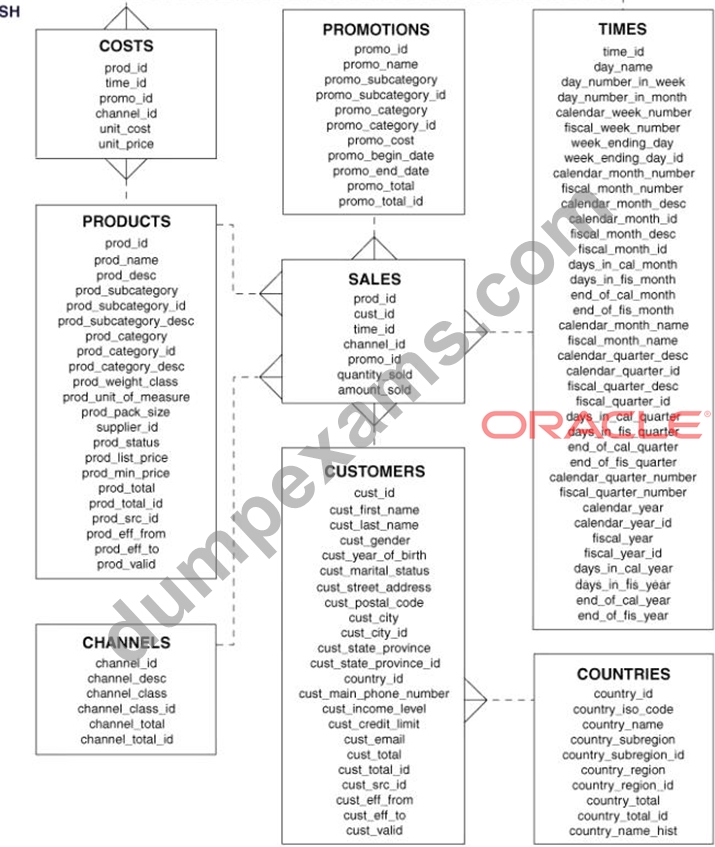
You execute this SQL statement: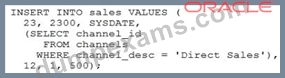
Which three statements are true?
- A. The statement will fail because a subquery may not be contained in a VALUES clause.
- B. A product can have a different unit price at different times.
- C. A customer can exist in many countries.
- D. The statement will fail if a row already exists in the SALES table for product 23.
- E. The statement will execute successfully and a new row will be inserted into the SALES table.
- F. The SALES table has five foreign keys.
Answer: C,E,F
NEW QUESTION # 141
Examine the description of the BRICKS table;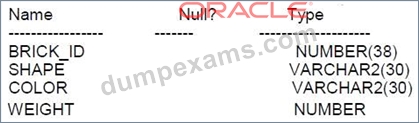
Examine the description of the BRICKS_STAGE table;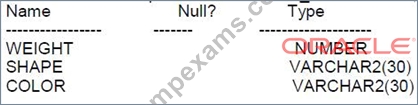
Which two queries execute successfully?
- A. SELECT shape,color FROM bricks
MINUS
SELECT WEIGHT,color FROM bricks_stage; - B. SELECT shape,color,weight from bricks
MINUS
SELECT * FROM bricks_stage; - C. SELECT shape,color FROM bricks
MINUS
SELECT color,shape FROM bricks_stage; - D. select * from bricks
MINUS
select * from bricks_stage; - E. SELECT brick_id,shape FROM bricks
MINUS
SELECT WEIGHT,COLOR from bricks_stage;
Answer: D
Explanation:
In Oracle SQL, when using the set operators like MINUS, the number of columns and their data types in the SELECT statements must match in sequence.
A). This query will not execute successfully because the SELECT * FROM bricks_stage will return all columns from the BRICKS_STAGE table, which are WEIGHT, SHAPE, and COLOR, but the first SELECT statement specifies only SHAPE and COLOR. The order and number of columns must match.
B). This query will not execute successfully. The SELECT statements have a different number of columns, and the data types of the columns in the same positions do not match between the two queries. The first column in the first SELECT is SHAPE (VARCHAR2), and in the second SELECT, it is WEIGHT (NUMBER).
C). This query will execute successfully. The SELECT * from both tables will ensure that the number of columns and their data types are the same, as SELECT * selects all columns from the table. As long as the two tables have the same column order and data types for those columns, the query will execute.
D). This query will not execute successfully. Even though the columns are of the same data types, their order in the SELECT statements must match for the set operator to work. The order of SHAPE and COLOR is switched between the two queries.
E). This query will not execute successfully. The number of columns in the SELECT statements is the same, but their data types do not match between the two queries. BRICK_ID (NUMBER) in the first query does not match WEIGHT (NUMBER) in the second, and SHAPE (VARCHAR2) does not match COLOR (VARCHAR2).
References:
* Oracle Database SQL Language Reference, 12c Release 1 (12.1): "Combining Queries with Set Operators"
* Oracle Database SQL Language Reference, 12c Release 1 (12.1): "MINUS"
NEW QUESTION # 142
Evaluate the following query:
SQL> SELECT TRUNC (ROUND (156.00, -1),-1)
FROM DUAL;
What would be the outcome?
- A. 0
- B. 1
- C. 2
- D. 3
- E. 4
Answer: E
NEW QUESTION # 143
Which three actions can you perform by using the ORACLE_DATAPUMP access driver?
- A. Read data from an external table and load it into a table in the database.
- B. Read data from a table in the database and insert it into an external table.
- C. Query data from an external table.
- D. Execute DML statements on an external table.
- E. Create a directory object for an external table.
- F. Create a directory object for a flat file.
Answer: A,B
NEW QUESTION # 144
Which three statements are correct regarding indexes? (Choose three.)
- A. A non-deferrable PRIMARY KEYor UNIQUE KEYconstraint in a table automatically attempts to creates a unique index.
- B. When a table is dropped, the corresponding indexes are automatically dropped.
- C. Indexes should be created on columns that are frequently referenced as part of any expression.
- D. For each DML operation performed, the corresponding indexes are automatically updated.
Answer: A,B,D
Explanation:
Explanation/Reference:
References:
http://viralpatel.net/blogs/understanding-primary-keypk-constraint-in-oracle/
NEW QUESTION # 145
Examine the description of the ORDER_ITEMS table: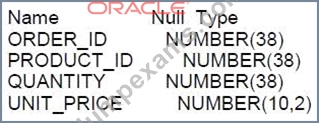
Examine this incomplete query:
SELECT DISTINCT quantity * unit_price total_paid FROM order_items ORDER BY <clause>; Which two can replace <clause> so the query completes successfully?
- A. quantity, unit_price
- B. quantity
- C. product_id
- D. quantity * unit_price
- E. total_paid
Answer: A,D
Explanation:
In a SELECT statement with DISTINCT, the ORDER BY clause can only order by expressions that are part of the SELECT list.
A). quantity alone is not sufficient to replace <clause> as it is not included in the SELECT list after DISTINCT.
B). This option can successfully replace <clause> because both quantity and unit_price are used in the SELECT expression, and thus their individual values are valid for the ORDER BY clause.
C). total_paid is an alias for the expression quantity * unit_price, but it cannot be used in the ORDER BY clause because Oracle does not allow aliases of expressions in DISTINCT queries to be used in ORDER BY.
D). product_id is not included in the SELECT list after DISTINCT and thus cannot be used in ORDER BY.
E). The expression quantity * unit_price is exactly what is selected, so it can replace <clause> and the query will complete successfully.
References:
* Oracle Database SQL Language Reference, 12c Release 1 (12.1): "ORDER BY Clause"
NEW QUESTION # 146
Which three statements are true regarding group functions? (Choose three.)
- A. They can be used only with a SQL statement that has the GROUP BY clause.
- B. They can be used on only one column in the SELECT clause of a SQL statement.
- C. They can be used along with the single-row function in the SELECT clause of a SQL statement.
- D. They can be used on columns or expressions.
- E. They can be passed as an argument to another group function.
Answer: C,D,E
Explanation:
Explanation
References:
https://www.safaribooksonline.com/library/view/mastering-oracle-sql/0596006322/ch04.html
NEW QUESTION # 147
Which two statements are true about views?
- A. Theethi CHEcK clause prevents certalin rows from being updated or inserted in the underying table through the view.
- B. The wITH CHECK clause prevents certain rows from being displayed when querying the view.
- C. Views can be updated without the need to re-grant privileges on the view.
- D. Tables in the defining query of a view must always exist in order to create the view.
- E. Views can be indexed.
Answer: C,D
Explanation:
Views in Oracle have specific properties regarding how they can be used and what limitations apply to them:
A . Oracle does not allow indexing directly on views. However, a view can display data from indexed tables.
B . The WITH CHECK OPTION clause on a view prevents DML operations that would result in rows that do not satisfy the view's filter criteria. It doesn't prevent certain rows from being updated or inserted in the underlying table through the view per se.
C . The tables (or other views) referenced in the creating query of a view must exist at the time the view is created, making this statement true.
D . Views do not require privileges to be re-granted when the view is updated; they are separate from the underlying object privileges, making this statement true.
E . The WITH CHECK OPTION clause is used to ensure that all data modifications through the view are consistent with the view's defining query, not to prevent rows from being displayed.
Reference:
Oracle Database SQL Language Reference, 12c Release 1 (12.1): "CREATE VIEW" Oracle Database Concepts, 12c Release 1 (12.1): "Views"
NEW QUESTION # 148
View the Exhibit and examine PRODUCTSand ORDER_ITEMStables.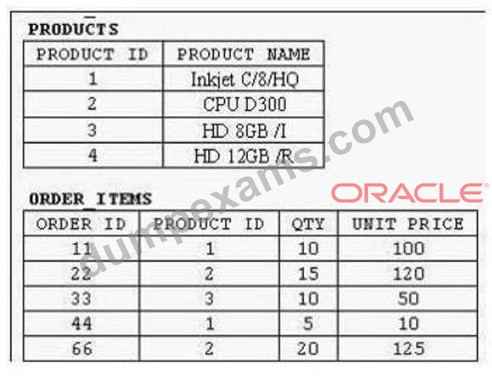
You executed the following query to display PRODUCT_NAMEand the number of times the product has been ordered:
SELECT p.product_name, i.item_cnt
FROM (SELECT product_id, COUNT (*) item_cnt
FROM order_items
GROUP BY product_id) i RIGHT OUTER JOIN products p
ON i.product_id = p.product_id;
What would happen when the above statement is executed?
- A. The statement would execute successfully to produce the required output.
- B. The statement would not execute because the GROUP BYclause cannot be used in the inline.
- C. The statement would not execute because the ITEM_CNTalias cannot be displayed in the outer query.
- D. The statement would not execute because inline views and outer joins cannot be used together.
Answer: A
NEW QUESTION # 149
You issued this command:
Which three statements are true?
- A. Sequences used to populate columns in the HR.EMPLOYEES table are dropped.
- B. Synonyms for HR.EMPLOYEES are dropped.
- C. All indexes defined on HR.EMPLOYEES are dropped.
- D. All constraints defined on HR.EMPLOYEES are dropped.
- E. Views referencing HR.EMPLOYEES are dropped.
- F. The HR.EMPLOYEES table may be moved to the recycle bin.
Answer: C,D,E
NEW QUESTION # 150
View the Exhibit and examine the structure of the EMPLOYEES and JOB_HISTORY tables.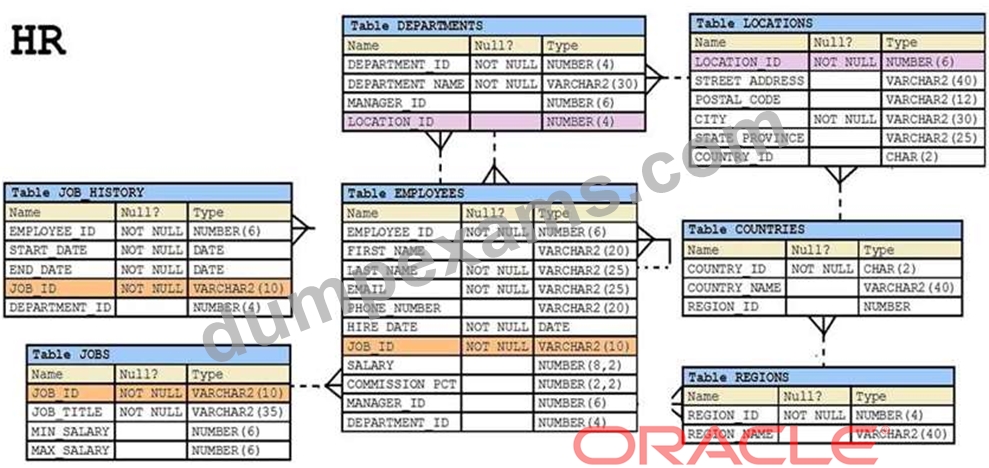
Examine this query which must select the employee IDs of all the employees who have held the job SA_MAN at any time during their employment.
SELECT EMPLOYEE_ID
FROM EMPLOYEES
WHERE JOB_ID = 'SA_MAN'
-------------------------------------
SELECT EMPLOYEE_ID
FROM JOB_HISTORY
WHERE JOB_ID = 'SA_MAN';
Choose two correct SET operators which would cause the query to return the desired result.
- A. UNION
- B. UNION ALL
- C. INTERSECT
- D. MINUS
Answer: A,B
Explanation:
Explanation/Reference:
NEW QUESTION # 151
Examine this data in the EMPLOYERS table: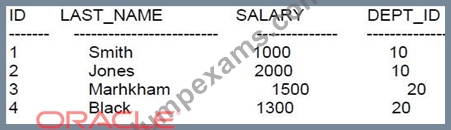
Which statement will execute successfully?
- A. SELECT dept_id, STDDEV (last_name), SUM (salary) FROM employees GROUP BY dept_id
- B. SELECT dept_id, INSTR (last_name,'A'), SUM (salary) FROM employees GROUP BY dept_id
- C. SELECT dept_id, LENGTH (last_name), SUM (salary) FROM employees GROUP BY dept_id
- D. SELECT dept_id, MAX (Last_name), SUM (salary) FROM employees GROUP BY dept_id
Answer: D
NEW QUESTION # 152
Examine the structure of the CUSTOMERS table: (Choose two.)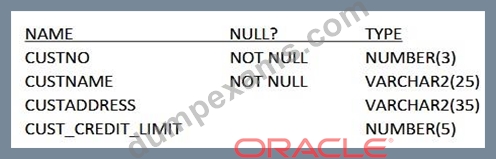
CUSTNO is the PRIMARY KEY.
You must determine if any customers' details have been entered more than once using a different CUSTNO, by listing all duplicate names.
Which two methods can you use to get the required result?
- A. Left outer-join with self-join
- B. Full outer-join with self-join
- C. Right outer-join with self-join
- D. Self-join
- E. Subquery
Answer: D,E
NEW QUESTION # 153
Examine the structure of the INVOICE table.
NameNull?Type
--------------------------------------------------
INV_NONOT NULLNUMBER(3)
INV_DATEDATE
INV_AMTNUMBER(10,2)
Which two SQL statements would execute successfully?
- A. SELECT inv_no, NVL2(inv_date, 'Pending', 'Incomplete')FROM invoice;
- B. SELECT inv_no, NVL2(inv_amt, inv_amt*.25, 'Not Available')FROM invoice;
- C. SELECT inv_no, NVL2(inv_amt, inv_date, 'Not Available')FROM invoice;
- D. SELECT inv_no, NVL2(inv_date, sysdate-inv_date, sysdate)FROM invoice;
Answer: A,D
NEW QUESTION # 154
Which two statements are true about selecting related rows from two tables based on entity relationship diagram (ERD)?
- A. Implementing a relationship between two tables might require joining additional tables.
- B. Relating data from a table with data from the same table is implemented with a self join.
- C. Rows from unrelated tables cannot be joined.
- D. An inner join relates rows within the same table.
- E. Every relationship between the two tables must be implemented in a Join condition.
Answer: A,B
Explanation:
Understanding the functionality of SQL joins and their application in a relational database:
* Option A: Correct. A self join is used to relate or compare rows within the same table. It typically involves using table aliases to distinguish the different instances of the table in the query.
* Option B: Incorrect. An inner join relates rows between two different tables based on a common condition, not within the same table.
* Option C: Incorrect. SQL allows joining of rows from any tables, whether directly related by foreign keys or not, as long as there is a logical condition that can relate their columns.
* Option D: Correct. Sometimes establishing a relationship between two specific tables might require joining through one or more intermediary tables, particularly in cases involving complex relationships or normalization.
* Option E: Incorrect. While joins are often used to implement relationships, not every logical relationship necessitates a join condition, especially if data from only one table is required or if multiple relations are possible but not relevant to the specific query.
NEW QUESTION # 155
Which two statements are true about Oracle synonyms?
- A. A synonym can be created on an object in a package.
- B. A synonym can have a synonym.
- C. Any user can create a PUBLIC synonym.
- D. A synonym has an object number.
- E. All private synonym names must be unique in the database.
Answer: B,D
NEW QUESTION # 156
View the Exhibit and examine the description of the EMPLOYEEStable.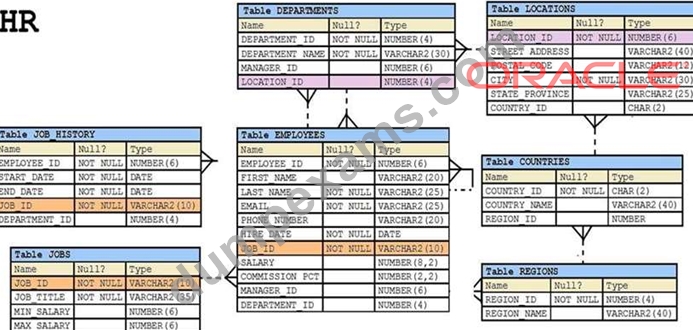
You want to calculate the total remuneration for each employee. Total remuneration is the sum of the annual salary and the percentage commission earned for a year. Only a few employees earn commission.
Which SQL statement would you execute to get the desired output?
SELECT first_name, salary, salary*12+(salary*NVL2 (commission_pct,
- A. FROM EMPLOYEES;
- B. FROM EMPLOYEES;
SELECT first_name, salary, salary*12 + NVL(salary,0)*commission_pct, "Total" - C. salary,salary+commission_pct))"Total"
FROM EMPLOYEES;
SELECT first_name, salary, salary*12+salary*commission_pct "Total" - D. FROM EMPLOYEES;
SELECT first_name, salary (salary + NVL (commission_pct, 0)*salary)*12 "Total"
Answer: C
NEW QUESTION # 157
The PROD_ID column is the foreign key in the SALES table.Which references the PRODUCTS table.
Similarly,the CUST_ID and TIME_ID columns are Also foreign keys in the SALES table referencing the CUSTOMERS and TIMES tables, respectively.
Evaluate the following CREATE TABLE command:
CREATE TABLE new_sales(prod_id, I cust_id, order_date DEFAULT SYSDATE)
AS SELECT I prod_id,cust_id,time_id FROM sales.
Which statement is true regarding the above command?
- A. The NEW_SALES table would not get created because the column names in the CREATE TABLE command and the SELECT clause I do not match.
- B. The NEW_SALES table would get created and all the FOREIGN KEY constraints defined on the specified columns would be passed to the new table
- C. The NEW_SALES table would get created and all the NOT NULL constraints defined on the specified columns would be passed to the new table.
- D. The NEW_SALES table would not get created because the DEFAULT value cannot be specified in the column definition.
Answer: C
NEW QUESTION # 158
Which two statements are true regarding the EXISTSoperator used in the correlated subqueries? (Choose two.)
- A. It is used to test whether the values retrieved by the outer query exist in the result set of the inner query.
- B. The outer query stops evaluating the result set of the inner query when the first value is found.
- C. It is used to test whether the values retrieved by the inner query exist in the result of the outer query.
- D. The outer query continues evaluating the result set of the inner query until all the values in the result set are processed.
Answer: A,B
Explanation:
Explanation/Reference:
References:
http://www.techonthenet.com/oracle/exists.php
NEW QUESTION # 159
......
Actual Questions Answers Pass With Real 1z0-071 Exam Dumps: https://passleader.dumpexams.com/1z0-071-vce-torrent.html