


[2026] New FCP_FAZ_AN-7.6 exam Free Sample Questions to Practice
Cover Real FCP_FAZ_AN-7.6 Exam Questions Make Sure You 100% Pass
NEW QUESTION # 28
Which two statements about playbook execution are true? (Choose two)
- A. You can <un the default debugging playbook to investigate playbook errors.
- B. FortiAnalyzer will not commit changes made by a Failed playbook
- C. Even I the playbook status is Failed, individual tasks may have succeeded.
- D. The Playbook Monitor provides troubleshooting logs
Answer: B,D
NEW QUESTION # 29
An administrator on your team has configured multiple reports to run periodically. Management has an additional request that all new generated reports be sent to a company email inbox for accessibility. The mail server has already been configured on FortiAnalyzer. Which item must configure on FortiAnalyzer so that emails are sent when the reports are generated?
- A. Enable an output profile on the reports.
- B. Enable the option to email all repots under the mail server.
- C. Add a mailto:<email address> option within the report layouts.
- D. Enable email notification under the report calendar.
Answer: A
Explanation:
To ensure that reports generated by FortiAnalyzer are automatically sent to an email inbox, you need to set up an output profile for the reports. Output profiles specify where and how reports should be delivered, including the option to send them via email.
Option D - Enable an Output Profile on the Reports:
An output profile can be configured on FortiAnalyzer to define delivery options, including emailing the report to specified recipients. This setup ensures that every time a report is generated according to the schedule, it is automatically emailed to the configured address.
NEW QUESTION # 30
Which two FortiAnalyzer features allow you to automatically build a dataset and chart based on a filtered search result? (Choose two.)
- A. Chart Builder
- B. Custom View
- C. Dataset Library
- D. Export to Report Chart (FortiView)
Answer: A,D
NEW QUESTION # 31
What is the purpose of using data selectors when configuring event handlers?
- A. They apply their filter criteria to the entire event handler so that you don't have to configure the same criteria in the individual rules.
- B. They download new filters can be used in event handlers.
- C. They filter the types of logs that FortiAnalyzer can accept from registered devices.
- D. They are common filters that can be applied simultaneously to all event handlers.
Answer: A
NEW QUESTION # 32
Which statement about sending notifications with incident update is true?
- A. Notifications can be sent only by email.
- B. Notifications can be sent only when an incident is updated or deleted.
- C. If you use multiple fabric connectors, all connectors must have the same settings.
- D. You can send notifications to multiple external platforms.
Answer: D
Explanation:
In FortiOS and FortiAnalyzer, incident notifications can be sent to multiple external platforms, not limited to a single method such as email. Fortinet's security fabric and integration capabilities allow notifications to be sent through various fabric connectors and third-party integrations. This flexibility is designed to ensure that incident updates reach relevant personnel or systems using preferred communication channels, such as email, Syslog, SNMP, or integration with SIEM platforms.
NEW QUESTION # 33
Refer to the exhibit. What can you conclude about the output?
- A. The output is not ADOM specific.
- B. The log rate higher than the message rate is not normal.
- C. There are more event logs than traffic logs.
- D. The low indexing values require investigation.
Answer: B
NEW QUESTION # 34
Which two methods can you use to send notifications when an event occurs that matches a configured event handler? (Choose two.)
- A. Send SMS notification
- B. Send Alert through FortiSIEM MEA
- C. Send SNMP trap
- D. Send Alert through Fabric Connectors
Answer: C,D
Explanation:
Send Alert through Fabric Connectors: This method involves creating a Fabric Connector profile and selecting the option "Send Alert through Fabric Connectors" in the event handler notification settings. Notifications are then sent in JSON format to the configured endpoint, such as Microsoft Teams or other integrated platforms.
Send SNMP trap: You can configure SNMP traps to be sent when an event triggers an incident.
This involves setting the SNMP Trap IP address, community string, trap type, and protocol in the system's analytics or incident settings.
NEW QUESTION # 35
You discover that a few reports are taking a long tine lo generate. Which two steps can you Like to troubleshoot? (Choose two.)
- A. Enable auto-cache and run the reports again
- B. Remove old reports from the hcache
- C. Increase the ADOM reports quota
- D. Review report diagnostics
Answer: A,B
NEW QUESTION # 36
It is a best practice to upload FortiAnalyzer local logs to a remote server. Which three remote servers are supported for the upload? (Choose three.)
- A. SFTP
- B. TCP
- C. UDP
- D. FTP
- E. SCP
Answer: A,D,E
NEW QUESTION # 37
As part of your analysis, you discover that a Medium severity level incident is fully remediated.
You change the incident status to Closed:Remediated.
Which statement about your update is true?
- A. The corresponding event will be marked as Mitigated.
- B. The incident dashboard will be updated.
- C. The incident severity will be lowered.
- D. The incident can no longer be deleted.
Answer: B
NEW QUESTION # 38
You are tasked with finding logs corresponding to a suspected attack on your network. You need to use an interface where all identified threats within timeframe are listed and organized. You also need to be able to quickly export the information to a PDF file.
Where can you go to accomplish this task?
- A. Fabric View
- B. FortiView
- C. Log View
- D. Log Browse
Answer: B
Explanation:
FortiView is a comprehensive monitoring system on FortiAnalyzer that integrates real-time and historical data into a single view, including threats. It provides intuitive summary dashboards listing top threats, sources, destinations, and more, all filterable by timeframe and other criteria.
FortiView allows drill-down into detailed threat information and supports exporting data and reports, including to PDF format, facilitating quick sharing and analysis.
https://docs.fortinet.com/document/fortigate/7.6.3/administration-guide/96300/using-the-fortiview- interface
NEW QUESTION # 39
After generating a report, you notice the information you where expecting to see is not included in it. However, you confirm that the logs are there.
- A. Check the time frame covered by the report.
- B. Test the dataset
- C. Increase the report utilization quota.
- D. Disable auto-cache.
Answer: A,B
Explanation:
When a generated report does not contain the expected information even though the logs are confirmed to be present, it typically indicates an issue with the report's configuration. There are a few common reasons this might happen:
Option A - Check the Time Frame Covered by the Report:
Reports are generated based on a specific time frame. If the report's time frame does not cover the period when the relevant logs were collected, those logs won't appear in the report output.
Verifying and adjusting the time frame is essential to ensure the report includes all relevant data.
Option D - Test the Dataset:
Datasets determine which logs and data fields are pulled into the report. If a dataset is configured incorrectly or does not include the required log fields, it could lead to missing information. Testing the dataset allows you to verify that it's correctly configured and pulling the expected data.
NEW QUESTION # 40
You crested a playbook on FortiAnalyzer that uses a FortiOS connector.
When configuring the FortiGate side, which type of trigger must be used so that the actions in an automation stitch are available in the FortiOS connector?
- A. Incoming webhook
- B. FortiOS Event Log
- C. FortiAnalyzer Event Handler
- D. Fabric Connector event
Answer: A
Explanation:
When using FortiAnalyzer to create playbooks that interact with FortiOS devices, an Incoming Webhook trigger is required on the FortiGate side to make the actions in an automation stitch accessible through the FortiOS connector. The incoming webhook trigger allows FortiAnalyzer to initiate actions on FortiGate by sending HTTP POST requests to specified endpoints, which in turn trigger automation stitches defined on the FortiGate.
NEW QUESTION # 41
You find that as part of your role as an analyst, you frequently search log View using the same parameters.
Instead of defining your search filters repeatedly, what can you do to save time?
- A. Configure a custom view.
- B. Configure a custom dashboard.
- C. Configure a marco and apply it to device groups.
- D. Configure a data selector.
Answer: A
Explanation:
When you frequently use the same search parameters in FortiAnalyzer's Log View, setting up a reusable filter or view can save considerable time.
Option B - Configure a Custom View:
Custom views in FortiAnalyzer allow analysts to save specific search filters and configurations. By setting up a custom view, you can retain your frequently used search parameters and quickly access them without needing to reapply filters each time. This option is specifically designed to streamline the process of recurring log searches.
NEW QUESTION # 42
What is the purpose of playbook trigger variables?
- A. To use information from the trigger to filter the action in a task
- B. To display statistics about the playbook runtime
- C. To store the start the times of playbooks with On_Schedule triggers
- D. To provide the trigger information to make the playbook start running
Answer: B
NEW QUESTION # 43
Which two external servers can you configure to validate administrator logins? (Choose two.)
- A. Syslog
- B. RADIUS
- C. Only locally by FortiAnalyzer
- D. LDAP
Answer: B,D
NEW QUESTION # 44
Exhibit. What is the analyst trying to create?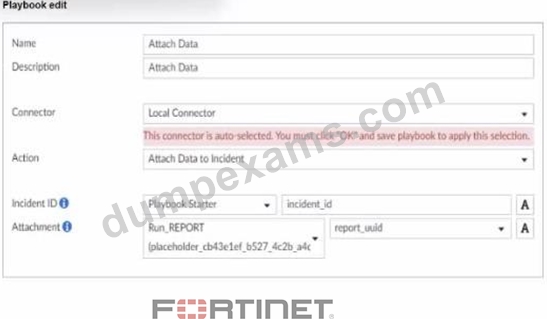
- A. The analyst is trying to create a SOC report in the playbook.
- B. The analyst is trying to create a trigger variable to the used in the playbook.
- C. The analyst is trying to create an output variable to be used in the playbook.
- D. The analyst is trying to create a report in the playbook.
Answer: C
Explanation:
In the exhibit, the playbook configuration shows the analyst working with the "Attach Data" action within a playbook. Here's a breakdown of key aspects:
Incident ID: This field is linked to the "Playbook Starter," which indicates that the playbook will attach data to an existing incident.
Attachment: The analyst is configuring an attachment by selecting Run_REPORT with a placeholder ID for report_uuid. This suggests that the report's UUID will dynamically populate as part of the playbook execution.
Option B - Creating an Output Variable:
The field Attachment with a report_uuid placeholder suggests that the analyst is defining an output variable that will store the report data or ID, allowing it to be attached to the incident. This variable can then be referenced or passed within the playbook for further actions or reporting.
NEW QUESTION # 45
Which two actions should an administrator take to vide Compromised Hosts on FortiAnalyzer?
(Choose two.)
- A. Make sure all endpoints are reachable by FortiAnalyzer.
- B. Enable device detection on the FotiGate device that are sending logs to FortiAnalyzer.
- C. Subscribe FortiAnalyzer to FortiGuard to keep its local threat database up to date.
- D. Enable web filtering in firewall policies on FortiGate devices, and make sure these logs are sent to fortiAnalyzer.
Answer: B,D
Explanation:
To view Compromised Hosts on FortiAnalyzer, certain configurations need to be in place on both FortiGate and FortiAnalyzer. Compromised Host data on FortiAnalyzer relies on log information from FortiGate to analyze threats and compromised activities effectively.
Option A: Enable device detection on the FortiGate devices that are sending logs to FortiAnalyzer Enabling device detection on FortiGate allows it to recognize and log devices within the network, sending critical information about hosts that could be compromised. This is essential because FortiAnalyzer relies on these logs to determine which hosts may be at risk based on suspicious activities observed by FortiGate. This setting enables FortiGate to provide device-level insights, which FortiAnalyzer uses to populate the Compromised Hosts view.
Option B: Enable web filtering in firewall policies on FortiGate devices, and make sure these logs are sent to FortiAnalyzer Web filtering is crucial in identifying potentially compromised hosts since it logs any access to malicious sites or blocked categories. FortiAnalyzer uses these web filter logs to detect suspicious or malicious web activity, which can indicate compromised hosts. By ensuring that FortiGate sends these web filtering logs to FortiAnalyzer, the administrator enables FortiAnalyzer to analyze and identify hosts engaging in risky behavior.
NEW QUESTION # 46
Refer to the exhibit. What is the purpose of using the Chart Builder feature on FortiAnalyzer?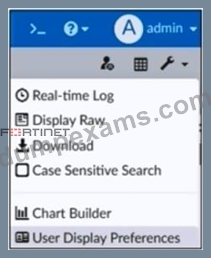
- A. To build a chart automatically based on the top 100 log entries
- B. To add charts directly to generate reports in the current ADOM.
- C. To build a dataset and chart based on the filtered search results
- D. To add a new chart under FortiView to be used in new reports
Answer: C
Explanation:
A quick way to build a custom dataset and chart is to use the chart builder tool. This tool is located in LogView, and allows you to build a dataset and chart automatically, based on your filtered search results. In LogView, set filters to return the logs you want.
NEW QUESTION # 47
Which two statement regarding the outbreak detection service are true? (Choose two.)
- A. An additional license is required.
- B. It automatically downloads new event handlers and reports.
- C. New alerts are received by email.
- D. Outbreak alerts are available on the root ADOM only.
Answer: A,B
Explanation:
The FortiAnalyzer Outbreak Detection Service is a licensed feature that requires a valid license to access outbreak alerts, event handlers, and reports. Without a valid license, these features are not available, and only a default alert page is shown.
When licensed, the service automatically downloads outbreak-related event handlers and reports from FortiGuard, enabling timely detection and response to emerging malware outbreaks.
https://docs.fortinet.com/document/fortianalyzer/7.0.0/new-features/371125/fortiguard-outbreak- detection-service
https://docs.fortinet.com/document/fortianalyzer/7.6.3/administration-guide/658619/outbreak- alerts
NEW QUESTION # 48
When managing incidents on FortiAnlyzer, what must an analyst be aware of?
- A. Severity incidents rated with the level High have an initial service-level agreement (SLA) response time of 1 hour.
- B. The status of the incident is always linked to the status of the attach event.
- C. You can manually attach generated reports to incidents.
- D. Incidents must be acknowledged before they can be analyzed.
Answer: C
Explanation:
In FortiAnalyzer's incident management system, analysts have the option to manually manage incidents, which includes attaching relevant reports to an incident for further investigation and documentation. This feature allows analysts to consolidate information, such as detailed reports on suspicious activity, into an incident record, providing a comprehensive view for incident response.
NEW QUESTION # 49
Which FortiAnalyzer feature allows you to use a proactive approach when managing your network security?
- A. Outbreak alert services
- B. FortiView Monitor
- C. Threat hunting
- D. Incidents dashboard
Answer: C
Explanation:
FortiAnalyzer offers several features for monitoring, alerting, and incident management, each serving different purposes.
Option D - Threat Hunting:
Threat Hunting in FortiAnalyzer enables security analysts to actively search for hidden threats or malicious activities within the network by leveraging historical data, analytics, and intelligence.
This is a proactive approach as it allows analysts to seek out threats before they escalate into incidents.
NEW QUESTION # 50
What is the purpose of running the command diagnose sql status sqlreportd?
- A. To list the current SQL processes running
- B. To display the SQL query connections and hcache status
- C. To identify the database log insertion status
- D. To view a list of scheduled reports
Answer: B
Explanation:
The command diagnose sql status sqlreportd is used in FortiAnalyzer to obtain specific information about the SQL reporting process and caching status. Here's what this command accomplishes and an analysis of each option:
Command Functionality:
sqlreportd is the FortiAnalyzer daemon responsible for managing SQL-based reporting processes. The diagnose sql status sqlreportd command provides information on active SQL query connections and the hcache (historical cache) status, which helps in monitoring and troubleshooting SQL report generation.
NEW QUESTION # 51
Refer to the exhibit. Laptop1 is used by several administrators to manage FortiAnalyzer. You want to configure a generic text filter that matches all login attempts to the web interface generated by any user other than "admin", and coming from Laptop1.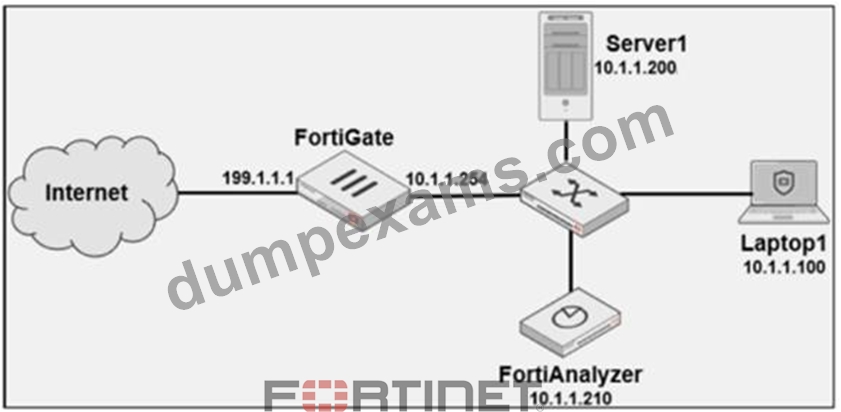
Which filter will achieve the desired result?
- A. Operation-login and dstip==10.1.1.210 and user!-admin
- B. Operation-login and performed_on==''GU (10.1.1.120)' and user!=admin
- C. Operation-login and performed_on==''GUI(10.1.1.100)' and user!=admin
- D. Operation-login and srcip== 10.1.1.100 and dstip==10.1.1.1.210 and user==admin
Answer: C
Explanation:
On there the task was to create a filter for failed logins from any other location but the local computer:
"Add the text performed_on!~10.0.1.10.
This includes any attempts coming from devices with an IP address that is not the one configured on the Local-Client computer."
NEW QUESTION # 52
You are trying to configure a task in the playbook editor to run a report. However, when you try to select the desired playbook, you do to see it listed.
What is the reason?
- A. The playbook is currently running and will be available after it is finished.
- B. You must create a trigger to run the report first.
- C. The report does not have auto-cache and extended log filtering enabled.
- D. The report has no result and must be reconfigured.
Answer: C
NEW QUESTION # 53
......
Real FCP_FAZ_AN-7.6 Quesions Pass Certification Exams Easily: https://passleader.dumpexams.com/FCP_FAZ_AN-7.6-vce-torrent.html