


[2026] Use Valid JN0-683 Exam - Actual Exam Question & Answer
Test Engine to Practice JN0-683 Test Questions
Juniper JN0-683 Exam Syllabus Topics:
| Topic | Details |
|---|---|
| Topic 1 |
|
| Topic 2 |
|
| Topic 3 |
|
| Topic 4 |
|
| Topic 5 |
|
NEW QUESTION # 23
You are selling up an EVPN-VXLAN architecture (or your new data center. thisinitial deployment will be less than 50 switches: however, it could scale up to 250 switches over time supporting 1024 VLANs. You are still deciding whether to use symmetric or asymmetric routing.
In this scenario, which two statements are correct? (Choose two.)
- A. Symmetric routing supports higher scaling numbers.
- B. Symmetric routing needs an extra VLAN with an IRB interface for each L3 VRF instance.
- C. Asymmetric routing routes traffic on the egress switch.
- D. Asymmetric routing is easier lo monitor because of the transit VNI.
Answer: A,C
Explanation:
* Symmetric vs. Asymmetric Routing in EVPN-VXLAN:
* Symmetric Routing:Traffic enters and exits the VXLAN network through the same VTEP, regardless of the source or destination. This approach simplifies routing decisions, especially in large networks, and is generally more scalable.
* Asymmetric Routing:The routing occurs on the egress VTEP. This method can be simpler to deploy in smaller environments but becomes complex as the network scales, particularly with larger numbers of VNIs and VLANs.
* Correct Statements:
* C. Symmetric routing supports higher scaling numbers:Symmetric routing is preferred in larger EVPN-VXLAN deployments because it centralizes routing decisions, which can be more easily managed and scaled.
* D. Asymmetric routing routes traffic on the egress switch:This is accurate, as asymmetric routing means the routing decision is made at the final hop, i.e., the egress VTEP before the traffic reaches its destination.
* Incorrect Statements:
* A. Symmetric routing needs an extra VLAN with an IRB interface for each L3 VRF instance:This is not accurate. Symmetric routing does not require an extra VLAN per VRF; rather, it uses the same VLAN/VNI across the network, simplifying routing and VLAN management.
* B. Asymmetric routing is easier to monitor because of the transit VNI:Asymmetric routing is not necessarily easier to monitor; in fact, it can add complexity due to the split routing logic between ingress and egress points.
Data Center References:
* The choice between symmetric and asymmetric routing in an EVPN-VXLAN environment depends on network size, complexity, and specific operational requirements. Symmetric routing is generally more scalable and easier to manage in large-scale deployments.
NEW QUESTION # 24
Click the Exhibit button. Both DC and DC2 are using EVPN-VXLAN technology deployed using an ERB architecture. A server on the Red VLAN must communicate with a server on the Green VLAN. The Blue VLAN in DC and DC2 needs to be the same VLAN.
Which statement is correct?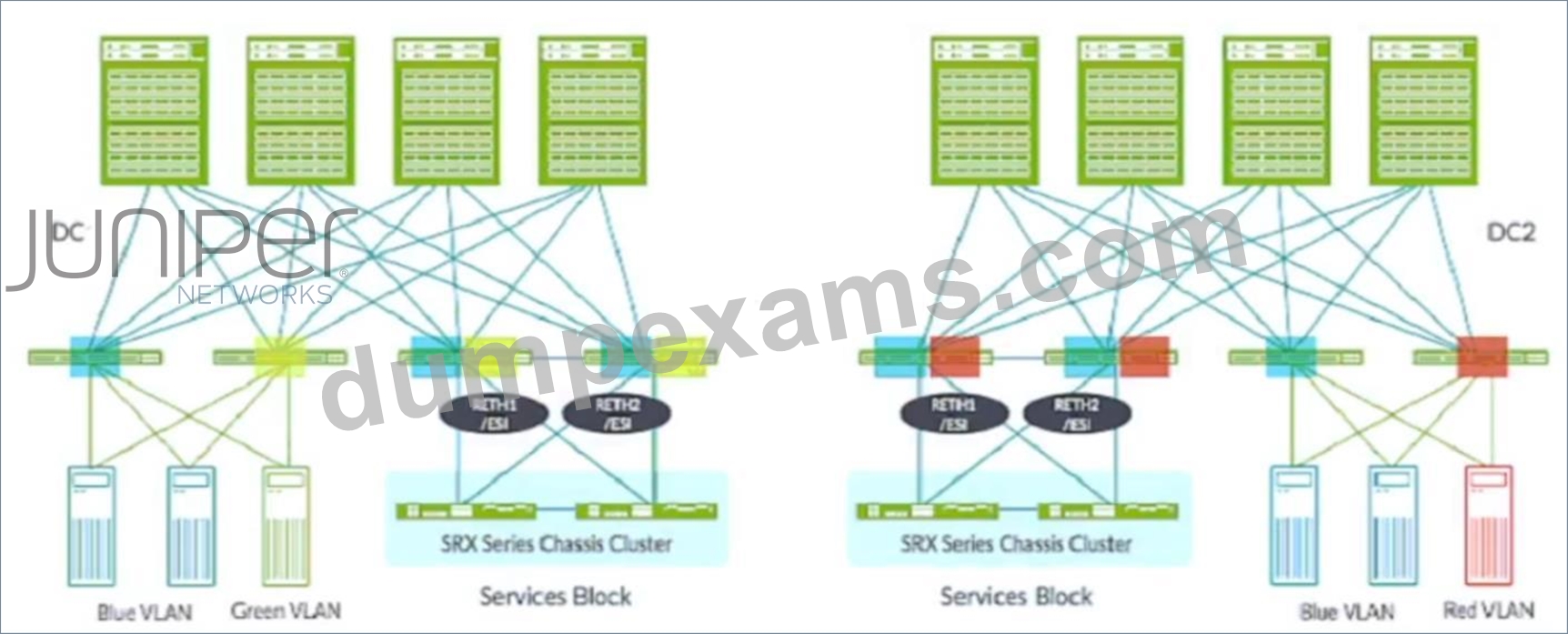
- A. An interconnect is required between the four SRX Series devices; the Blue VLAN must be stretched and a transit VNI must be added for the Red and Green VLANs.
- B. An interconnect is required between four leaf devices in the services blocks; the Red VLAN and the Green VLAN must be stitched and the Blue VLAN must be stretched.
- C. A lean super spine device must be added to DC and DC2; all VLANs must be stretched to the lean super spine device and the lean super spine devices must stitch all the VLANs together.
- D. The eight spine devices must be configured as border spine devices; a full mush interconnect must exist between all eight spine devices and the Blue VLAN must be stitched together
Answer: A
Explanation:
In an EVPN-VXLAN ERB (Edge Routed Bridging) architecture, Layer 2 VLANs can be stretched across data centers using VXLAN, while Layer 3 communication between different VLANs requires routing at the edge. Since the Blue VLAN must remain the same across DC and DC2, it must be stretched using VXLAN. However, inter-VLAN communication (between the Red and Green VLANs) requires Layer 3 routing, which is typically handled by a services block, such as the SRX Series chassis cluster shown in the diagram.
To enable inter-VLAN communication, a transit VNI (VXLAN Network Identifier) must be introduced, allowing the Red and Green VLANs to communicate across the two data centers. The interconnect between the SRX Series devices ensures that Layer 3 routing can be performed while maintaining VXLAN encapsulation between the two sites.
NEW QUESTION # 25
You are asked to deploy 100 QFX Series devices using ZTP Each OFX5120 requires a different configuration. In this scenario, what are two components that you would configure on the DHCP server?
(Choose two.)
- A. the MAC address of the FTP server
- B. the IP address of the FTP server
- C. the MAC address for each OFX5120
- D. the management IP address for each OFX5120
Answer: C,D
Explanation:
* Zero Touch Provisioning (ZTP):
* ZTP allows for the automated configuration of network devices, like QFX Series switches, without manual intervention. During ZTP, a switch will obtain its configuration from a DHCP server and then download the required software and configuration files from a specified server (e.
g., FTP, HTTP).
* DHCP Server Configuration:
* Option B:The DHCP server needs to know theMAC address for each QFX5120to provide a specific configuration based on the device identity. By mapping the MAC address to a particular configuration, the DHCP server can ensure that each switch gets the correct configuration.
* Option D:Themanagement IP address for each QFX5120must also be assigned by the DHCP server. This IP address allows the device to communicate on the network and access the configuration files and other required resources during the ZTP process.
Conclusion:
* Option B:Correct-MAC addresses allow the DHCP server to identify each QFX5120 and assign the appropriate configuration.
* Option D:Correct-Management IP addresses are essential for network communication during ZTP.
NEW QUESTION # 26
You are deploying an EVPN-VXLAN overlay. You must ensure that Layer 3 routing happens on the spine devices. In this scenario, which deployment architecture should you use?
- A. ERB
- B. distributed symmetric routing
- C. CRB
- D. bridged overlay
Answer: C
Explanation:
In the CRB architecture, inter-VNI (Virtual Network Identifier) routing occurs on the spine switches, meaning the spine devices handle the Layer 3 routing. The leaf switches primarily provide Layer 2 bridging and VXLAN encapsulation/decapsulation, while routing between VXLAN segments is done centrally on the spines.
NEW QUESTION # 27
Exhibit.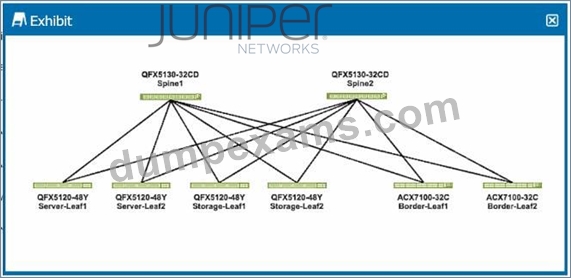
You are deploying a VXLAN overlay with EVPN as the control plane in an ERB architecture.
Referring to the exhibit, which three statements are correct about where the VXLAN gateways will be placed?
(Choose three.)
- A. All leaf devices will have L3 VXLAN gateways.
- B. Only the border and leaf devices will have L3 VXLAN gateways.
- C. Only the spine devices will have L2 VXLAN gateways.
- D. All leaf devices will have L2 VXLAN gateways.
- E. Spine devices will have no VXLAN gateways.
Answer: A,D,E
Explanation:
* Understanding ERB Architecture:
* ERB (Edge Routed Bridging) architecture is a network design where the routing occurs at the edge (leaf devices) rather than in the spine devices. In a VXLAN overlay network with EVPN as the control plane, leaf devices typically act as both Layer 2 (L2) and Layer 3 (L3) VXLAN gateways.
* Placement of VXLAN Gateways:
* Option B:All leaf devices will have L2 VXLAN gateways to handle the bridging of VLAN traffic into VXLAN tunnels.
* Option C:All leaf devices will also have L3 VXLAN gateways to route traffic between different VXLAN segments (VNIs) and external networks.
* Option E:Spine devices in an ERB architecture generally do not function as VXLAN gateways.
They primarily focus on forwarding traffic between leaf nodes and do not handle VXLAN encapsulation/decapsulation.
Conclusion:
* Option B:Correct-All leaf devices will have L2 VXLAN gateways.
* Option C:Correct-All leaf devices will have L3 VXLAN gateways.
* Option E:Correct-Spine devices will not act as VXLAN gateways
NEW QUESTION # 28
You are asked to interconnect two of your company's data centers across an IP backbone. Both data centers require Layer 2 and Layer 3 connectivity. In this scenario, which three actions would accomplish this task?
(Choose three.)
- A. Ensure there is a full mesh of VTEPs between all leaf nodes within data centers.
- B. Advertise Type 5 EVPN routes across the DCI.
- C. Advertise Type 2 EVPN routes across the DCI.
- D. Ensure border leaf nodes in each data center can exchange EVPN routes.
- E. Ensure there is a full mesh of VTEPs between all spine nodes within both data centers.
Answer: B,C,D
Explanation:
* Layer 2 and Layer 3 Connectivity Requirements:
* To interconnect two data centers across an IP backbone with both Layer 2 (L2) and Layer 3 (L3) connectivity, EVPN-VXLAN (Ethernet VPN with Virtual Extensible LAN) is the ideal solution.
EVPN supports L2 VPNs while also enabling L3 connectivity across multiple locations.
* Necessary EVPN Route Types:
* Type 2 EVPN Routes:These routes are used to advertise MAC addresses for Layer 2 connectivity. They are essential for enabling seamless L2 communication across data centers.
* Type 5 EVPN Routes:These routes are necessary for advertising IP prefixes for Layer 3 connectivity between data centers. They enable the exchange of L3 information across the IP backbone, ensuring routed traffic can reach its destination.
* Border Leaf Nodes:
* Border Leaf Nodes:Ensuring that the border leaf nodes (the entry and exit points for traffic between data centers) can exchange EVPN routes is critical for the correct dissemination of both L2 and L3 information across the data centers.
Conclusion:
* Option A:Correct-Type 2 EVPN routes are required for Layer 2 MAC address learning and communication across the DCI (Data Center Interconnect).
* Option B:Correct-Border leaf nodes need to exchange EVPN routes to maintain connectivity between data centers.
* Option D:Correct-Type 5 EVPN routes are essential for Layer 3 connectivity across the DCI.
OptionsCandEare incorrect because they refer to establishing full mesh VTEPs (VXLAN Tunnel Endpoints) across all spine or leaf nodes, which is unnecessary for the scenario provided. The focus should be on border leaf nodes and appropriate route advertisements for L2 and L3 connectivity.
NEW QUESTION # 29
Exhibit.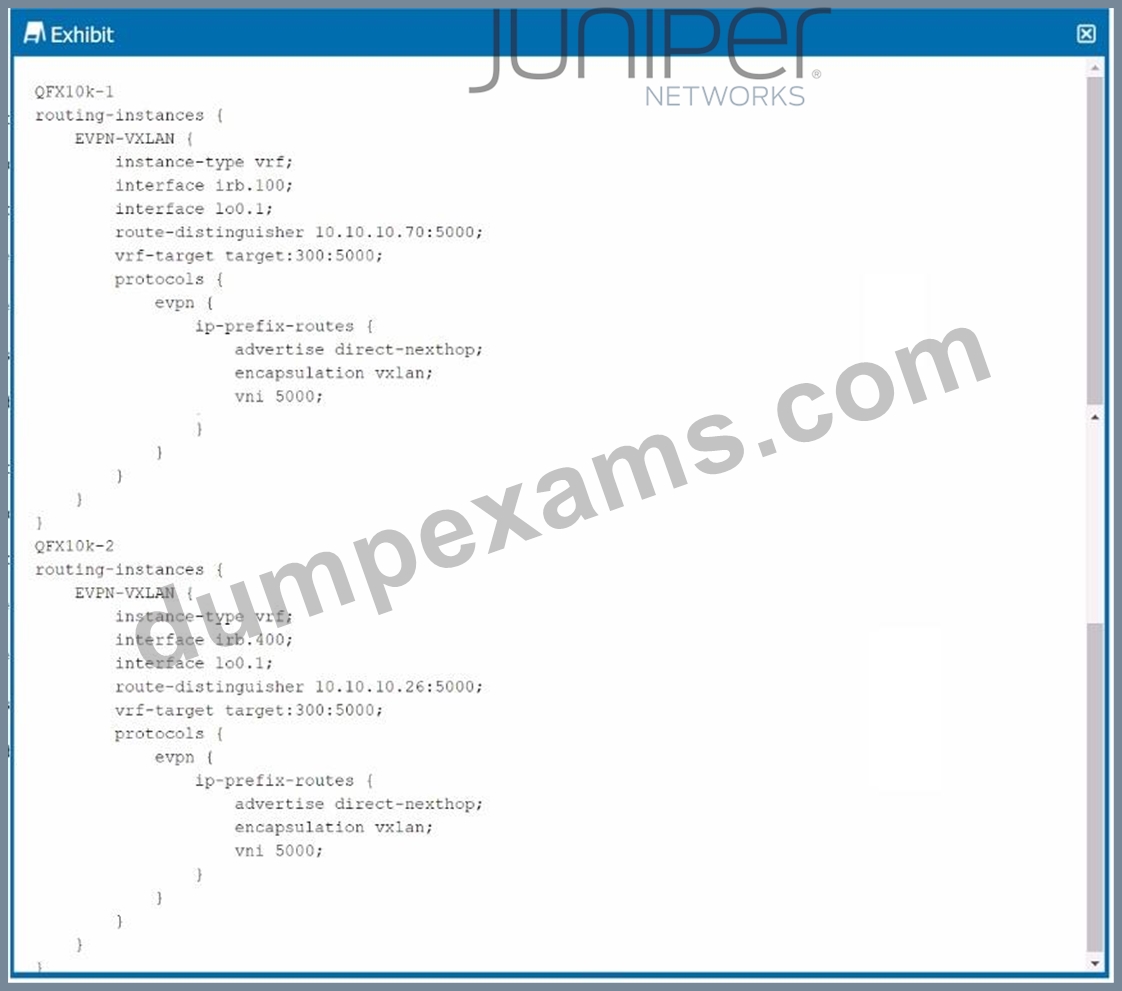
You have a sample configuration for connecting two sites through EVPN-VXLAN by exchanging IP prefix routes.
Referring to the exhibit, which two statements regarding the configuration are true? {Choose two.)
- A. The VNI must match on all devices for the same customer.
- B. The advertise direct-nexthop option enables the receiver to resolve the next-hop route using only information carried in the Type 5 route.
- C. The VNI should be unique on all devices for each customer site.
- D. The advertise direct-nexthop option enables the receiver to resolve the next-hop route using only information carried in the Type 2 route.
Answer: A,B
Explanation:
EVPN-VXLAN Configuration:
* The configuration provided in the exhibit shows an EVPN-VXLAN setup where IP prefix routes are exchanged between two sites. The advertise direct-nexthop option and the VNI (Virtual Network Identifier) settings are crucial in this context.
Advertise Direct-Nexthop:
* Option A:The advertise direct-nexthop option ensures that the next-hop route is resolved using only the information carried in the EVPN Type 5 route. Type 5 routes are used for IP prefix advertisement in EVPN, which is key to enabling Layer 3 interconnectivity between different VXLAN segments.
VNI Consistency:
* Option C:For the same customer across different devices, the VNI must be consistent. This consistency ensures that all devices can correctly map traffic to the appropriate VXLAN segment, maintaining seamless Layer 2 and Layer 3 connectivity.
NEW QUESTION # 30
Exhibit.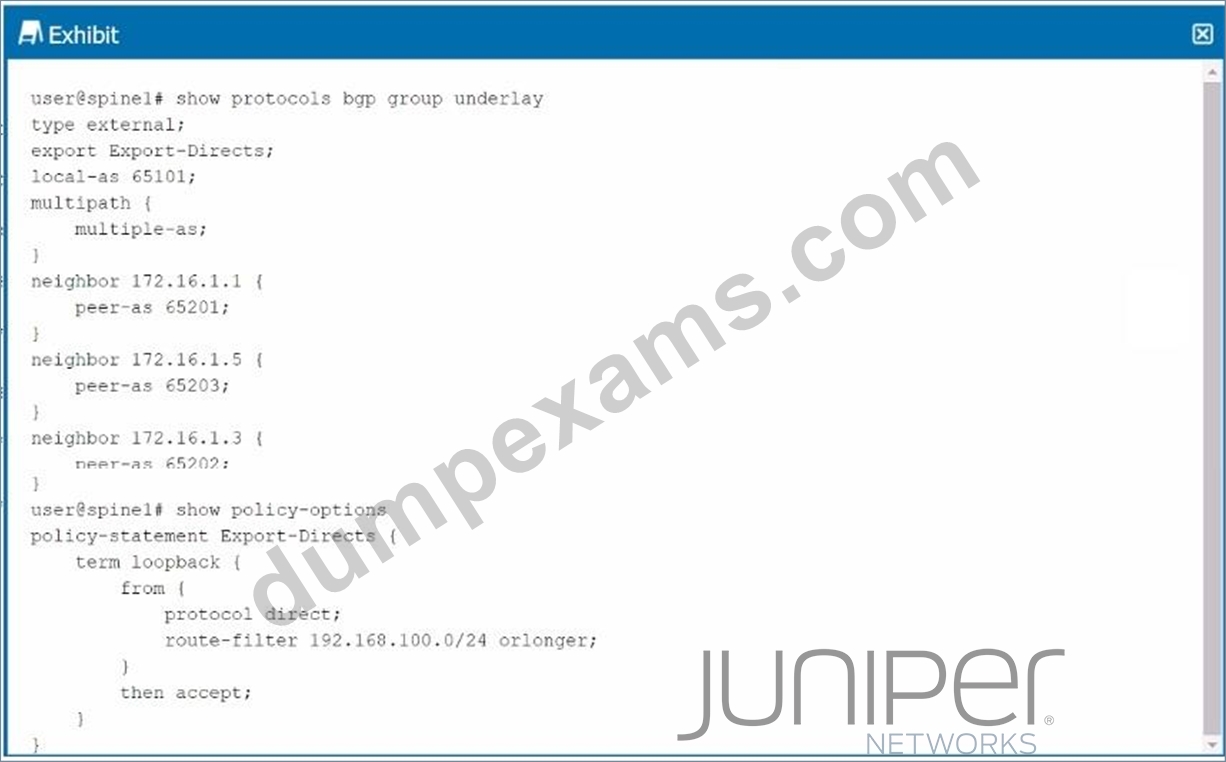
Referring to the exhibit, the spinel device has an underlay BGP group that is configured to peer with its neighbors' directly connected interfaces. Which two statements are true in this scenario? (Choose two.)
- A. Load balancing for the underlay is configured correctly.
- B. Load balancing for the underlay is not configured correctly.
- C. The multihop statement is required to establish the underlay BGP sessions.
- D. The multihop statement is not required to establish the underlay BGP sessions.
Answer: A,D
Explanation:
* Understanding BGP Configuration in the Exhibit:
* The exhibit shows a BGP configuration on spine1 with a group named underlay, configured to peer with directly connected interfaces of other devices in the network.
* Multipath multiple-as:This statement allows the router to install multiple paths in the routing table for routes learned from different ASes, facilitating load balancing.
* Key Statements:
* A. The multihop statement is not required to establish the underlay BGP sessions:In this case, the BGP peers are directly connected (as indicated by their neighbor IP addresses), so the multihop statement is unnecessary. Multihop is typically used when BGP peers are not directly connected and packets need to traverse multiple hops.
* D. Load balancing for the underlay is configured correctly:The multipath { multiple-as; } statement in the configuration enables load balancing across multiple paths from different autonomous systems, which is appropriate for underlay networks in data center fabrics.
* Incorrect Statements:
* C. The multihop statement is required to establish the underlay BGP sessions:This is incorrect because the peers are directly connected, making the multihop statement unnecessary.
* B. Load balancing for the underlay is not configured correctly:This is incorrect because the configuration includes the necessary multipath settings for load balancing.
Data Center References:
* BGP configurations in EVPN-VXLAN underlay networks are crucial for ensuring redundancy, load balancing, and efficient route propagation across the data center fabric.
NEW QUESTION # 31
Which two statements are correct about an IP fabric? (Choose two.)
- A. EBGP is only required to route most routing information to external devices outside the fabric.
- B. Only a single point to point EBGP session is required between peers in an IP fabric.
- C. All leaf devices can use the same AS number in an IP fabric without making any adjustments to the EBGP configuration
- D. The multipath multiple-as statement is required to enable ECMP if every device has a different AS number.
Answer: B,D
Explanation:
When each device in the IP fabric has a different AS number, the BGP "multipath multiple-as" statement must be enabled to allow ECMP (Equal-Cost Multi-Path) across EBGP peers with different ASNs.
EBGP sessions in an IP fabric are established as single point-to-point sessions between directly connected devices, typically leaf-to-spine, allowing for scalable and straightforward peering.
NEW QUESTION # 32
Exhibit.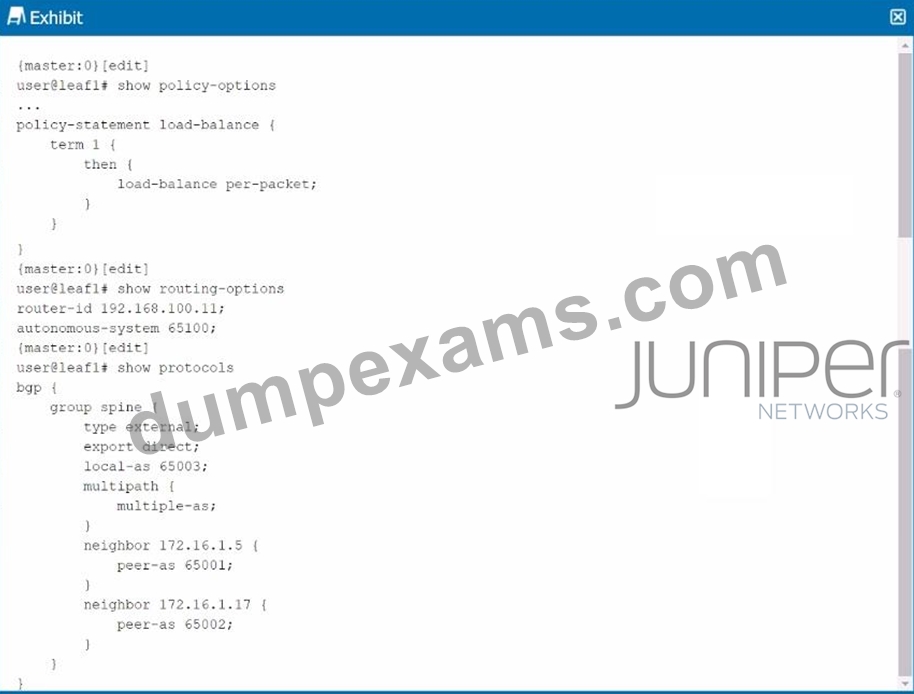
You are troubleshooting an IP fabric (or your data center. You notice that your traffic is not being load balanced to your spine devices from your leaf devices. Referring to the configuration shown in the exhibit, what must be configured to solve this issue?
- A. The multipast multiple -as configuration must be configured for each peer in the BGP spine group.
- B. The load-balance policy must be applied to the forwarding table under the routing-options hierarchy.
- C. The load-balance policy must have a from statement that matches on protocol bgp.
- D. The load-balance policy must be applied as an export policy to your BGP
Answer: B
Explanation:
Step 1: Understand the Configuration in the Exhibit
The exhibit provides three configuration snippets from a leaf device (user@leaf#):
* Policy Options:
user@leaf# show policy-options
policy-statement load-balance {
term 1 {
then {
load-balance per-packet;
}
}
}
* A policy named load-balance is defined, which applies the load-balance per-packet action. In Juniper terminology, per-packet actually means per-flow load balancing (a common point of confusion). This policy is intended to enable load balancing across multiple paths.
* Routing Options:
user@leaf# show routing-options
router-id 192.168.100.11;
autonomous-system 65100;
* The router ID is set to 192.168.100.11, and the autonomous system (AS) number is 65100. There' s no mention of applying the load-balance policy here, which is a clue to the issue.
* BGP Configuration:
user@leaf# show protocols
bgp {
group spine {
type external;
export direct;
local-as 65003;
multipath {
multiple-as;
}
neighbor 172.16.1.5 {
peer-as 65001;
}
neighbor 172.16.1.17 {
peer-as 65002;
}
}
}
* BGP is configured with an external group spine, where the leaf device (local AS 65003) peers with spine devices (AS 65001 and 65002).
* The multipath multiple-as statement is enabled, which allows BGP to install multiple paths for the same prefix in the routing table, even if the paths come from different AS numbers. This is a prerequisite for load balancing in a multi-AS environment like an IP fabric.
* The export direct policy is applied, which likely exports directly connected routes to the spine devices.
Step 2: Identify the Problem
The issue is that traffic from the leaf to the spine devices is not being load-balanced, despite the presence of a load-balance policy and BGP multipath. For load balancing to work in this scenario:
* BGP multipath ensures multiple paths are installed in the routing table.
* The load-balance per-packet policy is meant to distribute traffic across those paths.
* However, the load-balance policy is defined but not applied anywhere in the configuration shown. For load balancing to take effect, the policy must be applied in the correct context.
Step 3: Evaluate the Options
Let's go through each option to determine the correct solution:
* A. The load-balance policy must be applied to the forwarding table under the routing-options hierarchy.
* In Junos, to enable load balancing across multiple paths for forwarding, the load-balance policy must be applied at the forwarding table level. This is done under the routing-options hierarchy using the forwarding-table export statement. For example:
set routing-options forwarding-table export load-balance
* This ensures that the load-balancing policy is applied to the forwarding table, allowing traffic to be distributed across multiple equal-cost paths installed by BGP.
* B. The multipath multiple-as configuration must be configured for each peer in the BGP spine group.
* The multipath multiple-as statement is already configured under the spine group, and it applies to all neighbors in that group (172.16.1.5 and 172.16.1.17). There's no need to configure it per peer, as the group-level configuration is sufficient. This option is incorrect because the required setting is already in place.
* C. The load-balance policy must be applied as an export policy to your BGP.
* Applying the load-balance policy as a BGP export policy (e.g., export load-balance under the BGP group) would affect the routes advertised to the spine devices. However, the load-balance per-packet action is a forwarding action, not a route advertisement action. Applying it as a BGP export policy would not achieve the desired load balancing for traffic forwarding and is incorrect.
* D. The load-balance policy must have a from statement that matches on protocol bgp.
* The load-balance policy currently applies the load-balance per-packet action unconditionally (no from statement). Adding a from protocol bgp condition would make the policy apply only to BGP routes, but this is unnecessary in this context. The policy needs to be applied to the forwarding table to affect traffic, not modified with a from statement. This option doesn't address the core issue of applying the policy.
Step 4: Determine the Correct Answer
The key issue is that the load-balance policy is defined but not applied. For load balancing to work, it must be applied to the forwarding table under routing-options. This matchesOption A:
* A. The load-balance policy must be applied to the forwarding table under the routing-options hierarchy.
Step 5: Provide Official Juniper Documentation Reference
Since I don't have direct access to Juniper's proprietary documents, I can provide an explanation based on standard Junos documentation practices and publicly available resources, such as the Juniper TechLibrary, which is the official source for Junos configuration guides.
In Juniper's official documentation, specifically in theJunos OS Routing Protocols and Policies Configuration Guide, the process for enabling load balancing is described as follows:
* Load Balancing in Junos: To enable per-flow load balancing across multiple paths, you must define a policy with the load-balance per-packet action and apply it to the forwarding table. The relevant configuration hierarchy is:
routing-options {
forwarding-table {
export <policy-name>;
}
}
* Explanation from Documentation: The load-balance per-packet action (which performs per-flow balancing) requires the policy to be applied at the forwarding-table level to influence how traffic is distributed across multiple paths in the forwarding table. Without this, even if BGP installs multiple paths (via multipath), the forwarding engine will not load-balance traffic.
This aligns with the JNCIP-DC exam objectives, which include understanding how to configure and troubleshoot load balancing in an IP fabric, such as applying policies for traffic distribution.
NEW QUESTION # 33
Exhibit.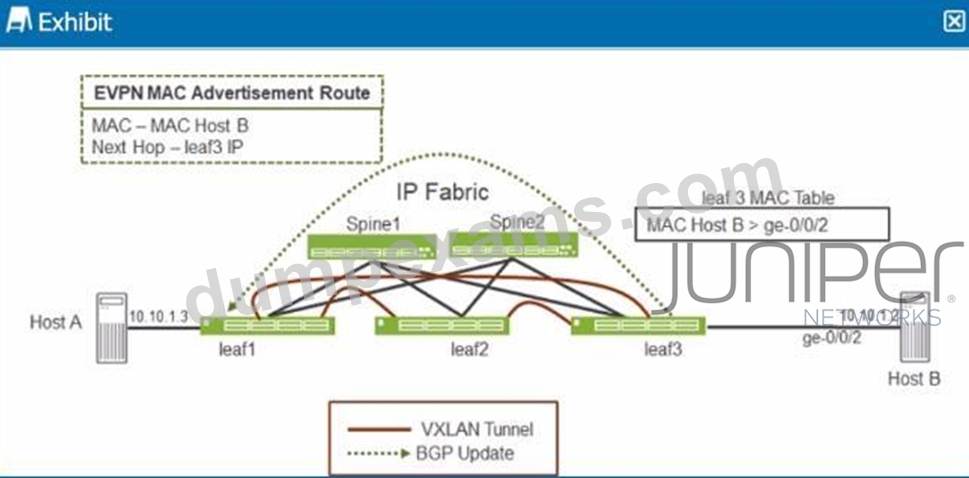
Referring to the exhibit, when Host A sends an ARP request for Host B's IP address, which Junos feature does leaf1require to send an ARP response back to Host A without having to send a broadcast frame over the fabric?
- A. GARP
- B. proxy NDP
- C. DAD
- D. proxy ARP
Answer: D
Explanation:
* Scenario Overview:
* In the exhibit, Host A is trying to resolve Host B's IP address (10.10.1.2) through ARP (Address Resolution Protocol). Normally, an ARP request would be broadcasted over the network, and the host owning the IP address (Host B) would respond.
* Role of Proxy ARP:
* Option A:Proxy ARPallows a router or switch (in this case, leaf1) to respond to ARP requests on behalf of another host. Leaf1, knowing the MAC address of Host B through the EVPN MAC advertisement, can reply to Host A's ARP request directly without broadcasting the request across the entire network fabric. This feature reduces unnecessary traffic and increases network efficiency.
Conclusion:
* Option A:Correct-Proxy ARP enables leaf1 to respond to Host A's ARP request for Host B's IP without broadcasting over the IP fabric, thus providing the ARP response locally.
NEW QUESTION # 34
You are implementing VXLAN broadcast domains in your data center environment. Which two statements are correct in this scenario? (Choose two.)
- A. A VXLAN packet does not contain a VLAN ID.
- B. Layer 2 frames are encapsulated by the source VTEP.
- C. The VNI must match the VLAN tag to ensure that the remote VTEP can decapsulate VXLAN packets.
- D. The VNI is a 16-bit value and can range from 0 through 16.777.215.
Answer: A,B
Explanation:
* VXLAN Overview:
* VXLAN (Virtual Extensible LAN) is a network virtualization technology that encapsulates Layer
2 Ethernet frames into Layer 3 UDP packets for transmission over an IP network. It allows the creation of Layer 2 overlay networks across a Layer 3 infrastructure.
* Understanding VXLAN Components:
* VTEP (VXLAN Tunnel Endpoint):A VTEP is responsible for encapsulating and decapsulating Ethernet frames into and from VXLAN packets.
* VNI (VXLAN Network Identifier):A 24-bit identifier used to distinguish different VXLAN segments, allowing for up to 16 million unique segments.
* Correct Statements:
* C. Layer 2 frames are encapsulated by the source VTEP:This is correct. In a VXLAN deployment, the source VTEP encapsulates the original Layer 2 Ethernet frame into a VXLAN packet before transmitting it over the IP network to the destination VTEP, which then decapsulates it.
* A. A VXLAN packet does not contain a VLAN ID:This is correct. The VXLAN header does not carry the original VLAN ID; instead, it uses the VNI to identify the network segment. The VLAN ID is local to the switch and does not traverse the VXLAN tunnel.
* Incorrect Statements:
* B. The VNI must match the VLAN tag to ensure that the remote VTEP can decapsulate VXLAN packets:This is incorrect. The VNI is independent of the VLAN tag, and the VLAN ID does not need to match the VNI. The VNI is what the remote VTEP uses to identify the correct VXLAN segment.
* D. The VNI is a 16-bit value and can range from 0 through 16,777,215:This is incorrect because the VNI is a 24-bit value, allowing for a range of 0 to 16,777,215.
Data Center References:
* VXLAN technology is critical for modern data centers as it enables scalability and efficient segmentation without the constraints of traditional VLAN limits.
NEW QUESTION # 35
Exhibit.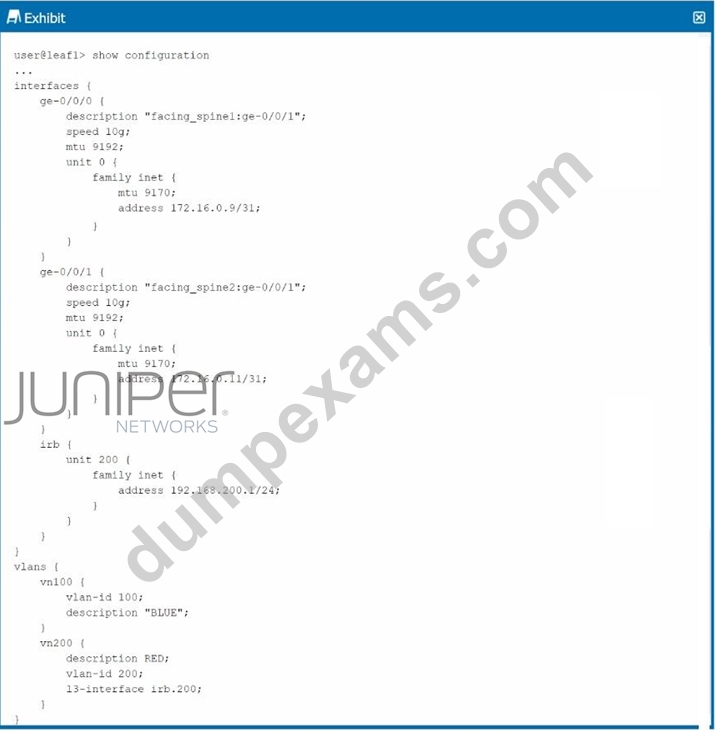
Host A is connected to vlan 100 on lead. Host B is connected to vlan 200 on leaf1. Host A and Host B ate unable to communicate. You have reviewed the touting and your hosts have the correct default route (.1) Referring to the exhibit, which two commands will solve the problem? (Choose two.)
- A. set interfaces irb unit 100 family inet address 192-168.100.1
- B. set vlans vn10013-interface irb.100
- C. set routing-options static route 0.0.0.0/0 next-hop 192.168.200.10
- D. delete vlans vn200 13-interface irb.200
Answer: B,C
Explanation:
In the provided network configuration, Host A is in VLAN 100 and Host B is in VLAN 200. The issue arises because these two hosts are unable to communicate, which indicates that either the interfaces are not properly linked to their respective VLANs, or there is a missing static route required for inter-VLAN routing.
Step-by-Step Analysis:
* VLAN Assignment:
* The exhibit shows that irb.200 is correctly associated with VLAN 200 in the configuration.
However, there is no corresponding irb.100 for VLAN 100. Without irb.100, the network lacks the logical interface to handle routing for VLAN 100. Thus, adding irb.100 to VLAN 100 is necessary.
Command to solve this:
set vlans vn100 13-interface irb.100
* Static Route Configuration:
* For inter-VLAN routing to occur, a static route needs to be configured that allows traffic to pass between different subnets (in this case, between VLAN 100 and VLAN 200). The command set routing-options static route 0.0.0.0/0 next-hop 192.168.200.10 would add a static route that directs all traffic from VLAN 100 to the correct gateway (192.168.200.10), which is necessary to route traffic between the two VLANs.
Command to solve this:
set routing-options static route 0.0.0.0/0 next-hop 192.168.200.10
Explanation of Incorrect Options:
* Option A (delete vlans vn200 13-interface irb.200): This would remove the logical interface associated with VLAN 200, which is not desired because we need VLAN 200 to remain active and properly routed.
* Option B (set interfaces irb unit 100 family inet address 192-168.100.1): This command would incorrectly assign an IP address that does not correspond with the subnet of VLAN 100 (192.168.200.1
/24). This could create a misconfiguration, leading to routing issues.
Data Center References:
For a Data Center, proper VLAN management and static routing are crucial for ensuring that different network segments can communicate effectively, especially when dealing with separated subnets or zones like in different VLANs. This aligns with best practices in DCIM (Data Center InfrastructureManagement) which stress the importance of proper network configuration to avoid downtime and ensure seamless communication between all critical IT infrastructure components.
Ensuring that the correct interfaces are associated with the correct VLANs and having the proper static routes in place are both essential steps in maintaining a robust and reliable data center network.
This detailed analysis reflects best practices as noted in standard data center design and network configuration guides.
NEW QUESTION # 36
Which three statements are correct about VXLAN control planes? (Choose three.)
- A. Both multicast and EVPN can facilitate MAC learning.
- B. Multicast is not agile and requires manual VNI mapping.
- C. EVPN enables fast convergence and updates.
- D. Multicast does not require as many resources.
- E. EVPN is inefficient and does not scale well.
Answer: A,C,D
Explanation:
EVPN enables fast convergence and updates: EVPN (Ethernet VPN) provides a more scalable and efficient control plane for VXLAN, enabling fast convergence and quicker updates for network changes. This is achieved through the use of BGP (Border Gateway Protocol) as the control plane protocol, which allows for efficient distribution of MAC and IP address information.
Both multicast and EVPN can facilitate MAC learning: Both multicast and EVPN can handle MAC address learning in a VXLAN environment. In multicast-based VXLAN, MAC addresses are learned and distributed via multicast control messages, whereas in EVPN, MAC addresses are distributed via BGP advertisements, which are more efficient and scalable.
Multicast does not require as many resources: Multicast-based VXLAN control planes use standard multicast protocols like PIM (Protocol Independent Multicast) to forward traffic across the VXLAN fabric. While multicast has resource requirements for managing multicast groups, it does not require the same level of control-plane processing as EVPN, which uses BGP to handle MAC address advertisements. However, multicast can be less agile and may require additional configuration.
NEW QUESTION # 37
You are designing an IP fabric tor a large data center, and you are concerned about growth and scalability.
Which two actions would you take to address these concerns? (Choose two.)
- A. Design a five-stage Clos IP fabric.
- B. Use EX4300 Series devices as the spine devices.
- C. Design a three-stage Clos IP fabric.
- D. Use OFX5700 Series devices as the super spines.
Answer: C,D
Explanation:
* Clos IP Fabric Design:
* A Clos fabric is a network topology designed for scalable, high-performance data centers. It is typically arranged in multiple stages, providing redundancy, high bandwidth, and low latency.
* Three-Stage Clos Fabric:
* Option B:A three-stage Clos fabric, consisting of leaf, spine, and super spine layers, is widely used in data centers. This design scales well and allows for easy expansion by adding more leaf and spine devices as needed.
* Super Spines for Scalability:
* Option D:Using high-capacity devices like the QFX5700 Series as super spines can handle the increased traffic demands in large data centers and support future growth. These devices provide the necessary bandwidth and scalability for large-scale deployments.
Conclusion:
* Option B:Correct-A three-stage Clos fabric is a proven design that addresses growth and scalability concerns in large data centers.
* Option D:Correct-QFX5700 Series devices are suitable for use as super spines in large-scale environments due to their high performance.
NEW QUESTION # 38
You are asked to build redundant gateways in your EVPN-VXLAN environment, but you must conserve address space because these gateways must span across seven PEs.
What should you implement on the PEs to satisfy these requirements?
- A. Use IRB interfaces with different IP addresses and the same VGA.
- B. Use IRB interfaces with the same IP and MAC address.
- C. Use IRB interfaces with the same IP and VGA.
- D. Use IRB interfaces with the same IP address and different MAC addresses.
Answer: B
Explanation:
In an EVPN-VXLAN environment, when you need redundant gateways across multiple PEs (for hosts in the same VLAN/VRF), you want all PEs to present a single logical gateway IP to the hosts.
This is achieved using anycast IRB:
Same IP address on all PEs → ensures hosts have a single default gateway.
Same MAC address on all PEs → ensures traffic is correctly forwarded to the closest PE without ARP conflicts.
This design conserves IP address space because you don't need a unique gateway IP for each PE.
NEW QUESTION # 39
You are deploying an IP fabric using EBGP and notice that your leaf devices are advertising and receiving all the routes. However, the routes are not installed in the routing table and are marked as hidden.
Which two statements describe how to solve the issue? (Choose two.)
- A. You need to configure a next-hop self policy.
- B. You need to configure loops 2.
- C. You need to configure as-override.
- D. You need to configure multipath multiple-as.
Answer: A,B
Explanation:
You need to configure a next-hop self policy: When using EBGP, the next-hop IP address in the routing advertisements might not be reachable from the receiving device, causing the routes to be marked as hidden. By configuring the next-hop-selfpolicy, the leaf devices will change the next-hop IP to their own IP address for the routes they advertise, making them reachable within the fabric and allowing the routes to be installed in the routing table.
You need to configure loops 2: When all leaves share the same AS (common-AS design), BGP loop prevention drops routes learned from the same AS. Configuring loops 2 allows the leaf to accept routes with its own AS in the path twice, which is needed in an eBGP IP fabric with repeated AS numbers.
NEW QUESTION # 40
......
JN0-683 Actual Questions Answers PDF 100% Cover Real Exam Questions: https://passleader.dumpexams.com/JN0-683-vce-torrent.html