


C_ABAPD_2507 Exam Dumps Free Test Engine Verified By SAP Certified Associate Certified Experts
Use Real SAP Achieve the C_ABAPD_2507 Dumps - 100% Exam Passing Guarantee
NEW QUESTION # 41
You want to join two database tables, T_CARRIER, and T_CONNECTIONS, to retrieve all carriers, whether they have corresponding connections or not.
Which statements would achieve this? Note: There are 2 correct answers to this question.
- A. SELECT FROM carrier LEFT OUTER JOIN t_connectionsON...
- B. SELECT FROM carrier LEFT INNER JOIN t_connectionsON..
- C. SELECT FROM carrier INNERR JOIN t_connections ON...
- D. SELECT FROM connections RIGHT OUTER JOIN t_carrier ON...
Answer: A,D
NEW QUESTION # 42
You want to define the following CDS view entity with an input parameter:
define view entity Z_CONVERT
with parameters i_currency : ???
Which of the following can you use to replace ????
(Select 2 correct answers)
- A. A component of an ABAP Dictionary structure
- B. A built-in ABAP type
- C. A data element
- D. A built-in ABAP Dictionary type
Answer: C,D
Explanation:
Comprehensive and Detailed Explanation from Exact Extract:
CDS view parameters must be defined with types that are visible in the ABAP Dictionary.
* A. Built-in ABAP Dictionary type # # Supported (e.g., CURR, CHAR).
* D. Data element # # Supported, as data elements are dictionary-level types.
* B. Built-in ABAP type (like i, string) # # Not supported directly, CDS requires dictionary-compatible types.
* C. Component of a structure # # Not supported directly; parameters cannot reference structure components.
This ensures that CDS definitions remain database-compatible and semantically rich, which is critical for RAP services.
Verified Study Guide Reference: ABAP CDS Development Guide - Defining View Parameters.
NEW QUESTION # 43
You have attached a system field too an input parameter of a CDS view entity as follows:
* define view entity Z_ENTITYY with parameters
* @Environment.SystemFieldd: #SYSTEM_LANGUAGE
* language :spras...
What are the effects of this annotation?
Note: There are 2 correct answers to this question.
- A. You can still override the default value with a value of your own.
- B. The value of sy-langu will be passed to the CDS view automatically both when you use the CDS view in ABAP and in another CDS view entity (view on view).
- C. The value of sy-langu will be passed to the CDS view automatically when you use the CDS view in ABAP but not when you use it in another view entity.
- D. It is no longer possible to pass your own value to the parameter.
Answer: A,C
NEW QUESTION # 44
What is the syntax to access component carrier_name of structure connection?
- A. connection/carrier_name
- B. connection>carrier_name
- C. connection-carrier_name
- D. connection=>carrier_name
Answer: C
Explanation:
Comprehensive and Detailed Explanation From Exact Extract:
* In ABAP, structure component access uses the hyphen (-): structure-component. The other tokens are used for different purposes: -> for object reference attributes, => for static components, and / is not a field selector in ABAP.
* ABAP Cloud stresses typed APIs and static checks, ensuring misuse of component selectors is caught early; correct structure access with - is part of the enforced style.
NEW QUESTION # 45
In RESTful Application Programming, which EML statement retrieves an object?
- A. Read entity
- B. Find entity
- C. Get entity
- D. Select entity
Answer: C
Explanation:
In RESTful Application Programming, the EML statement that retrieves an object is GET entity. The GET entity statement is used to read data of an entity instance from the database or the transaction buffer. The GET entity statement can specify the entity name, the entity key, and the entity elements to be retrieved. The GET entity statement can also use the IN LOCAL MODE addition to bypass the access control, authorization control, and feature control checks. The GET entity statement returns a single entity instance or raises an exception if no instance is found or multiple instances match the key.
The other EML statements are not used to retrieve an object, but have different purposes and effects. These statements are:
FIND entity: This statement is used to search for entity instances that match a given condition. The FIND entity statement can specify the entity name, the entity elements to be returned, and the condition to be applied. The FIND entity statement can also use the IN LOCAL MODE addition to bypass the access control, authorization control, and feature control checks. The FIND entity statement returns a table of entity instances or an empty table if no instances match the condition.
SELECT entity: This statement is used to query data of entity instances from the database or the transaction buffer. The SELECT entity statement can specify the entity name, the entity elements to be returned, and the filter, order, and aggregation options to be applied. The SELECT entity statement can also use the IN LOCAL MODE addition to bypass the access control, authorization control, and feature control checks. The SELECT entity statement returns a table of entity instances or an empty table if no instances match the query.
READ entity: This statement is not a valid EML statement, but an ABAP statement. The READ statement is used to access a single row of an internal table using the table index or the table key. The READ statement can also use the TRANSPORTING addition to specify which fields should be returned, and the INTO addition to specify the target variable. The READ statement returns a single row of the internal table or raises an exception if no row is found or multiple rows match the key.
NEW QUESTION # 46
Which of the following string functions are predicate functions? Note: There are 2 correct answers to this question.
- A. matchesQ
- B. find_any_not_of()
- C. count_any_of()
- D. contains_any_of()
Answer: A,D
Explanation:
String functions are expressions that can be used to manipulate character-like data in ABAP. String functions can be either predicate functions or non-predicate functions. Predicate functions are string functions that return a truth value (true or false) for a condition of the argument text. Non-predicate functions are string functions that return a character-like result for an operation on the argument text1.
The following string functions are predicate functions:
B . contains_any_of(): This function returns true if the argument text contains at least one of the characters specified in the character set. For example, the following expression returns true, because the text 'ABAP' contains at least one of the characters 'A', 'B', or 'C':
contains_any_of( val = 'ABAP' set = 'ABC' ).
D . matches(): This function returns true if the argument text matches the pattern specified in the regular expression. For example, the following expression returns true, because the text 'ABAP' matches the pattern that consists of four uppercase letters:
matches( val = 'ABAP' regex = '[A-Z]{4}' ).
The following string functions are not predicate functions, because they return a character-like result, not a truth value:
A . find_any_not_of(): This function returns the position of the first character in the argument text that is not contained in the character set. If no such character is found, the function returns 0. For example, the following expression returns 3, because the third character of the text 'ABAP' is not contained in the character set 'ABC':
find_any_not_of( val = 'ABAP' set = 'ABC' ).
C . count_any_of(): This function returns the number of characters in the argument text that are contained in the character set. For example, the following expression returns 2, because there are two characters in the text 'ABAP' that are contained in the character set 'ABC':
count_any_of( val = 'ABAP' set = 'ABC' ).
NEW QUESTION # 47
Which internal table type allows unique and non-unique keys?
- A. Hashed
- B. Sorted
- C. Standard
Answer: C
Explanation:
The internal table type that allows both unique and non-unique keys is the standard table. A standard table has an internal linear index that can be used to access the table entries. The key of a standard table is always non-unique, which means that the table can contain duplicate entries. However, the system does not check the uniqueness of the key when inserting new entries, so the programmer can ensure that the key is unique by using appropriate logic. A standard table can be accessed either by using the table index or the key, but the response time for key access is proportional to the table size.
The other two internal table types, sorted and hashed, do not allow non-unique keys. A sorted table is filled in sorted order according to the defined table key, which must be unique. A sorted table can be accessed either by using the table index or the key, but the response time for key access is logarithmically proportional to the table size. A hashed table can only be accessed by using a unique key, which must be specified when declaring the table. A hashed table has no index, and the response time for key access is constant, regardless of the table size.
NEW QUESTION # 48
In a CDS view, where can a value help be defined?
- A. In the SQL console
- B. In a view definition
- C. In an annotation
- D. In an association
Answer: C
NEW QUESTION # 49
How do you make class sub1 a subclass of class super1?
- A. In sub1 use clause "INHERITTING FROM super1" in the IMPLEMENTATION part.
- B. In sub1 use clause "INHERITTING FROM super1" in the DEFINITION part.
- C. In super1 use clause "sub1 REDEFINITION" in the DEFINITION part.
- D. In super1 use clause "sub1 REDEFINITION" in the IMPLEMENTATION part.
Answer: B
NEW QUESTION # 50
What are advantages of using a field symbol for internal table row access? Note: There are answers to this question.
- A. The field symbol can be reused for other programs.
- B. Using a field symbol is faster than using a work area.
- C. A MODIFY statement to write changed contents back to the table is not required.
- D. The row content is copied to the field symbol instead to a work area
Answer: B,C
Explanation:
A field symbol is a pointer that allows direct access to a row of an internal table without copying it to a work area. Using a field symbol for internal table row access has some advantages over using a work area, such as12:
A MODIFY statement to write changed contents back to the table is not required: This is true. When you use a work area, you have to copy the row content from the internal table to the work area, modify it, and then copy it back to the internal table using the MODIFY statement. This can be costly in terms of performance and memory consumption. When you use a field symbol, you can modify the row content directly in the internal table without any copying. Therefore, you do not need the MODIFY statement12.
Using a field symbol is faster than using a work area: This is true. As explained above, using a field symbol avoids the overhead of copying data between the internal table and the work area. This can improve the performance of the loop considerably, especially for large internal tables. According to some benchmarks, using a field symbol can save 25-40% of the runtime compared to using a work area12.
You cannot do any of the following:
The field symbol can be reused for other programs: This is false. A field symbol is a local variable that is only visible within the scope of its declaration. It cannot be reused for other programs unless it is declared globally or passed as a parameter. Moreover, a field symbol must have the same type as the line type of the internal table that it accesses. Therefore, it cannot be used for any internal table with a different line type12.
The row content is copied to the field symbol instead to a work area: This is false. As explained above, using a field symbol does not copy the row content to the field symbol. Instead, the field symbol points to the memory address of the row in the internal table and allows direct access to it. Therefore, there is no copying involved when using a field symbol12.
NEW QUESTION # 51
After you created a database table in the RESTful Application Programming model, what do you create next?
- A. A data model view
- B. A metadata extension
- C. A service definition
- D. A projection view
Answer: D
Explanation:
After you created a database table in the RESTful Application Programming model (RAP), the next step is to create a projection view on the database table. A projection view is a CDS artefact that defines a view on one or more data sources, such as tables, views, or associations. A projection view can select, rename, or aggregate the fields of the data sources, but it cannot change the properties of the fields, such as whether they are read-only or not. The properties of the fields are inherited from the data sources or the behaviour definitions of the business objects12. For example:
The following code snippet defines a projection view ZI_AGENCY on the database table /DMO/AGENCY:
define view ZI_AGENCY as select from /dmo/agency { key agency_id, agency_name, street, city, region, postal_code, country, phone_number, url } The projection view is used to expose the data of the database table to the service definition, which is the next step in the RAP. The service definition is a CDS artefact that defines the interface and the binding of a service. A service is a CDS entity that exposes the data and the functionality of one or more business objects as OData, InA, or SQL services. A service definition can specify the properties of the fields of a service, such as whether they are filterable, sortable, or aggregatable12. For example:
The following code snippet defines a service definition ZI_AGENCY_SRV that exposes the projection view ZI_AGENCY as an OData service:
define service ZI_AGENCY_SRV { expose ZI_AGENCY as Agency; }
You cannot do any of the following:
A . A metadata extension: A metadata extension is a CDS artefact that defines additional annotations for a CDS entity, such as a business object, a service, or a projection view. A metadata extension can specify the properties of the fields of a CDS entity for UI or analytical purposes, such as whether they are visible, editable, or hidden. However, a metadata extension is not the next step after creating a database table in the RAP, as it is not required to expose the data of the database table to the service definition. A metadata extension can be created later to customize the UI or analytical application that uses the service12.
C . A data model view: A data model view is a CDS artefact that defines a view on one or more data sources, such as tables, views, or associations. A data model view can select, rename, or aggregate the fields of the data sources, and it can also change the properties of the fields, such as whether they are read-only or not. The properties of the fields are defined by the annotations or the behaviour definitions of the data model view. A data model view is used to define the data model of a business object, which is a CDS entity that represents a business entity or concept, such as a customer, an order, or a product. However, a data model view is not the next step after creating a database table in the RAP, as it is not required to expose the data of the database table to the service definition. A data model view can be created later to define a business object that uses the database table as a data source12.
D . A service definition: A service definition is a CDS artefact that defines the interface and the binding of a service. A service is a CDS entity that exposes the data and the functionality of one or more business objects as OData, InA, or SQL services. A service definition can specify the properties of the fields of a service, such as whether they are filterable, sortable, or aggregatable. However, a service definition is not the next step after creating a database table in the RAP, as it requires a projection view or a data model view to expose the data of the database table. A service definition can be created after creating a projection view or a data model view on the database table12.
NEW QUESTION # 52
Refer to the exhibit.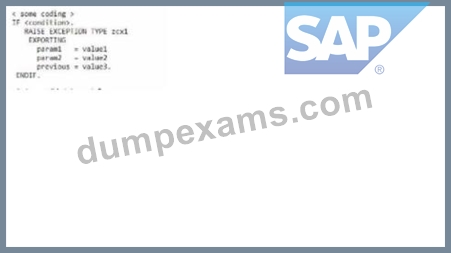
What are valid statements? Note: There are 2 correct answers to this question.
- A. "paraml11 and "param2" are predefined names.
- B. "previous" expects the reference to a previous exception
- C. "zcxl" is a dictionary structure, and "paraml" and "param2" are this structure.
- D. The code creates an exception object and raises an exception.
Answer: B,D
Explanation:
The code snippet in the image is an example of using the RAISE EXCEPTION statement to raise a class-based exception and create a corresponding exception object. The code snippet also uses the EXPORTING addition to pass parameters to the instance constructor of the exception class12. Some of the valid statements about the code snippet are:
The code creates an exception object and raises an exception: This is true. The RAISE EXCEPTION statement raises the exception linked to the exception class zcxl and generates a corresponding exception object. The exception object contains the information about the exception, such as the message, the source position, and the previous exception12.
"previous" expects the reference to a previous exception: This is true. The previous parameter is a predefined parameter of the instance constructor of the exception class cx_root, which is the root class of all class-based exceptions. The previous parameter expects the reference to a previous exception object that was caught during exception handling. The previous parameter can be used to chain multiple exceptions and preserve the original cause of the exception12.
You cannot do any of the following:
"zcxl" is a dictionary structure, and "paraml" and "param2" are this structure: This is false. zcxl is not a dictionary structure, but a user-defined exception class that inherits from the predefined exception class cx_static_check. param1 and param2 are not components of this structure, but input parameters of the instance constructor of the exception class zcxl. The input parameters can be used to pass additional information to the exception object, such as the values that caused the exception12.
"paraml" and "param2" are predefined names: This is false. param1 and param2 are not predefined names, but user-defined names that can be chosen arbitrarily. However, they must match the names of the input parameters of the instance constructor of the exception class zcxl. The names of the input parameters can be declared in the interface of the exception class using the RAISING addition12.
NEW QUESTION # 53
In ABAP SQL, which of the following retrieves the association field_Airline-Name of a CDS view?
- A. @_Airline-Name
- B. /_Airline Name
- C. "_Airline Name
- D. \_Airline-Name
Answer: A
Explanation:
In ABAP SQL, the syntax to retrieve the association field of a CDS view is to use the @ sign followed by the association name and the field name, separated by a period sign (.). For example, to retrieve the association field _Airline-Name of a CDS view, the syntax is @_Airline.Name. This syntax allows the access to the fields of the target data source of the association without explicitly joining the data sources1. The other options are incorrect because they use the wrong symbols or formats to access the association field.
NEW QUESTION # 54
What are some principles of encapsulation?
(Select 2 correct answers)
- A. Attributes can only be changed by the class.
- B. Attributes can be changed through public class methods.
- C. Attributes cannot be changed.
- D. Attributes can be changed by the client program directly.
Answer: A,B
Explanation:
Comprehensive and Detailed Explanation from Exact Extract:
Encapsulation in ABAP OO and ABAP Cloud ensures that internal object details are hidden from outside consumers.
* A. Attributes can be changed through public methods # # Correct, because controlled access is provided through getter/setter or other methods.
* B. Attributes can be changed by the client program directly # # Incorrect, this violates encapsulation.
* C. Attributes cannot be changed # # Incorrect, they can be changed, but only via allowed mechanisms.
* D. Attributes can only be changed by the class itself # # Correct, ensuring business logic consistency.
This aligns with RAP behavior definitions (BDEF) where internal attributes are encapsulated and only manipulated through behavior implementation methods.
Verified Study Guide Reference: ABAP Objects Programming Guide - Encapsulation Principles.
NEW QUESTION # 55
Given the following code excerpt that defines an SAP HANA database table: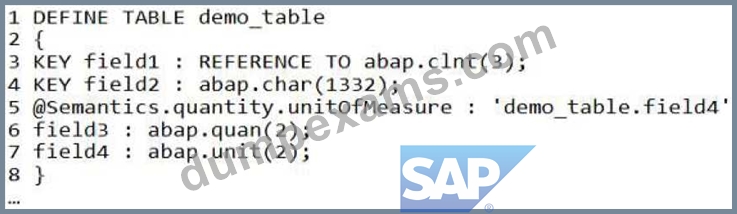
Which field is defined incorrectly?
- A. field1
- B. field3
- C. field2
- D. field4
Answer: A
NEW QUESTION # 56
Exhibit
Which of the following ABAP SQL snippets are syntactically correct ways to provide a value for the parameter on line #4? Note: There are 2 correct answers to this question
- A. ...SELECT * FROM deno_cds_param_view_entity (p_date - '20230101')... )
- B. ...SELECT * FROM demo_cds_param_view entity (p_date: $session.system_date)...
- C. ...SELECT * FROM deno_cds_param_view_entity (p_date = @ (cl_abap_context_info->get_system_date ())...
- D. ...SELECT * FROM demo_cds_param_view_entity (p_date: 20238181')... )
Answer: A,C
NEW QUESTION # 57
......
SAP C_ABAPD_2507 Exam Syllabus Topics:
| Topic | Details |
|---|---|
| Topic 1 |
|
| Topic 2 |
|
| Topic 3 |
|
Check the Free demo of our C_ABAPD_2507 Exam Dumps with 80 Questions: https://passleader.dumpexams.com/C_ABAPD_2507-vce-torrent.html