


Dec-2025 New Version Analytics-DA-201 Certificate & Helpful Exam Dumps is Online
Analytics-DA-201 Free Certification Exam Material with 176 Q&As
Salesforce Analytics-DA-201 Exam Syllabus Topics:
| Topic | Details |
|---|---|
| Topic 1 |
|
| Topic 2 |
|
| Topic 3 |
|
| Topic 4 |
|
| Topic 5 |
|
NEW QUESTION # 54
Which function should a Data Analyst use to average sales at a less-granular level of detail than is in the view?
- A. EXCLUDE
- B. INCLUDE
- C. RUNNING_AVG
- D. AVG
Answer: A
NEW QUESTION # 55
You have a workbook that uses an extracted data source.
You publish the workbook to Tableau Server.
Which three actions can you perform from the Extract Refresh page in Tableau Server? Choose three.
- A. Run a refresh.
- B. Change the priority of the refresh.
- C. Modify the frequency of the refresh.
- D. Delete the refresh.
- E. Change the refresh from full to incremental.
Answer: A,B,D
NEW QUESTION # 56
You have the following dataset.
You need to generate the results in the Day field.
How should you complete the formula? (Use the dropdowns in the Answer Area to select the correct options to complete the formula.)
Answer:
Explanation:
Explanation:
NEW QUESTION # 57
A Data Analyst has the following sets in a Tableau workbook:
* Top N Customers
* Customers of 2024
* Top N Products
* Sellers of 2024
Which two sets can the analyst combine? (Choose two.)
- A. Customers of 2024
- B. Top N Customers
- C. Sellers of 2024
- D. Top N Products
Answer: A,B
NEW QUESTION # 58
You have the following dataset in Microsoft Excel.
You are using Data interpreter to cleans the dataset. Data interpreter provides the following results.
How many rows of data will be ingested into Tableau as values?
- A. 0
- B. 1
- C. 2
- D. 3
Answer: C
Explanation:
Data interpreter is a feature that helps you clean and structure your data in Excel before importing it into Tableau. It detects and removes any headers, footers, subtotals, or other elements that are not part of the actual data. It also splits any merged cells and fills in any missing values. In this case, data interpreter provides the following results:
* It removes the first three rows and the last two rows that contain headers and footers.
* It splits the merged cells in column A and fills in the missing values with "Fiction" or "Non-Fiction".
* It does not remove or change any other rows or cells.
Therefore, the number of rows of data that will be ingested into Tableau as values is 17, which is the number of rows left after removing the headers and footers. References: https://help.tableau.com/current/pro/desktop
/en-us/importing_cleaning_up_data.htm https://help.tableau.com/current/pro/desktop/en-us
/importing_data_interpreter.htm
Based on the Data Interpreter's results and the provided Excel dataset screenshot, the number of rows of data that will be ingested into Tableau as values is 17. The Data Interpreter has identified and excluded headers and footers, and the rows with actual data are considered for analysis.
NEW QUESTION # 59
You receive a tab-delimited data file name sales.tsv.
You need to connect to the file.
Which option should you select in Tableau Desktop?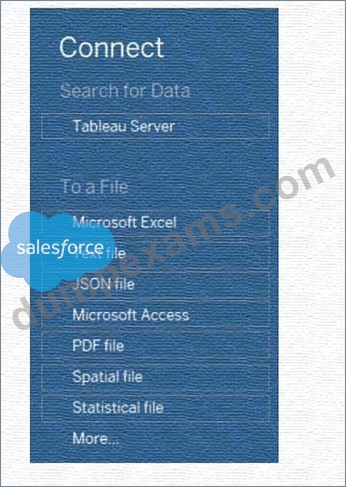
Answer:
Explanation: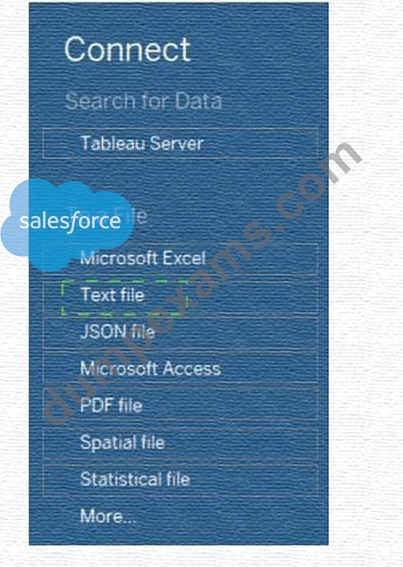
Explanation:
To connect to a tab-delimited data file named sales.tsv, you should select the option To a File > Text file in Tableau Desktop. This option will allow you to browse and select the file from your local or network drive and connect to it as a data source. You can then specify the text file properties, such as the delimiter, the text qualifier, and whether the first row contains column names. You can also join, union, or blend the data with other data sources if needed. References:
* Text File - Tableau
* Tableau Certified Data Analyst Study Guide
NEW QUESTION # 60
A Data Analyst has the following chart.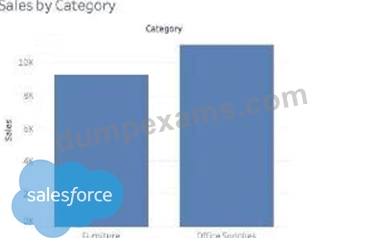
The analyst needs to enable the drilldown from Category to Subcategory as shown in the following chart.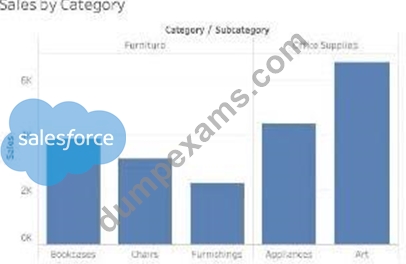
What should the analyst create?
- A. A combined set for Category and Subcategory
- B. A group of Category and Subcategory
- C. A bin for Category and a bin for Subcategory
- D. A hierarchy of Category and Subcategory
Answer: D
NEW QUESTION # 61
Open the link to Book1 found on the desktop. Open Disciplines worksheet.
Filter the table to show the members of the Top10 set and the members of the Bottom10 set. There should be a total of 20 rows.
Answer:
Explanation:
check the steps below in explanation.
Explanation:
To filter the table to show the members of the Top10 set and the Bottom10 set, you need to do the following steps:
* Open the link to Book1 found on the desktop. This will open the Tableau workbook that contains the Disciplines worksheet.
* Click on the Disciplines tab at the bottom of the workbook to open the worksheet. You will see a table that shows the disciplines, sales, and profit for each salesperson.
* Click on the drop-down arrow next to Salesperson on the Filters shelf. This will open a menu that allows you to filter by different criteria.
* Select Set from the menu. This will show you the sets that are available for the Salesperson field. You will see Top10 and Bottom10 as two sets that have been created based on the sales ranking.
* Check the boxes next to Top10 and Bottom10. This will filter the table to show only the members of these two sets. You can also click on All to deselect all other values.
* Click OK to apply the filter. You will see that the table now shows 20 rows, 10 for each set.
References: https://help.tableau.com/current/pro/desktop/en-us/sets.htm
https://help.tableau.com/current/pro/desktop/en-us/filtering.htm
NEW QUESTION # 62
You have the following dashboard that contains two sheets.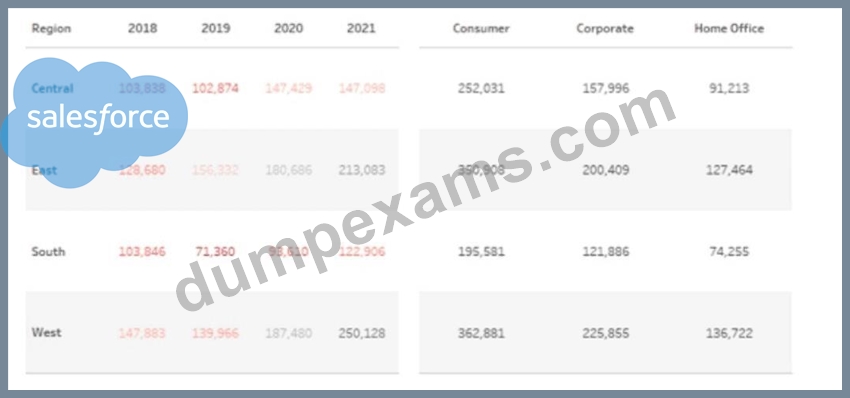
You want to minimize the whitespace between the sheets.
What should you configure?
- A. The size
- B. The border
- C. The padding
- D. The position
- E. The background
Answer: C
Explanation:
To minimize the whitespace between the sheets, you should configure the padding of the sheets and the dashboard. Padding is the amount of space between the edge of a sheet or dashboard and its content. You can adjust the padding by using the Layout tab in the Format pane. You can reduce the padding for each sheet by selecting the sheet and changing the values for the inner and outer padding. You can also reduce the padding for the dashboard by selecting the dashboard and changing the values for the outer padding. Reducing the padding will make the sheets and the dashboard more compact and eliminate unnecessary whitespace. References:
* Format Dashboards - Tableau
* Tableau Certified Data Analyst Study Guide
NEW QUESTION # 63
Open the link to Book1 found on the desktop. Open the Line worksheet.
Modify the chart to show only main and max values of both measures in each region.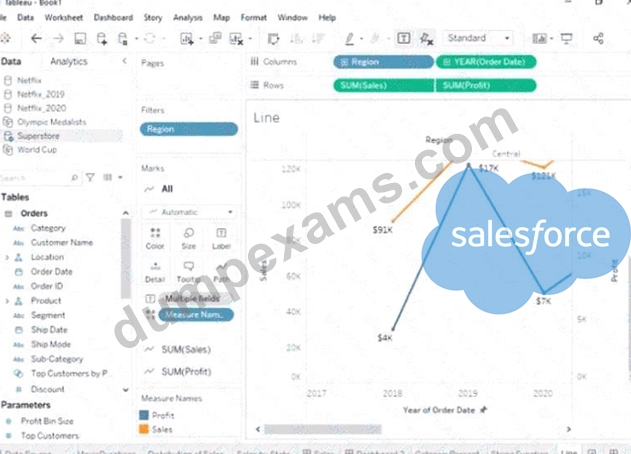
Answer:
Explanation:
check the steps below in explanation.
Explanation:
To modify the chart to show only min and max values of both measures in each region, you need to do the following steps:
* Open the link to Book1 found on the desktop. This will open the Tableau workbook that contains the Line worksheet.
* Click on the Line tab at the bottom of the workbook to open the worksheet. You will see a line chart that shows the sales and profit for each month by region.
* Drag Month from the Columns shelf to Filters shelf. This will open a dialog box that allows you to filter by different criteria.
* Select Range of Dates from the dialog box. This will show you options to filter by a range of dates or values.
* Select Minimum and Maximum from the drop-down list next to Month. This will filter by the minimum and maximum values of Month for each region. You can also enter specific values or use the sliders to adjust the range.
* Click OK to apply the filter. You will see that the line chart now shows only min and max values of both measures in each region.
References: https://help.tableau.com/current/pro/desktop/en-us/filtering.htm https://help.tableau.com/current/pro/desktop/en-us/filtering_range.htm
NEW QUESTION # 64
You have the following visualization.
The Last() calculation is set to compute using Table (across)
Which value will appear in the crosstab for the Consumer segment of the year 2018 if you change compute to use Oder Dale?
- A. 0
- B. 1
- C. 2
- D. 3
Answer: A
Explanation:
The LAST() function in Tableau returns the number of rows from the current row to the last row in the partition. When you compute using 'Order Date', it will change the partitioning of the calculation. If
'Consumer' in '2018' is the last row in its partition when computed by 'Order Date', then LAST() will return 0 for that cell.
The LAST() function in Tableau is a table calculation that returns the number of rows from the current row to the last row in the partition. The value of LAST() is 0 for the last row, increases by 1 for each row above the last row, and can be negative for rows below the current row if there are such rows in the partition.
In the provided visualization, LAST() is set to compute using Table (across). Changing the compute mode to use "Order Date" will adjust the partitioning of the data upon which the LAST() function is calculated. Since
"Order Date" is likely to be a unique value per row (assuming each order has a unique date), each row becomes its own partition.
For the Consumer segment of the year 2018, if "Order Date" is unique for each row, then the last row in each partition (in this case, each individual row) will have a LAST() value of 0 because there are no other rows in the partition - it's the last row of its own partition.
Therefore, when you change the compute mode of LAST() to use "Order Date", each cell under the Consumer segment for the year 2018 will have the LAST() value of 0, because each order date creates a partition of one, making every row the last in its partition.
NEW QUESTION # 65
A Data Analyst has the following dataset in Microsoft Excel.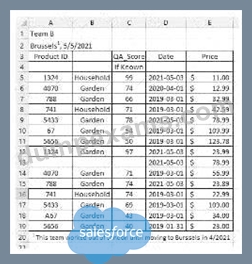
The analyst is using Data Interpreter to cleanse the dataset. Data Interpreter provides the following results.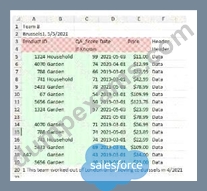
How many rows of data will be ingested into Tableau as values?
- A. 0
- B. 1
- C. 2
- D. 3
Answer: C
NEW QUESTION # 66
You want to create the following dashboard that will contain two sheets.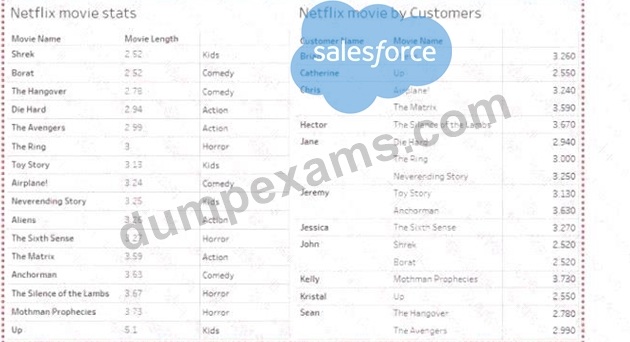
What should you do?
- A. Drag both sheets to the dashboard and add a border to each sheet.
- B. Drag both sheets to the dashboard and add a background lo each sheet.
- C. Add both sheets lo a horizontal container and add a border to the container.
- D. Add a border to both sheets and add both sheets to a horizontal object.
Answer: C
NEW QUESTION # 67
You plan to publish a workbook to Tableau Server.
You want to ensure that users can see other published dashboards from their current dashboard.
Which setting should you configure? (Click the appropriate Option in the Answer Area.)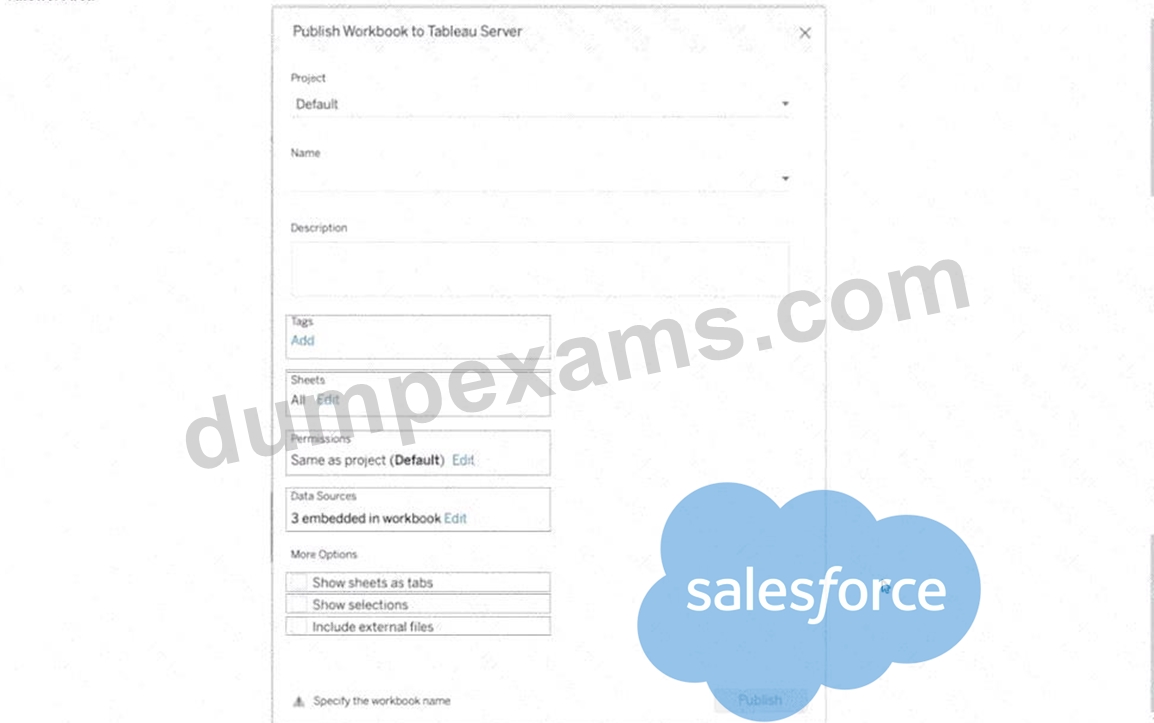
Answer:
Explanation: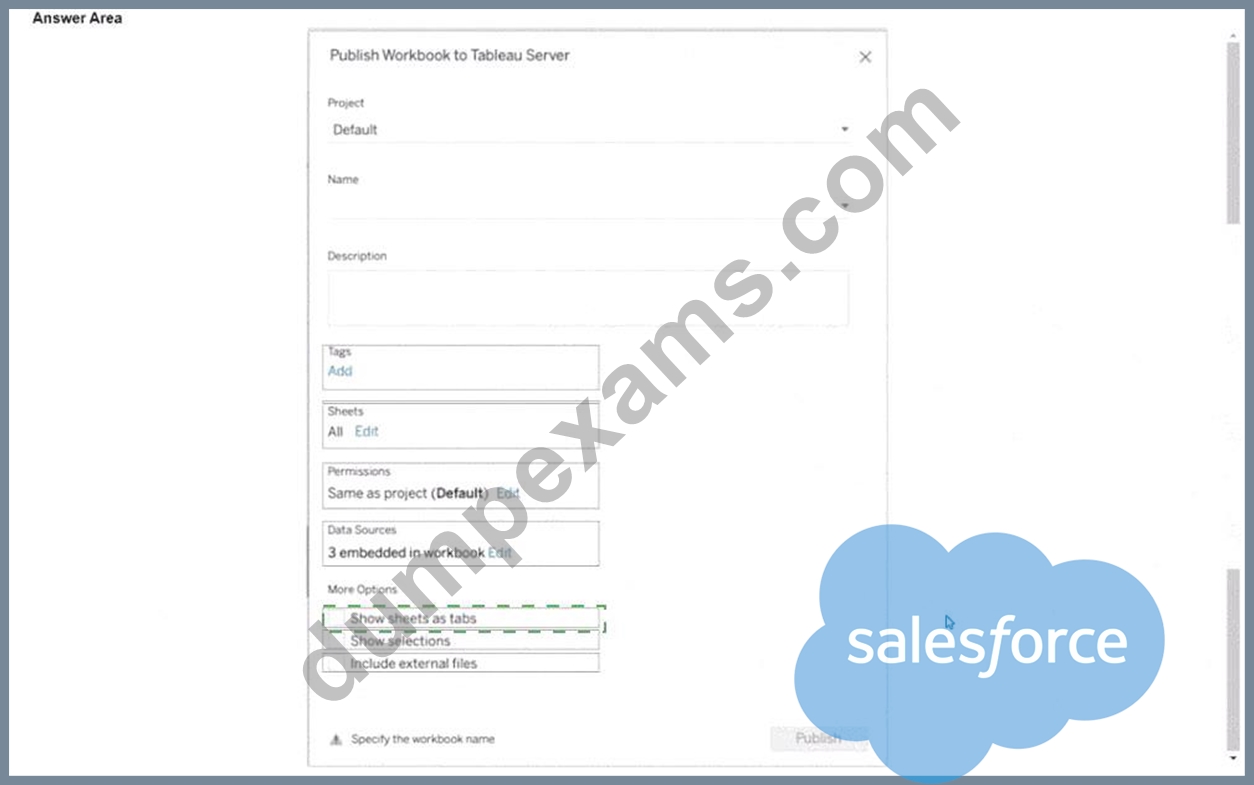
Explanation:
To ensure that users can see other published dashboards from their current dashboard when publishing a workbook to Tableau Server, you need to enable the option that shows sheets as tabs. This allows users to navigate between different sheets (dashboards) within the published workbook.
In the provided Publish Workbook to Tableau Server dialog box, you should check the option labeled:
"Show sheets as tabs"
This setting will display the sheets as tabs on Tableau Server, enabling users to switch between dashboards easily.
NEW QUESTION # 68
A Data Analyst needs to calculate the first Tuesday of each month in the data.
Which set of functions should the analyst use to perform this calculation?
- A. DATEADD, DATENAME
- B. DATEDIFF, DATEPART
- C. DATETRUNC, DATEPART
- D. DATETRUNC, DATEADD
Answer: C
NEW QUESTION # 69
You publish a dashboard tut uses an attract. The extract refreshes every Monday at 10:00.
You need to ensure that the extract also refreshes on the last day of the month at 18:00.
What should you do?
- A. From Tableau Desktop, open the Publish Workbook dialog box and configure the schedule.
- B. From Tableau Server. select Schedules and change the priority of the existing schedule
- C. From Tableau Server. select Schedules find the schedule of the extract, and change the frequency to the Last day of the month
- D. From Tableau Server select the workbook select Refresh Extracts and then add a new extract refresh
Answer: D
Explanation:
To refresh an extract on Tableau Server, you need to select the workbook, select Refresh Extracts, and then add a new extract refresh. You can specify the frequency and time of the refresh, as well as any custom options. You can have multiple extract refreshes for the same workbook with different schedules. References:
https://help.tableau.com/current/server/en-us/refresh_extracts.htm https://help.tableau.com/current/server/en- us/refresh_extracts_add.htm On Tableau Server, you can manage the scheduling of extract refreshes by selecting the specific workbook and configuring additional refresh schedules as needed. This allows for multiple refresh triggers, such as the regular Monday at 10:00 AM schedule, as well as an additional trigger for the last day of the month at 18:00.
NEW QUESTION # 70
In a dataset, you have a string field named Name that contains unnecessary semicolons.
Which function should you use to remove the semicolons from the Name field?
- A. REPLACE
- B. CONTAINS
- C. SPLIT
- D. TRIM
Answer: A
Explanation:
The REPLACE function is used to replace all occurrences of a substring within a string with another substring. In this case, it can be used to remove the semicolons from the Name field by replacing them with an empty string. For example, REPLACE ("John;Doe", ";", "") = "JohnDoe". References: The information is based on the following sources:
* String Functions - Tableau
* Remove special characters and add a semi colon in a word - Tableau
NEW QUESTION # 71
You conned to a Microsoft SQL Server database
You need to create a custom SQL query that retrieves rows from a table named Students Only students m the city of Berlin must be returned How should you complete the query? (Drag the appropriate Options to the Answer Area and drop into the correct locations.)
Answer:
Explanation: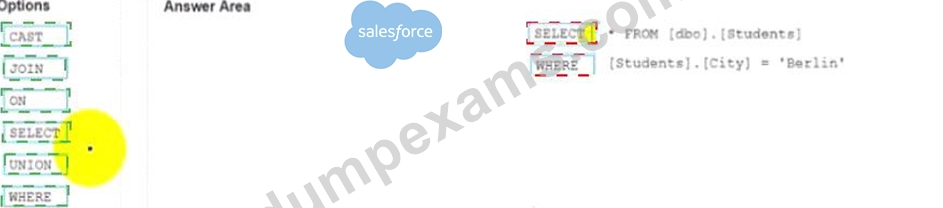
Explanation:
Select
Where
The correct way to complete the query is:
SELECT * FROM [dbo] . [Students]
WHERE [Students].[City] = 'Berlin'
The SELECT statement is used to retrieve data from a table or a view. The * symbol means that all columns will be returned. The FROM clause specifies the table or view name and the schema name.
The WHERE clause is used to filter the data based on a condition. The condition is [Students].[City] =
'Berlin', which means that only rows where the City column of the Students table is equal to 'Berlin' will be returned.
The other options are not relevant for this query. CAST is a function that converts a value from one data type to another. JOIN is a clause that combines data from two or more tables based on a common field. ON is a keyword that specifies the join condition. UNION is a set operation that combines the results of two or more queries into one result set.
References: https://docs.microsoft.com/en-us/sql/t-sql/queries/select-transact-sql?view=sql-server-ver15
https://docs.microsoft.com/en-us/sql/t-sql/queries/where-transact-sql?view=sql-server-ver15 https://docs.
microsoft.com/en-us/sql/t-sql/functions/cast-and-convert-transact-sql?view=sql-server-ver15 https://docs.
microsoft.com/en-us/sql/t-sql/queries/from-transact-sql?view=sql-server-ver15#join https://docs.microsoft.
com/en-us/sql/t-sql/language-elements/set-operators-union-transact-sql?view=sql-server-ver15
NEW QUESTION # 72
A Data Analyst has the following chart.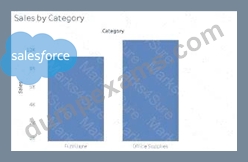
The analyst needs to enable the drilldown from Category to Subcategory as shown in the following chart.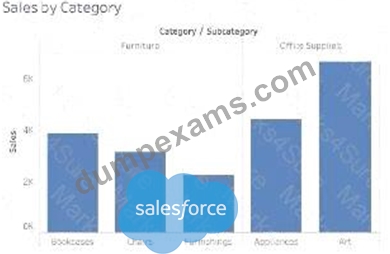
What should the analyst create?
- A. A combined set for Category and Subcategory
- B. A group of Category and Subcategory
- C. A bin for Category and a bin for Subcategory
- D. A hierarchy of Category and Subcategory
Answer: D
NEW QUESTION # 73
You have a data source that contains 20 tables.
You want the tables to be organized within the Data pane based on the type of data contained within the tables.
What should you use?
- A. Groups
- B. Hierarchies
- C. Folders
- D. Sets
Answer: C
Explanation:
To organize the tables in the Data pane based on the type of data contained within the tables, you should use folders. Folders are a way to manually group fields, parameters, sets, or tables in the Data pane according to your preference. You can create folders by right-clicking on the fields or tables you want to group and selecting Folders > Create Folder. You can also drag and drop fields or tables into existing folders. You can name the folders according to the type of data they contain, such as sales, customer, product, etc. Folders can help you find and access the fields or tables you need more easily and efficiently. References:
* Organize and Customize Fields in the Data Pane - Tableau
* Tableau Certified Data Analyst Study Guide
NEW QUESTION # 74
You have the following line chart that shows the average sales by month.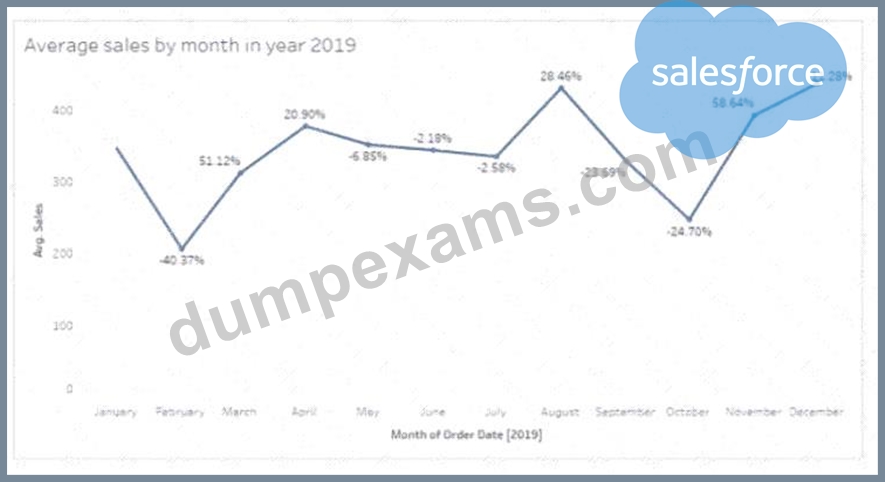
Which month had the biggest increase in swage sales compared to me previous month in 2019?
- A. November
- B. December
- C. October
- D. August
Answer: A
Explanation:
Based on the line chart provided, each point on the line chart represents the average sales for a given month, and the percentage values indicate the change in average sales compared to the previous month. The month of November shows a significant increase from the month of October, indicated by a large upward spike on the chart and a high percentage increase.
NEW QUESTION # 75
......
Get The Important Preparation Guide With Analytics-DA-201 Dumps: https://passleader.dumpexams.com/Analytics-DA-201-vce-torrent.html