


Guaranteed Success in Oracle Database 19c 1Z0-084 Exam Dumps
Oracle 1Z0-084 Daily Practice Exam New 2026 Updated 57 Questions
Oracle 1Z0-084 exam consists of 75 multiple-choice questions and has a time limit of 120 minutes. 1Z0-084 exam is available in several languages, including English, Japanese, and Korean. The passing score for the exam is 63%, and candidates who pass the exam will receive the Oracle Database 19c Performance and Tuning Management certification.
NEW QUESTION # 14
Which two actions can cause invalidation or loss of one or more results in the SQL Query Result Cache?
- A. Decreasing the value set for RESULT_CACHE_REMOTE_EXPIRATION.
- B. result_cache_max_size is set dynamically to 0.
- C. A request was made by the RCBG background process in a physical standby database that is opened read only and whose primary has a result cache.
- D. One or more results were aged out of the result cache.
- E. A request was made by the RCBG background of a non-RAC database.
Answer: B,D
Explanation:
The SQL Query Result Cache stores the results of queries and PL/SQL function calls for reuse. However, entries in the result cache can be invalidated or lost under certain conditions:
A: Results can be aged out of the cache when the cache becomes full and new results need to be stored. This process ensures that the cache does not exceed its allocated memory and that it contains the most recently used entries.
B: Setting theRESULT_CACHE_MAX_SIZEparameter to 0 will effectively disable the result cache and all cached results will be lost, as Oracle will no longer allocate any memory to the result cache.
References:
* Oracle Database Performance Tuning Guide, 19c
NEW QUESTION # 15
Examine this statement and output: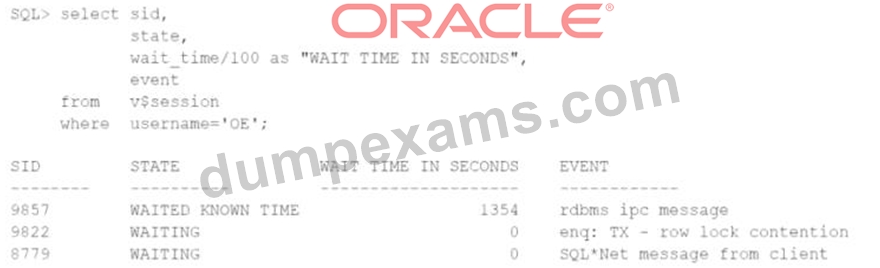
Which three statements are true?
- A. Session 8779 may be waiting due to a network problem.
- B. Session 9857 is not waiting.
- C. Both 9822 and 8779 sessions are waiting for operating system resources.
- D. Session 9822 will always stop waiting if the session that owns the TX enqueue issues a COMMIT statement as session 9822 is the first session in the transaction queue.
- E. Session 9857 waited 1354 seconds for another process, which was also waiting for a transaction to end.
- F. Session 8779 may be waiting for a user or application response.
Answer: A,D,F
Explanation:
For this SQL statement and output, we can analyze theEVENTcolumn to understand the type of wait:
B: The event "SQL*Net message from client" typically indicates that the session is waiting for a response from the client. This can be due to a network issue, user response, or an application processing delay.
E: The event "SQL*Net message from client" also implies that the session is idle waiting for the client (a user or an application) to send a request to the server. This event usually indicates that the session is not actively working but is instead waiting for the next command.
F: The wait event "enq: TX - row lock contention" suggests that session 9822 is waiting for a row-level lock held by another session. If the holding session issues a COMMIT or ROLLBACK, the lock will be released, and session 9822 will stop waiting. Since this session is experiencing row lock contention, it implies it's waiting for a specific transaction to complete.
References:
* Oracle Database Reference, 19c
* Oracle Wait Events Documentation
NEW QUESTION # 16
Which three types of statistics are captured by statspack with snap level 6?
- A. Parent and child latches
- B. Parent and child latches
- C. Optimizer execution plans
- D. Segment-level statistics
- E. Plan usage data
- F. Enqueue statistics
Answer: B,D,F
Explanation:
Statspack is a performance diagnostic tool provided by Oracle prior to the introduction of the Automatic Workload Repository (AWR). At snap level 6, Statspack captures the following types of statistics:
* A (Correct):Parent and child latches are captured. Latch statistics provide information about contention for latches, which are low-level serialization mechanisms used by Oracle.
* E (Correct):Enqueue statistics, which provide information on the waits for locks that manage the concurrency between users.
* F (Correct):Segment-level statistics, which provide detailed information on database segments such as tables, indexes, etc., to identify I/O and contention issues.
* C (Incorrect):While optimizer execution plans are an essential aspect of performance tuning, detailed execution plan capture is not part of the Statspack report at level 6.
* D (Incorrect):Plan usage data refers to how frequently a plan is being used, which is more associated with AWR and not typically captured in Statspack reports.
References:
* Oracle Database Performance Tuning Guide:Using Statspack
NEW QUESTION # 17
An Oracle 19c database uses default values for all optimizer initialization parameters.
After a table undergoes partition maintenance, a large number of wait events occur for:
cursor: pin S wait on X
Which command reduces the number of these wait events?
- A. ALTER SYSTEM SET SESSION CACHED CURSORS = 500;
- B. ALTER SYSTEM SET CURSOR_INVALIDATION = DEFERRED;
- C. ALTER SYSTEM SET CURSOR_SPACE_FOR_TIME - TRUE;
- D. ALTER SYSTEM SET CURSOR_SHARING = FORCE;
Answer: B
Explanation:
Thecursor: pin S wait on Xwait event suggests contention for a cursor pin, which is associated with mutexes (a type of locking mechanism) that protect the library cache to prevent concurrent modifications. This issue can often be alleviated by deferring the invalidation of cursors until the end of the call to reduce contention.
The correct command to use would be:
* C (Correct):ALTER SYSTEM SET CURSOR_INVALIDATION=DEFERRED;This setting defers the invalidation of dependent cursors until the end of the PL/SQL call, which can reduce thecursor: pin S wait on Xwait events.
The other options are incorrect in addressing this issue:
* A (Incorrect):SettingCURSOR_SHARINGtoFORCEmakes the optimizer replace literal values with bind variables. It doesn't address the contention for cursor pins directly.
* B (Incorrect):CURSOR_SPACE_FOR_TIME=TRUEaims to reduce the parsing effort by keeping cursors for prepared statements open. It may increase memory usage but does not directly resolve cursor: pin S wait on Xwaits.
* D (Incorrect):IncreasingSESSION_CACHED_CURSORScaches more session cursors but doesn't necessarily prevent the contention indicated by thecursor: pin S wait on Xwait events.
References:
* Oracle Database Reference:CURSOR_INVALIDATION
* Oracle Database Performance Tuning Guide:Reducing Cursor Invalidation
NEW QUESTION # 18
Multiple sessions are inserting data concurrently into a table that has an LOB column.
At some point in time, one of the sessions cannot find available space in the LOB segment and needs to allocate a new extent.
Which wait event will be raised in the other sessions that need space in the LOB column?
- A. enq: HW - contention
- B. enq: SQ - contention
- C. enq: TM - contention
- D. enq: TX - allocate ITL entry
Answer: A
Explanation:
When sessions concurrently insert data into a table with an LOB column and one session needs to allocate a new extent because it cannot find available space, the wait event associated with this contention is "enq: HW - contention". The HW stands for High Water Mark which is related to space allocation in the database segment.
When asession needs to allocate a new extent, it may raise this wait event in other sessions that are also attempting to allocate space in the same LOB segment.
References
* Oracle Database 19c Reference Guide - enq: HW - contention
NEW QUESTION # 19
You must write a statement that returns the ten most recent sales. Examine this statement:
Users complain that the query executes too slowly. Examine the statement's current execution plan: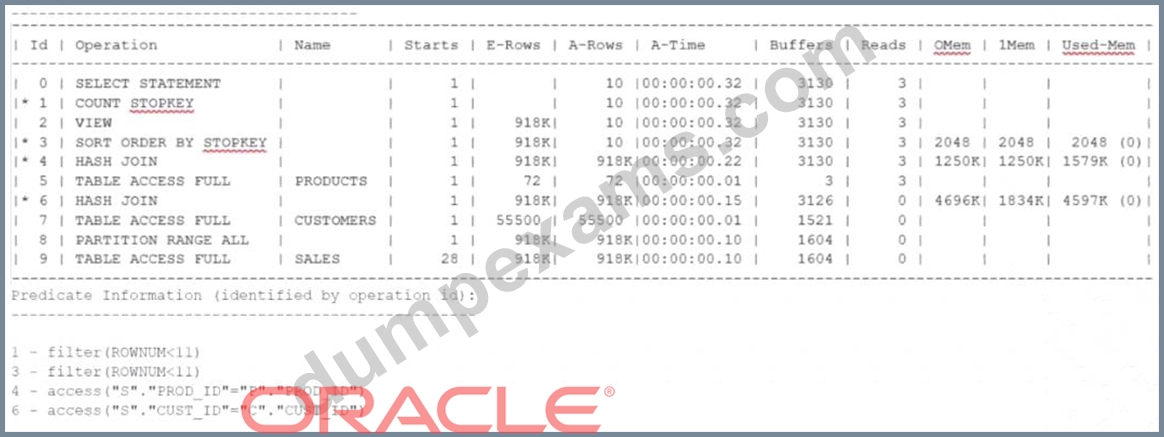
What must you do to reduce the execution time and why?
- A. Enable Adaptive Plans so that Oracle can change the Join method as well as the Join order for this query.
- B. Create an index on SALES.CUST_ID to force an INDEX RANGE SCAN on this index followed by a NESTED LOOP join between CUSTOMERS and SALES.
- C. Collect a new set of statistics on PRODUCT, CUSTOMERS, and SALES because the current stats are inaccurate.
- D. Create an index on SALES.TIME_ID to force the return of rows in the order specified by the ORDER BY clause.
- E. Replace the FETCH FIRST clause with ROWNUM to enable the use of an index on SALES.
Answer: D
Explanation:
The execution plan shows a full table access for theSALEStable. To reduce the execution time, creating an index onSALES.TIME_IDwould be beneficial as it would allow the database to quickly sort and retrieve the most recent sales without the need to perform a full table scan, which is I/O intensive and slower. By indexing TIME_ID, which is used in theORDER BYclause, the optimizer can take advantage of the index to efficiently sort and limit the result set to the ten most recent sales.
* B (Incorrect):ReplacingFETCH FIRSTwithROWNUMwould not necessarily improve the performance unless there is an appropriate index that the optimizer can use to avoid sorting the entire result set.
* C (Incorrect):There is no indication that the current statistics are inaccurate; hence, collecting new statistics may not lead to performance improvement.
* D (Incorrect):While adaptive plans can provide performance benefits by allowing the optimizer to adapt the execution strategy, the main issue here is the lack of an index on theORDER BYcolumn.
* E (Incorrect):Creating an index onSALES.CUST_IDcould improve join performance but would not address the performance issue caused by the lack of an index on theORDER BYcolumn.
References:
* Oracle Database SQL Tuning Guide:Managing Indexes
* Oracle Database SQL Tuning Guide:Using Indexes and Clusters
NEW QUESTION # 20
You want to reduce the amount of db file scattered read that is generated in the database.You execute the SQL Tuning Advisor against the relevant workload. Which two can be part of the expected result?
- A. recommendations regarding rewriting the SQL statements
- B. recommendations regarding the creation of SQL Patches
- C. recommendations regarding partitioning the tables
- D. recommendations regarding the creation of materialized views
- E. recommendations regarding the creation of additional indexes
Answer: D,E
Explanation:
The SQL Tuning Advisor provides recommendations for improving SQL query performance. This may include suggestions for creating additional indexes to speed up data retrieval and materialized views to precompute and store query results.References:
* Oracle Database SQL Tuning Guide, 19c
NEW QUESTION # 21
You must configure and enable Database Smart Flash Cache for a database.
You configure these flash devices:
Examine these parameter settings: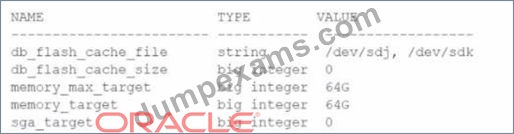
What must be configured so that the database uses these devices for the Database Smart Flash Cache?
- A. Set DB_FLASH_CACHE_SIZE to 256G and change device /dev/sdk to 128G.
- B. Disable Automatic Memory Management and set SGA_TARGET to 256G.
- C. Set DB_FLASH_CACHE_SIZE parameter to 128G, 64G.
- D. Set DB_FLASH_CACHE_SIZE to 192G and MEMORY_TARGET to 256G.
- E. Set DB_FLASH_CACHE_SIZE parameter to 192G.
Answer: C
Explanation:
To configure and enable Database Smart Flash Cache, you must set the DB_FLASH_CACHE_SIZE parameter to reflect the combined size of the flash devices you intend to use for the cache. In this scenario, two flash devices are configured: /dev/sdj with 128G and /dev/sdk with 64G.
* Determine the combined size of the flash devices intended for the Database Smart Flash Cache. In this case, it's 128G + 64G = 192G.
* However, Oracle documentation suggests setting DB_FLASH_CACHE_SIZE to the exact sizes of the individual devices, separated by a comma when multiple devices are used.
* Modify the parameter in the database initialization file (init.ora or spfile.ora) or using an ALTER SYSTEM command. Here's the command for altering the system setting:
ALTER SYSTEM SET DB_FLASH_CACHE_SIZE='128G,64G' SCOPE=SPFILE;
* Since this is a static parameter, a database restart is required for the changes to take effect.
* Upon database startup, it will allocate the Database Smart Flash Cache using the provided sizes for the specified devices.
It is important to note that MEMORY_TARGET and MEMORY_MAX_TARGET parameters should be configured independently of DB_FLASH_CACHE_SIZE. They control the Oracle memory management for the SGA and PGA, and do not directly correlate with the flash cache configuration.
References
* Oracle Database 19c Documentation on Database Smart Flash Cache
* Oracle Support Articles and Community Discussions on DB_FLASH_CACHE_SIZE Configuration
NEW QUESTION # 22
You execute the following:
EXECUTE DBMS_AuTO_TASK_ADMIN.DISABLE;
Which advisor remains enabled?
- A. Automatic SQL Tuning
- B. Optimizer Statistics Advisor
- C. SQL Plan Management Evolve Advisor
- D. Automatic Optimizer Statistics Collection
- E. Automatic Segment Advisor
Answer: D
Explanation:
When you executeDBMS_AUTO_TASK_ADMIN.DISABLE, it disables all automated maintenance tasks related to the Auto Task framework. This includes tasks such as the Automatic SQL Tuning Advisor, Automatic Segment Advisor, and others. However, the Automatic Optimizer Statistics Collection (D) remains enabled as it is not part of the Auto Task framework. The gathering of optimizer statistics is controlled separately and is a critical part of the database's self-tuning mechanism to ensure the optimizer has up-to-date information about the data distribution within tables and indexes.
References
* Oracle Database 19c PL/SQL Packages and Types Reference - DBMS_AUTO_TASK_ADMIN
* Oracle Database 19c Database Administrator's Guide - Managing Optimizer Statistics
NEW QUESTION # 23
During which application lifecycle phase do you take baselines?
- A. Design and development
- B. Production
- C. Deployment
- D. Migration or upgrade
- E. Testing
Answer: B
Explanation:
Baselines are typically taken during the production phase of the application lifecycle. They provide a snapshot of performance metrics under normal operating conditions which can be used for comparison against future performance. Baselines are essential for understanding how the system performs under its typical workload and for detecting deviations from this expected performance over time, especially after changes like migrations, upgrades, or significant changes in user activity.
References
* Oracle Database 19c Performance Tuning Guide - Managing Performance Through Baselines
NEW QUESTION # 24
What is the right time to stop tuning an Oracle database?
- A. When the tuning goal has been met
- B. When the I/O is less than 10% of the DB time
- C. When all the concurrency waits are eliminated from the Top 10
- D. When the allocated budget for performance tuning has been exhausted
- E. When the buffer cache and library cache hit ratio is above 95%
Answer: A
Explanation:
The objective of performance tuning in Oracle Database is to meet specific performance goals. These goals may vary based on the requirements of the system and business objectives. Let's evaluate each option in detail to understand why E is correct and others are not.
Option Analysis:
* A. When the allocated budget for performance tuning has been exhausted
* Why it's incorrect:
* Tuning should not stop simply because the budget is exhausted. If performance goals are not met, the database might still experience performance issues, impacting the end-users or business-critical processes. Budget is a constraint, but it shouldn't define when tuning stops.
* B. When all the concurrency waits are eliminated from the Top 10
* Why it's incorrect:
* Concurrency waits (such as locks or latches) are just one aspect of database performance tuning. Eliminating these waits does not necessarily mean the system meets its performance goals. Other factors like query optimization, I/O performance, and CPU usage might still need attention.
* C. When the buffer cache and library cache hit ratio is above 95%
* Why it's incorrect:
* Cache hit ratios are often overemphasized as a performance metric. While a high hit ratio indicates efficient memory usage, it doesn't guarantee optimal performance. A high ratio could still mask inefficient SQL queries, suboptimal execution plans, or other bottlenecks.
* D. When the I/O is less than 10% of the DB time
* Why it's incorrect:
* While reducing I/O is beneficial, it is not always a sufficient indicator that tuning can stop.
Certain workloads may inherently have high or low I/O percentages. The real question is whether the database is meeting its required service levels, not just reducing I/O.
* E. When the tuning goal has been met
* Why it's correct:
* The purpose of performance tuning is to meet the specific performance goals set by the business or the database administrators. Once the database meets these goals (e.g., query response times, throughput requirements, or SLA commitments), tuning can stop. This ensures effort is focused on achieving measurable outcomes, rather than chasing arbitrary metrics.
The Importance of Defining a Tuning Goal
Performance tuning should be driven by clear goals such as:
* Reducing response time for specific critical queries.
* Meeting SLAs for application performance.
* Supporting a target number of concurrent users.
* Reducing resource contention for improved scalability.
Tuning should stop once these goals are achieved because continuous tuning without purpose can lead to unnecessary complexity and resource usage.
Reference to Oracle Documentation:
* Oracle Database 19c Performance Tuning Guide:
* Section: Establishing Performance Goals and Metrics.
* Discussion on focusing tuning efforts on business requirements and goals.
* Oracle Database Concepts Guide:
* Best practices for balancing performance improvements with system complexity.
NEW QUESTION # 25
Which two Oracle Database features use database services?
- A. Oracle SQL Performance Management
- B. Oracle SQL Tuning Advisor
- C. Oracle Scheduler
- D. Database Resource Manager
- E. Oracle Automatic Reoptimization
Answer: C,D
Explanation:
Database services in Oracle are used to manage how resources are allocated and how workloads are managed within the database. The features that use database services are:
* B (Correct):Database Resource Manager (DBRM) uses services to control resource allocation to different workloads. It ensures that resources are assigned to the most critical tasks first, based on the service associated with the workload.
* E (Correct):Oracle Scheduler can also utilize database services. Jobs in Oracle Scheduler can be assigned to different services to control resource allocation and prioritization.
The other features mentioned are related to SQL performance but do not directly utilize database services in the way Resource Manager and Scheduler do:
* A:Oracle Automatic Reoptimization is a feature that allows the database to automatically improve the execution plan of a SQL statement after it is executed, based on the actual performance metrics, but it does not directly use database services.
* C:Oracle SQL Performance Management involves various components of SQL tuning and monitoring, but it does not use database services to operate.
* D:Oracle SQL Tuning Advisor provides advice on how to tune SQL queries for better performance.
While it can be used in conjunction with services for managing and analyzing workloads, it doesn't use services in its core functionality.
References:
* Oracle Database Administrator's Guide:Administering Services
* Oracle Database Administrator's Guide:Managing Resources with Oracle Database Resource Manager
* Oracle Database Scheduler Developer's Guide:Using the Scheduler
NEW QUESTION # 26
Which two statements are true about space usage in temporary tablespaces?
- A. Lack of temporary tablespace space for sort operations can be prevented by using temporary tablespace groups.
- B. When a global temporary table instantiation is too large to fit in memory, space is allocated in a temporary tablespace.
- C. When a session consumes all temporary tablespace storage, then the session would hang until the temporary space used by that session is cleared.
- D. A sort will fail if a sort to disk requires more disk space and no additional extent can be found/allocated in/for the sort segment.
- E. Temporary tablespaces setting Includes quotas to limit temporary space used by a session for that Temporary tablespace.
Answer: A,B
Explanation:
Regarding space usage in temporary tablespaces, the following statements are true:
* A (Correct): When a global temporary table or a sort operation exceeds the available memory, Oracle Database allocates space in a temporary tablespace to store the temporary data or intermediate results.
* E (Correct): Using temporary tablespace groups can prevent insufficient temporary tablespace for sort operations by providing a collective pool of space from multiple temporary tablespaces, which can be used for user sorting operations.
The other options provided have inaccuracies:
* B (Incorrect): Oracle does not provide a mechanism for setting quotas on temporary tablespaces.
Quotas can be set for permanent tablespaces but not for temporary ones.
* C (Incorrect): A sort operation may fail due to insufficient space, but Oracle will attempt to allocate space in the temporary tablespace dynamically. If no space can be allocated, an error is returned rather than a sort failure.
* D (Incorrect): If a session consumes all available temporary tablespace storage, Oracle will not hang the session; it will return an error to the session indicating that it has run out of temporary space.
References:
* Oracle Database Administrator's Guide: Managing Space for Schema Objects
* Oracle Database Concepts: Temporary Tablespaces
NEW QUESTION # 27
Which two types of performance problems are reported by ADDM for PDBS?
- A. Excessive checkpoint writes
- B. I/O capacity limits
- C. User I/O waits
- D. SGA sizing issues
- E. Top SQL statements
Answer: B,C
Explanation:
The Automatic Database Diagnostic Monitor (ADDM) analyzes and reports on various types of performance problems. For Pluggable Databases (PDBs), it can identify issues such as I/O capacity limits which may hinder the overall performance by causing bottlenecks. Additionally, ADDM can report on user I/O waits, which can indicate performance issues related to the time it takes for user queries to read data from the disk.
References:
* Oracle Multitenant Administrator's Guide, 19c
* Oracle Database Performance Tuning Guide, 19c
NEW QUESTION # 28
You want to reduce the amount of db file scattered read that is generated in the database. You execute the SQL Tuning Advisor against the relevant workload. Which two can be part of the expected result?
- A. recommendations regarding the creation of SQL Patches
- B. recommendations regarding partitioning the tables
- C. recommendations regarding rewriting the SQL statements
- D. recommendations regarding the creation of additional indexes
- E. recommendations regarding the creation of materialized views
Answer: C,D
Explanation:
https://docs.oracle.com/en/database/oracle/oracle-database/21/tgsql/sql-tuning-advisor.html#GUID-
8E1A39CB-A491-4254-8B31-9B1DF7B52AA1
The goal is to reduce the db file scattered read waits, which are associated with full table scans. These are I
/O operations where Oracle retrieves data blocks scattered across the disk, typically when large amounts of data are read inefficiently. Running the SQL Tuning Advisor analyzes the workload and provides tuning recommendations. Let's evaluate the options.
Why A. Recommendations regarding the creation of additional indexes is correct:
* Full table scans (which cause db file scattered read) often occur because suitable indexes are missing.
* The SQL Tuning Advisor can identify queries that would benefit from indexes and recommend creating them. Indexes allow the database to access data more efficiently using row lookups, reducing the need for full table scans.
Why B. Recommendations regarding rewriting the SQL statements is correct:
* Sometimes, poorly written SQL statements cause inefficient execution plans that lead to db file scattered read.
* SQL Tuning Advisor can recommend SQL rewrites to make better use of indexes, avoid full table scans, or optimize joins. For example:
* Rewriting predicates to use indexed columns.
* Using hints to guide the optimizer.
Why Other Options Are Incorrect:
* C. Recommendations regarding the creation of materialized views:
* Materialized views are typically recommended to optimize complex queries involving aggregations or joins, not to address db file scattered read directly. They are less relevant for solving I/O issues caused by full table scans in this context.
* D. Recommendations regarding the creation of SQL Patches:
* SQL Patches are used to influence the execution plan for specific SQL statements. While SQL Patches can potentially fix performance issues, the SQL Tuning Advisor focuses on improving SQL and database design rather than patching queries.
* E. Recommendations regarding partitioning the tables:
* Partitioning tables can improve query performance, especially for very large datasets. However, this is a database design-level recommendation and is not typically provided by SQL Tuning Advisor. Partitioning would not directly target db file scattered read.
How SQL Tuning Advisor Helps:
The SQL Tuning Advisor provides actionable recommendations, such as:
* Creating indexes to reduce full table scans.
* Rewriting SQL to optimize the execution plan.
* Improving statistics to help the optimizer make better decisions.
References to Oracle Documentation:
* Oracle Database 19c Performance Tuning Guide:
* Section: Using SQL Tuning Advisor to Optimize Workloads.
* Explains recommendations for indexes and SQL rewrites to reduce I/O.
* Understanding Wait Events:
* Details about db file scattered read and how to address it.
NEW QUESTION # 29
Database performance degraded between 23:15 and 23:30 for the last three nights. The awr snapshot interval is one hour. The AODM report contains nothing about this performance problem.
With which tool can you further analyze this problem?
- A. AWR Compare Periods report
- B. SQL Performance Analyzer
- C. SQL Tuning Advisor
- D. Active Session History report
Answer: D
Explanation:
The Active Session History (ASH) report is a tool that provides detailed information about active sessions for the time period specified. Since the AWR snapshot interval is one hour and does not capture the granularity needed for this issue, ASH reports aremore suitable as they contain more granular data for sessions that were active during the period of interest.
References:
* Oracle Database Performance Tuning Guide, 19c
NEW QUESTION # 30
You are informed that the RMAN session that is performing the database duplication is much slower than usual. You want to know the approximate time when the rman operation will be completed.
Which view has this information?
- A. V$SESSTAT
- B. V$SESSION_LONGOPS
- C. V$SESSION
- D. V$RMAN_BACKUP_JOB_DETAILS
Answer: B
Explanation:
In Oracle Database, theV$SESSION_LONGOPSview provides insights into various operations within the database that are expected to take more than six seconds to complete. These include operations related to RMAN (Recovery Manager), such as database duplication tasks. This view displays information about the progress of these long-running operations, including the start time, elapsed time, and estimated time to completion.
When an RMAN session is performing a database duplication and is observed to be slower than usual, checking theV$SESSION_LONGOPSview can give an approximation ofwhen the RMAN operation might complete. This view includes fields likeTIME_REMAININGandELAPSED_SECONDSthat help in estimating the completion time of the operation based on its current progress.
References:
* Oracle Database Reference:V$SESSION_LONGOPS
* Oracle Database Backup and Recovery User's Guide:Monitoring RMAN Jobs
NEW QUESTION # 31
You must configure and enable Database Smart Flash Cache for a database.
You configure these flash devices:
Examine these parameter settings: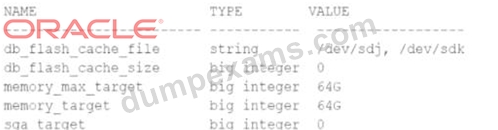
What must be configured so that the database uses these devices for the Database Smart Flash Cache?
- A. Set DB_FLASH_CACHE_SIZE to 256G and change device /dev/sdk to 128G.
- B. Disable Automatic Memory Management and set SGA_TARGET to 256G.
- C. Set DB_FLASH_CACHE_SIZE parameter to 128G, 64G.
- D. Set DB_FLASH_CACHE_SIZE to 192G and MEMORY_TARGET to 256G.
- E. Set DB_FLASH_CACHE_SIZE parameter to 192G.
Answer: C
Explanation:
To configure and enable Database Smart Flash Cache, you must set the DB_FLASH_CACHE_SIZE parameter to reflect the combined size of the flash devices youintend to use for the cache. In this scenario, two flash devices are configured: /dev/sdj with 128G and /dev/sdk with 64G.
* Determine the combined size of the flash devices intended for the Database Smart Flash Cache. In this case, it's 128G + 64G = 192G.
* However, Oracle documentation suggests setting DB_FLASH_CACHE_SIZE to the exact sizes of the individual devices, separated by a comma when multiple devices are used.
* Modify the parameter in the database initialization file (init.ora or spfile.ora) or using an ALTER SYSTEM command. Here's the command for altering the system setting:
ALTER SYSTEM SET DB_FLASH_CACHE_SIZE='128G,64G' SCOPE=SPFILE;
* Since this is a static parameter, a database restart is required for the changes to take effect.
* Upon database startup, it will allocate the Database Smart Flash Cache using the provided sizes for the specified devices.
It is important to note that MEMORY_TARGET and MEMORY_MAX_TARGET parameters should be configured independently of DB_FLASH_CACHE_SIZE. They control the Oracle memory management for the SGA and PGA, and do not directly correlate with the flash cache configuration.
References
* Oracle Database 19c Documentation on Database Smart Flash Cache
* Oracle Support Articles and Community Discussions on DB_FLASH_CACHE_SIZE Configuration
NEW QUESTION # 32
SGA_TARGET and PGA_AGGREGATE_TARGET are configured to nonzero values.
MEMORY_target is then set to a nonzero value but memory_MAX_TARGET is not set.
Which two statements are true?
- A.

- B.

- C.

- D.

- E.

- F.

- G.

Answer: E,G
Explanation:
When MEMORY_TARGET is set to a nonzero value, Oracle automatically manages the memory allocation between the System Global Area (SGA) and the Program Global Area(PGA). If MEMORY_MAX_TARGET is not explicitly set, Oracle will behave in the following manner:
* MEMORY_MAX_TARGET will default to the value of MEMORY_TARGET, assuming the platform allows for the value of MEMORY_TARGET to be increased dynamically. This means that MEMORY_TARGET represents both the initial allocation and the maximum limit for the dynamically managed memory unless MEMORY_MAX_TARGET is specified differently.
* If MEMORY_TARGET is set to a value that is less than the sum of the current values of SGA_TARGET and PGA_AGGREGATE_TARGET, Oracle will use the higher sum as the default value for MEMORY_MAX_TARGET to ensure that there is adequate memory for both areas. The database instance will not start if MEMORY_TARGET is not sufficient to accommodate the combined SGA and PGA requirements.
References
* Oracle Database Administrator's Guide 19c: Automatic Memory Management
* Oracle Database Performance Tuning Guide 19c: Using Automatic Memory Management
NEW QUESTION # 33
Multiple sessions are inserting data concurrently into a table that has an LOB column.
At some point in time, one of the sessions cannot find available space in the LOB segment and needs to allocate a new extent.
Which wait event will be raised in the other sessions that need space in the LOB column?
- A. enq: HW - contention
- B. enq: SQ - contention
- C. enq: TM - contention
- D. enq: TX - allocate ITL entry
Answer: A
Explanation:
When sessions concurrently insert data into a table with an LOB column and one session needs to allocate a new extent because it cannot find available space, the wait event associated with this contention is "enq: HW - contention". The HW stands for High Water Mark which is related to space allocation in the database segment. When a session needs to allocate a new extent, it may raise this wait event in other sessions that are also attempting to allocate space in the same LOB segment.
References
* Oracle Database 19c Reference Guide - enq: HW - contention
NEW QUESTION # 34
Users complain about slowness and session interruptions. Additional checks reveal the following error in the application log:
Which file has additional information about this error?
- A. Alert log
- B. Session trace file SQL trace file automatically generated by the error
- C. ASH report
- D. SQL trace file automatically generated by the error
Answer: A
Explanation:
When an ORA-00060 deadlock error occurs, detailed information about the error and the deadlock graph are dumped into the alert log. This log contains a trace file name that you can use to find additional detailed information about the sessions involved in the deadlock and the SQL statements they were executing.
References:
* Oracle Database Administrator's Guide, 19c
* Oracle Database Error Messages, 19c
NEW QUESTION # 35
A database supporting a mixed workload is hosted on a server with 64 CPUs.
A large number of free buffer waits and buffer busy waits occur affecting performance.
The buffer cache size was then increased but after a few hours, the same wait events occur more often than before the change.
Examine these parameter settings: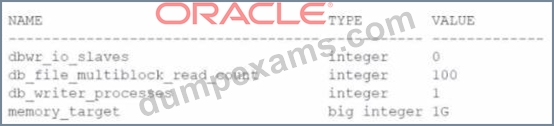
Which two actions can help reduce the number of these waits7
- A. increasing the value of DBWRITERPROCESSES to 64,
- B. reducing the values of DB_FILE_MULTILOCK_READ_COUNT to 64
- C. increasing the value of DB_FILE_MULTIBLOCK_READ_COUNT to 128
- D. setting dbwr_io_slaves to 64
- E. Increasing the size of MEMORYTARGET
Answer: A,D
Explanation:
Given a server with 64 CPUs, if the buffer cache size increase did not alleviate free buffer waits and buffer busy waits, one can look into optimizing I/O and the efficiency of the DB writer processes.
C: Setting the DBWR_IO_SLAVES parameter to a non-zero value, such as the number of CPUs, would initiate I/O slave processes to assist the DB writer process. This can help reduce I/O contention when writing from the buffer cache to disk, particularly for systems without asynchronous I/O capabilities.
D: Increasing the value of DBWRITERPROCESSES enables multiple DB writer processes to be active simultaneously. In a system with many CPUs, such as 64, increasing this value can improve the write throughput to disk and potentially reduce buffer busy waits.
References:
* Oracle Database Reference, 19c
* Oracle Database Performance Tuning Guide, 19c
NEW QUESTION # 36
This error occurred more than four hours ago in the database:
ORA-04036 PGA memory used by theinstance exceedsPGA_AGGREGATE_LIMIT
You want to know which process and query were at fault.
Which two views should you use for this purpose?
- A. DBA_HIST_PROCESS_MEM_SUMMARY
- B. DBA_HIST_ACTIVE_SESS_HISTORY
- C. DBA_HIST_SQLSTAT
- D. DBA_HIST_SQLTEXT
- E. DBA_HIST_PGASTAT
Answer: A,B
Explanation:
To investigate the cause of the ORA-04036 error, which indicates that PGA memory usage exceeds the PGA_AGGREGATE_LIMIT, the appropriate views to consult are DBA_HIST_ACTIVE_SESS_HISTORYandDBA_HIST_PROCESS_MEM_SUMMARY.
* DBA_HIST_ACTIVE_SESS_HISTORY:This view provides historical information about active sessions in the database. It includes details about the SQL executed, the execution context, and the resources consumed by each session. By examining this view, you can identify the specific sessions and SQL queries that were active and potentially consuming excessive PGA memory around the time the ORA-04036 error occurred.
* DBA_HIST_PROCESS_MEM_SUMMARY:This view contains historical summaries of memory usage by processes. It can help in identifying the processes that were consuming a significant amount of PGA memory, leading to the ORA-04036 error. This view provides aggregated memory usage information over time,making it easier to pinpoint the processes responsible for high PGA memory consumption.
Together, these views offer a comprehensive overview of the memory usage patterns and specific queries or processes that might have contributed to exceeding thePGA_AGGREGATE_LIMIT, resulting in the ORA-04036 error.
References:
* Oracle Database Reference:DBA_HIST_ACTIVE_SESS_HISTORY
* Oracle Database Reference:DBA_HIST_PROCESS_MEM_SUMMARY
* Oracle Database Performance Tuning Guide:Managing Memory
NEW QUESTION # 37
......
Test Engine to Practice 1Z0-084 Test Questions: https://passleader.dumpexams.com/1Z0-084-vce-torrent.html