


JN0-637 exam questions for practice in 2026 Updated 125 Questions
Updated Mar-2026 Premium JN0-637 Exam Engine pdf - Download Free Updated 125 Questions
Juniper JN0-637 Exam Syllabus Topics:
| Topic | Details |
|---|---|
| Topic 1 |
|
| Topic 2 |
|
| Topic 3 |
|
| Topic 4 |
|
NEW QUESTION # 55
Exhibit: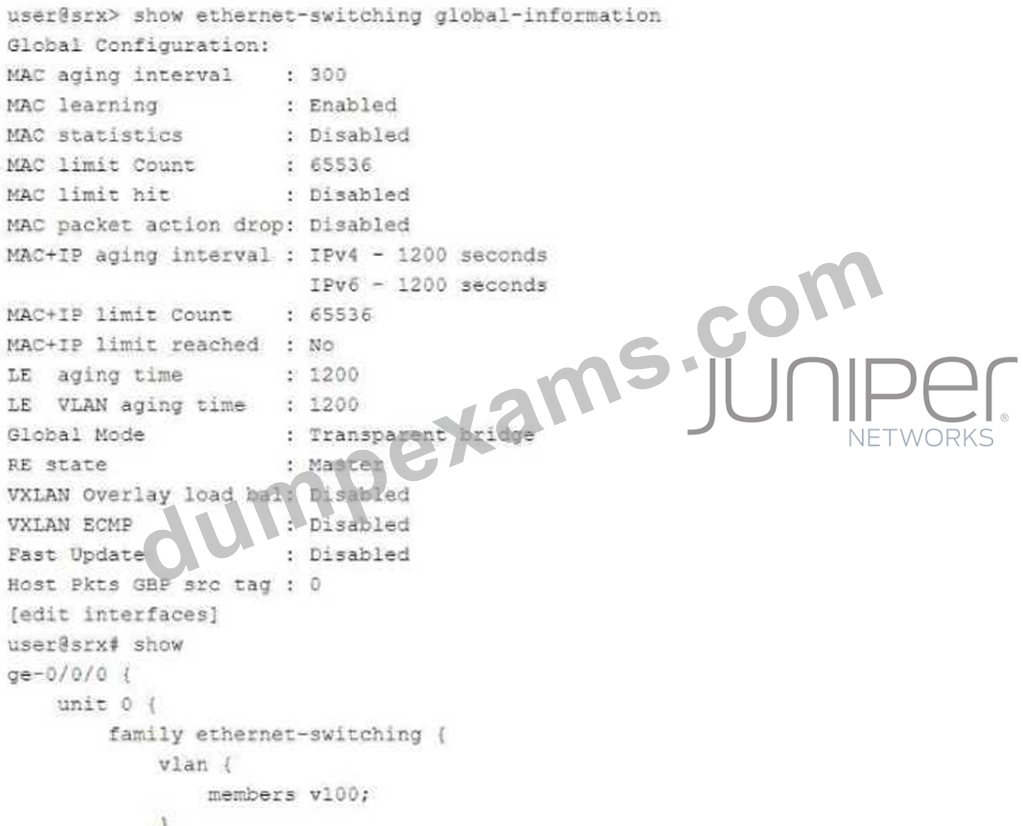
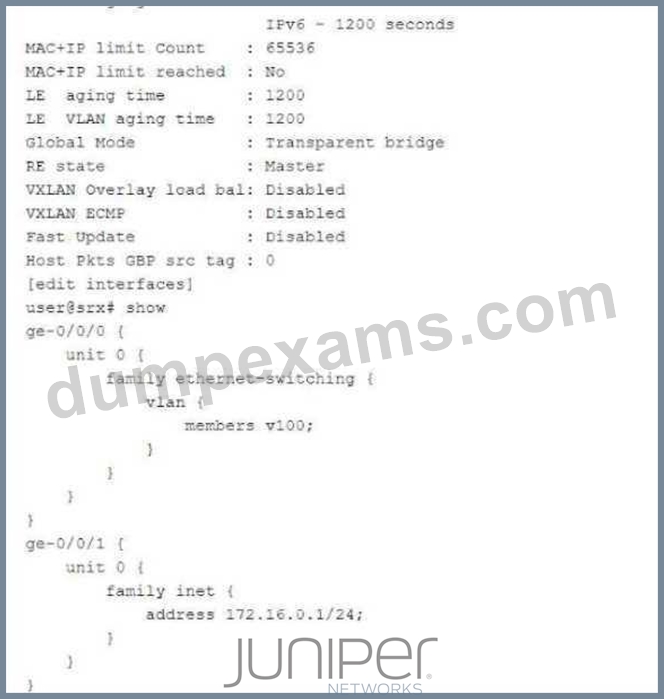
In which mode is the SRX Series device?
- A. Packet
- B. Transparent
- C. Mixed
- D. Ethernet switching
Answer: C
NEW QUESTION # 56
In Juniper ATP Cloud, what are two different actions available in a threat prevention policy to deal with an infected host? (Choose two.)
- A. Send a custom message
- B. Close the connection.
- C. Quarantine the host.
- D. Drop the connection silently.
Answer: B,D
NEW QUESTION # 57
Exhibit: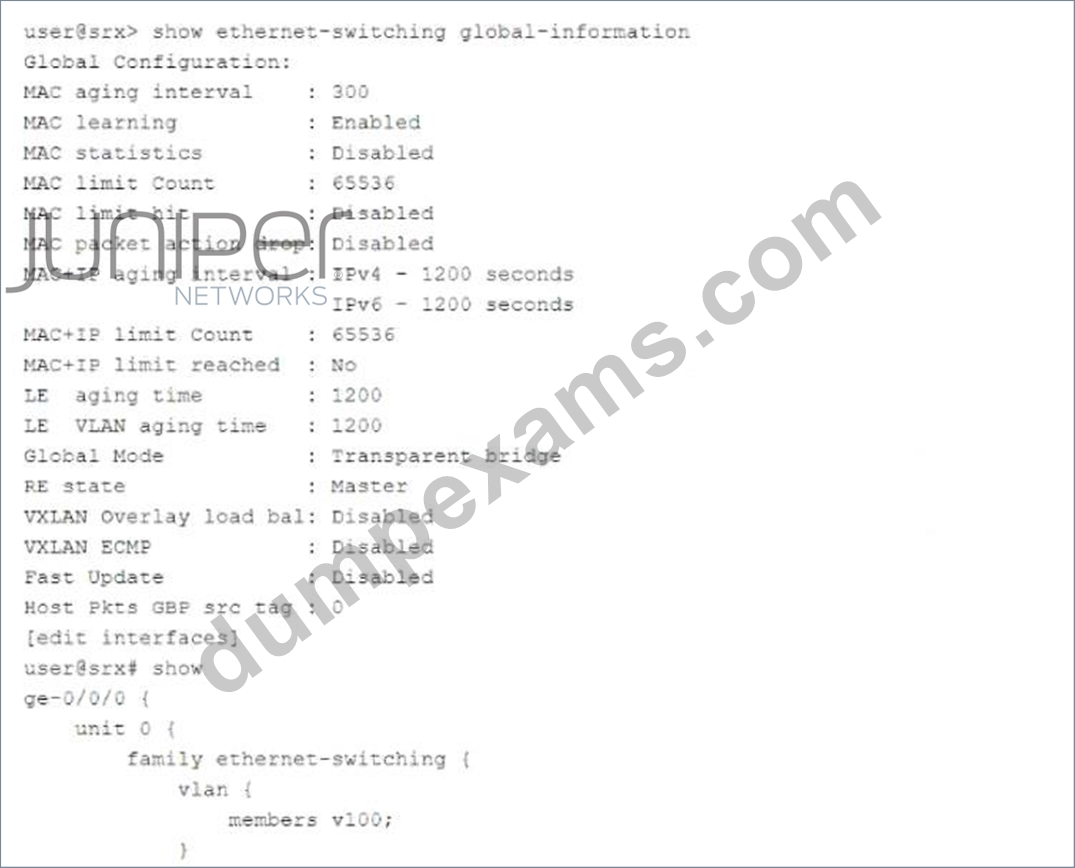
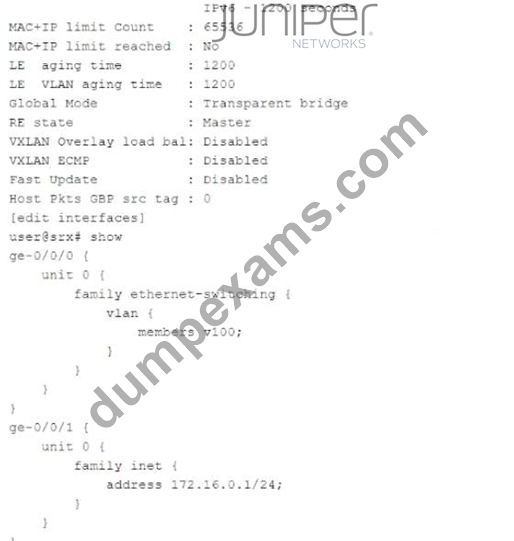
In which mode is the SRX Series device?
- A. Packet
- B. Transparent
- C. Mixed
- D. Ethernet switching
Answer: C
NEW QUESTION # 58
Exhibit
You configure Source NAT using a pool of addresses that are in the same subnet range as the external ge-0/0/0 interface on your vSRX device. Traffic that is exiting the internal network can reach external destinations, but the return traffic is being dropped by the service provider router.
Referring to the exhibit, what must be enabled on the vSRX device to solve this problem?
- A. DNS Doctoring
- B. STUN
- C. Proxy ARP
- D. Persistent NAT
Answer: A
NEW QUESTION # 59
A company has acquired a new branch office that has the same address space of one of its local networks, 192.168.100/24. The offices need to communicate with each other. Which two NAT configurations will satisfy this requirement? (Choose two.)
- A. [edit security nat static]
user@OfficeA# show rule-set From-Office-B {
from interface ge-0/0/0.0;
rule 1 {
match {
destination-address 192.168.200.0/24;
}
then {
static-nat {
prefix 192.168.100.0/24;
}
}
}
} - B. [edit security nat source]
user@OfficeA# show rule-set OfficeBtoA {
from zone OfficeB;
to zone OfficeA;
rule 1 {
match {
source-address 192.168.210.0/24;
destination-address 192.168.200.0/24;
}
then {
source-nat {
interface;
}
}
}
} - C. [edit security nat static]
user@OfficeB# show rule-set From-Office-A {
from interface ge-0/0/0.0;
rule 1 {
match {
destination-address 192.168.210.0/24;
}
then {
static-nat {
prefix 192.168.100.0/24;
}
}
}
} - D. [edit security nat source]
user@OfficeB# show rule-set OfficeAtoB {
from zone OfficeA;
to zone OfficeB;
rule 1 {
match {
source-address 192.168.200.0/24;
destination-address 192.168.210.0/24;
}
then {
source-nat {
interface;
}
}
}
}
Answer: B,D
Explanation:
The problem describes two offices needing to communicate, but both share the same IP address space, 192.168.100.0/24. To resolve this, NAT must be configured to translate the conflicting address spaces on each side. Here's how each of the configurations works:
Option A (Correct):
This source NAT rule translates the source address of traffic from Office B to Office A. By configuring source NAT, the source IP addresses from Office B (192.168.210.0/24) will be translated when communicating with Office A (192.168.200.0/24). This method ensures that there is no overlap in address space when packets are transmitted between the two offices.
Option D (Correct):
This is a source NAT rule configured on Office B, which translates the source addresses from Office A to prevent address conflicts. It ensures that when traffic is initiated from Office A to Office B, the overlapping address range (192.168.100.0/24) is translated.
NEW QUESTION # 60
You are using trace options to troubleshoot a security policy on your SRX Series device.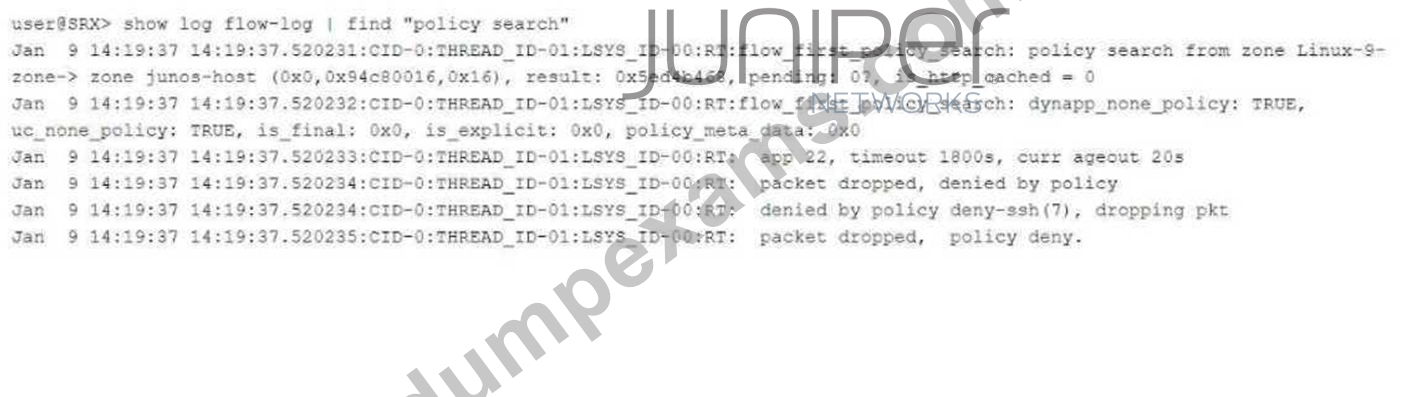
Referring to the exhibit, which two statements are true? (Choose two.)
- A. The security policy controls traffic destined to the SRX device.
- B. The traffic is not destined for the root logical system.
- C. The SSH traffic matches an existing session.
- D. No entries are created in the SRX session table.
Answer: A,C
NEW QUESTION # 61
Which two types of source NAT translations are supported in this scenario? (Choose two.)
- A. translation of IPv4 hosts to IPv6 hosts with or without port address translation
- B. translation of one IPv6 subnet to another IPv6 subnet with port address translation
- C. translation of one IPv6 subnet to another IPv6 subnet without port address translation
- D. translation of one IPv4 subnet to one IPv6 subnet with port address translation
Answer: A,D
NEW QUESTION # 62
You issue the command shown in the exhibit.
Which policy will be active for the identified traffic?
- A. Policy p7
- B. Policy p12
- C. Policy p1
- D. Policy p4
Answer: A
NEW QUESTION # 63
Exhibit: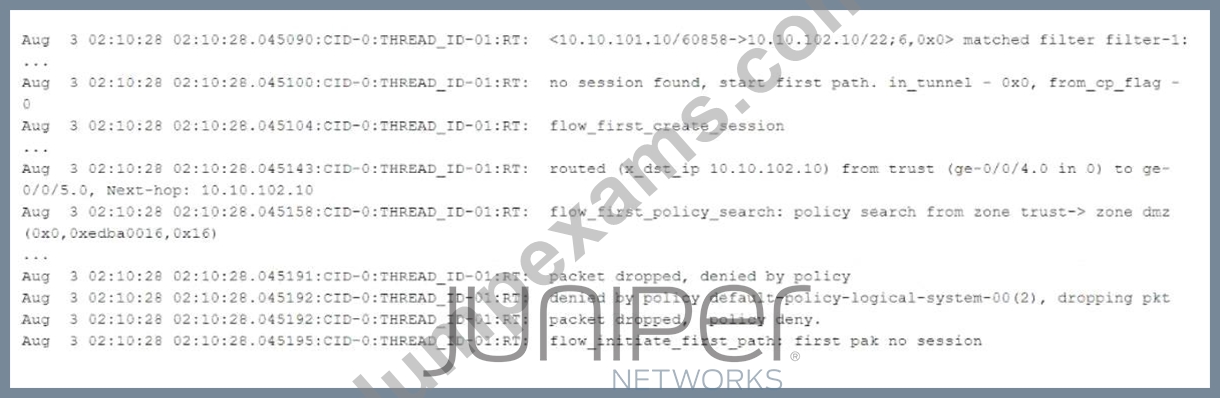
Referring to the flow logs exhibit, which two statements are correct? (Choose two.)
- A. The data shown requires a traceoptions flag of basic-datapath.
- B. The packet is dropped by the default security policy.
- C. The packet is dropped by a configured security policy.
- D. The data shown requires a traceoptions flag of host-traffic.
Answer: A,B
Explanation:
* Understanding the Flow Log Output:
From the flow logs in the exhibit, we can observe the following key events:
* The session creation was initiated (flow_first_create_session), but the policy searchfailed (flow_first_policy_search), which implies that no matching policy was found between the zones involved (zone trust-> zone dmz).
* The packet was dropped with the reason "denied by policy." This shows that the packet was dropped either due to no matching security policy or because the default policy denies the traffic (packet dropped, denied by policy).
* The line denied by policy default-policy-logical-system-00(2) indicates that the default security policy is responsible for denying the traffic, confirming that no explicit security policy was configured to allow this traffic.
* Explanation of Answer A (Dropped by the default security policy):
The log message clearly states that the packet was dropped by the default security policy (default-policy- logical-system-00). In Junos, when a session is attempted between two zones and no explicit policy exists to allow the traffic, the default policy is to deny the traffic. This is a common behavior in Junos OS when a security policy does not explicitly allow traffic between zones.
* Explanation of Answer D (Requires traceoptions flag of basic-datapath):
The information displayed in the log involves session creation, flow policy search, and packet dropping due to policy violations, which are all part of basic packet processing in the data path. This type of information is logged when the traceoptions flag is set tobasic-datapath. The basic-datapath traceoption provides detailed information about the forwarding process, including policy lookups and packet drops, which is precisely what we see in the exhibit.
* The traceoptions flaghost-traffic(Answer C) is incorrect because host-traffic is typically used for traffic destined to or generated from the Junos device itself (e.g., SSH or SNMP traffic to the SRX device), not for traffic passing through the device.
* To capture flow processing details like those shown, you need the basic-datapath traceoptions flag, which provides details about packet forwarding and policy evaluation.
Step-by-Step Configuration for Tracing (Basic-Datapath):
* Enable flow traceoptions:
To capture detailed information about how traffic is being processed, including policy lookups and flow session creation, enable traceoptions for the flow.
bash
Copy code
set security flow traceoptions file flow-log
set security flow traceoptions flag basic-datapath
* Apply the configuration and commit:
bash
Copy code
commit
* View the logs:
Once enabled, you can check the trace logs for packet flows, policy lookups, and session creation details:
bash
Copy code
show log flow-log
This log will contain information similar to the exhibit, including session creation attempts and packet drops due to security policy.
Juniper Security Reference:
* Default Security Policies: Juniper SRX devices have a default security policy to deny all traffic that is not explicitly allowed by user-defined policies. This is essential for security best practices. Reference:
Juniper Networks Documentation on Security Policies.
* Traceoptions for Debugging Flows: Using traceoptions is crucial for debugging and understanding how traffic is handled by the SRX, particularly when issues arise from policy misconfigurations or routing. Reference: Juniper Traceoptions.
By using the basic-datapath traceoptions, you can gain insights into how the device processes traffic, including policy lookups, route lookups, and packet drops, as demonstrated in the exhibit.
NEW QUESTION # 64
You are asked to establish a hub-and-spoke IPsec VPN using an SRX Series device as the hub.
All of the spoke devices are third-party devices.
Which statement is correct in this scenario?
- A. You must create a policy-based VPN on the hub device when peering with third-party devices.
- B. You must statically configure the next-hop tunnel binding table entries for each of the third-party spoke devices.
- C. You must always peer using loopback addresses when using non-Junos devices as your spokes.
- D. You must ensure that you are using aggressive mode when incorporating third-party devices as your spokes.
Answer: B
NEW QUESTION # 65
Exhibit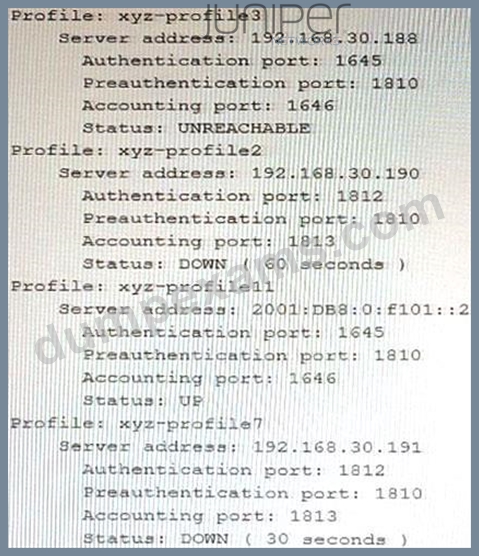
The show network-access aaa radius-servers command has been issued to solve authentication issues.
Referring to the exhibit, to which two authentication servers will the SRX Series device continue to send requests? (Choose TWO)
- A. 192.168.30.190
- B. 192.168.30.188
- C. 200l:DB8:0:f101;:2
- D. 192.168.30.191
Answer: B,D
NEW QUESTION # 66
Click the Exhibit button.
When attempting to enroll an SRX Series device to JATP, you receive the error shown in the exhibit.
What is the cause of the error?
- A. A firewall is blocking HTTPS on fxp0
- B. The SRX Series device does not have an IP address assigned to the interface that accesses JATP
- C. The SRX Series device certificate does not match the JATP certificate
- D. The fxp0 IP address is not routable
Answer: B
Explanation:
Reference:
https://kb.juniper.net/InfoCenter/index?page=content&id=KB33979&cat=JATP_SERIES&actp=LIST
NEW QUESTION # 67
Exhibit: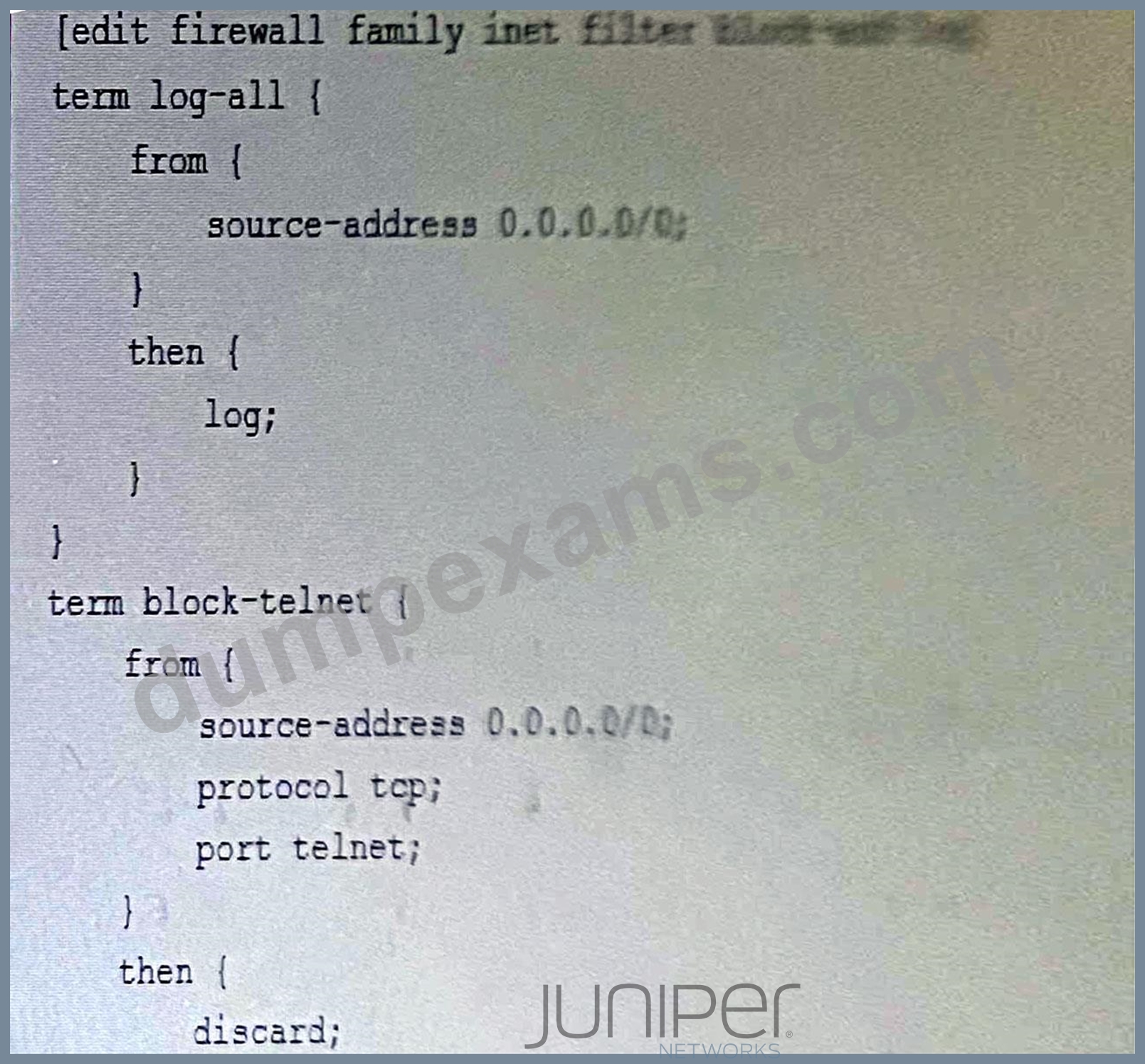
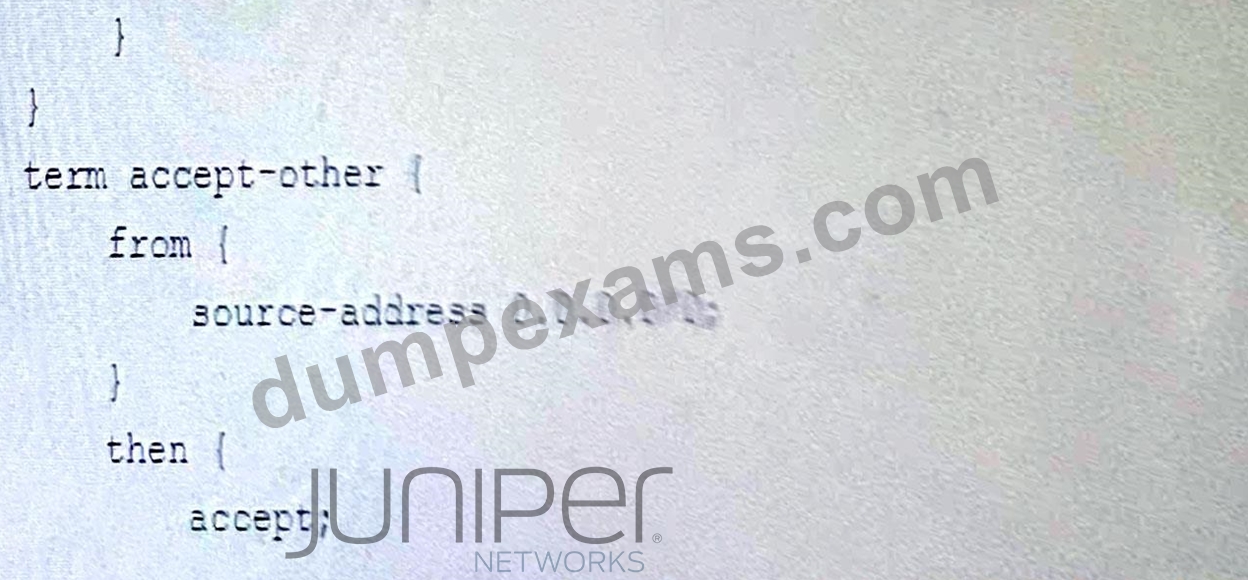
You are troubleshooting a firewall filter shown in the exhibit that is intended to log all traffic and block only inbound telnet traffic on interface ge-0/0/3.
How should you modify the configuration to fulfill the requirements?
- A. Apply a firewall filter to the loopback interface that blocks Telnet traffic
- B. Add a term before the log-all term that blocks Telnet
- C. Delete the log-all term
- D. Modify the log-all term to add the next term action
Answer: D
Explanation:
To modify the configuration to fulfill the requirements, you need to modify the log-all term to add the next term action.
The other options are incorrect because:
B) Deleting the log-all term would prevent logging all traffic, which is one of the requirements. The log-all term matches all traffic from any source address and logs it to the system log file1.
C) Adding a term before the log-all term that blocks Telnet would also prevent logging all traffic, because the log-all term would never be reached. The firewall filter evaluates the terms in sequential order and applies the first matching term. If a term before the log-all term blocks Telnet, then the log-all term would not match any traffic and no logging would occur2.
D) Applying a firewall filter to the loopback interface that blocks Telnet traffic would not block inbound Telnet traffic on interface ge-0/0/3, which is another requirement. The loopback interface is a logical interface that is always up and reachable. It is used for routing and management purposes, not for filtering traffic on physical interfaces3.
Therefore, the correct answer is A. You need to modify the log-all term to add the next term action. The next term action instructs the firewall filter to continue evaluating the subsequent terms after matching the current term. This way, the log-all term would log all traffic and then proceed to the block-telnet term, which would block only inbound Telnet traffic on interface ge-0/0/34. To modify the log-all term to add the next term action, you need to perform the following steps:
Enter the configuration mode: user@host> configure
Navigate to the firewall filter hierarchy: user@host# edit firewall family inet filter block-telnet Add the next term action to the log-all term: user@host# set term log-all then next term Commit the changes: user@host# commit Reference: log (Firewall Filter Action) Firewall Filter Configuration Overview loopback (Interfaces) next term (Firewall Filter Action)
NEW QUESTION # 68
Which two statements about transparent mode and Ethernet switching mode on an SRX series device are correct.
- A. In transparent mode, Layer 2 interfaces must be placed in a security zone.
- B. In Ethernet switching mode, Layer 2 interfaces must be placed in a security zone.
- C. In Ethernet switching mode, IRB interfaces must be placed in a security zone.
- D. In transparent mode, IRB interfaces must be placed in a security zone.
Answer: A,C
NEW QUESTION # 69
Exhibit: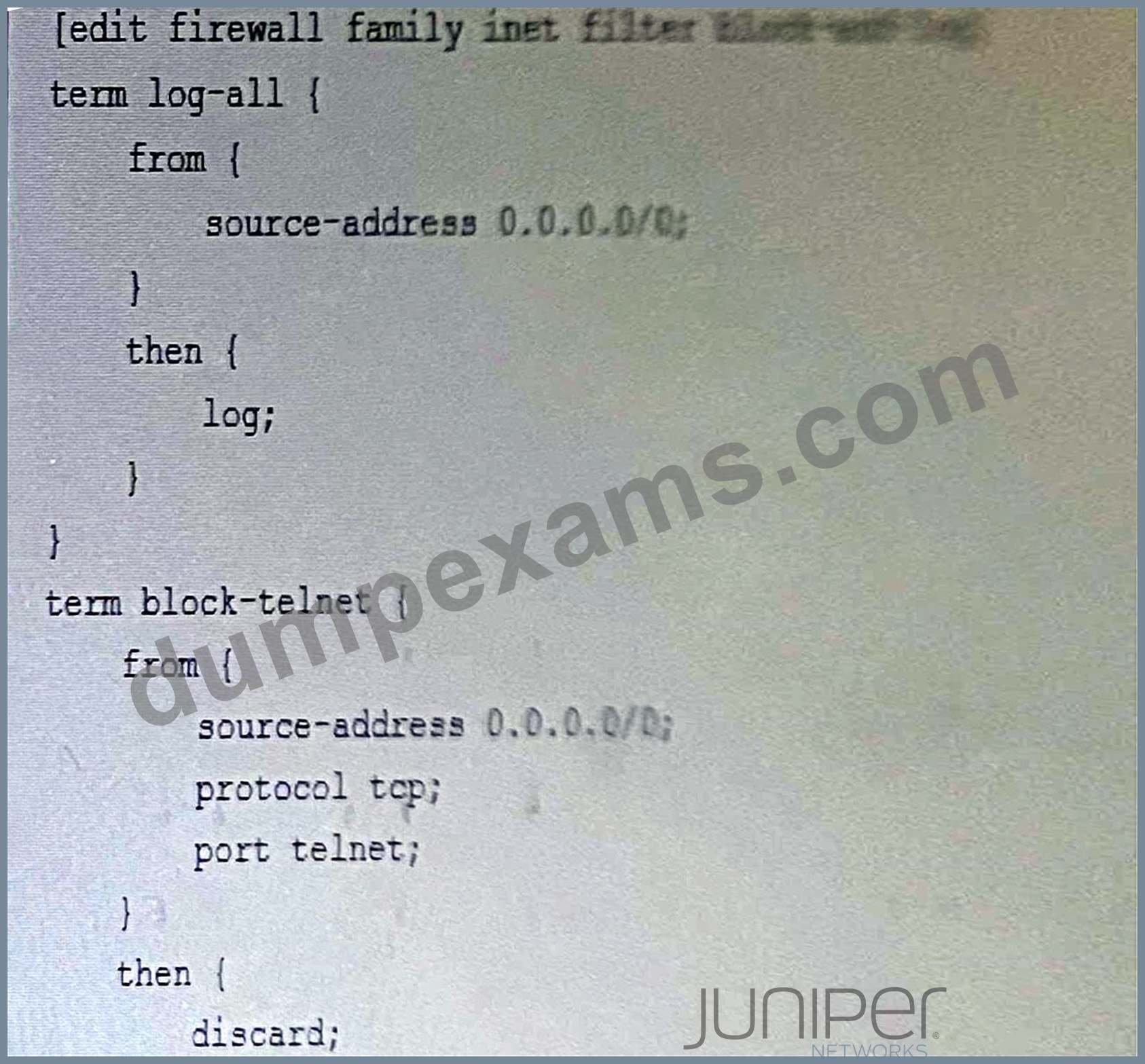
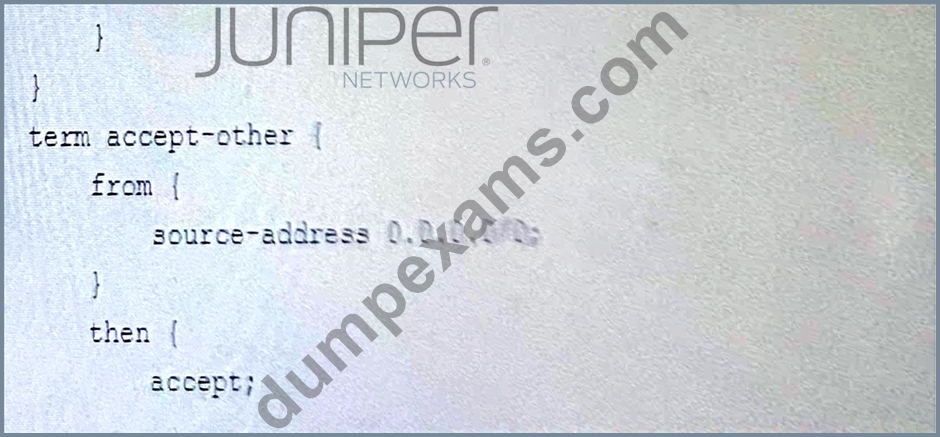
You are troubleshooting a firewall filter shown in the exhibit that is intended to log all traffic and block only inbound telnet traffic on interface ge-0/0/3.
How should you modify the configuration to fulfill the requirements?
- A. Apply a firewall filter to the loopback interface that blocks Telnet traffic
- B. Add a term before the log-all term that blocks Telnet
- C. Delete the log-all term
- D. Modify the log-all term to add the next term action
Answer: D
Explanation:
To modify the configuration to fulfill the requirements, you need to modify the log-all term to add the next term action.
The other options are incorrect because:
B) Deleting the log-all term would prevent logging all traffic, which is one of the requirements. The log-all term matches all traffic from any source address and logs it to the system log file1.
C) Adding a term before the log-all term that blocks Telnet would also prevent logging all traffic, because the log-all term would never be reached. The firewall filter evaluates the terms in sequential order and applies the first matching term. If a term before the log-all term blocks Telnet, then the log-all term would not match any traffic and no logging would occur2.
D) Applying a firewall filter to the loopback interface that blocks Telnet traffic would not block inbound Telnet traffic on interface ge-0/0/3, which is another requirement. The loopback interface is a logical interface that is always up and reachable. It is used for routing and management purposes, not for filtering traffic on physical interfaces3.
Therefore, the correct answer is A. You need to modify the log-all term to add the next term action. The next term action instructs the firewall filter to continue evaluating the subsequent terms after matching the current term. This way, the log-all term would log all traffic and then proceed to the block-telnet term, which would block only inbound Telnet traffic on interface ge-0/0/34. To modify the log-all term to add the next term action, you need to perform the following steps:
Enter the configuration mode: user@host> configure
Navigate to the firewall filter hierarchy: user@host# edit firewall family inet filter block-telnet Add the next term action to the log-all term: user@host# set term log-all then next term Commit the changes: user@host# commit Reference: log (Firewall Filter Action) Firewall Filter Configuration Overview loopback (Interfaces) next term (Firewall Filter Action)
NEW QUESTION # 70
You have cloud deployments in Azure, AWS, and your private cloud. You have deployed multicloud using security director with policy enforcer to. Which three statements are true in this scenario? (Choose three.)
- A. You can run Juniper ATP scans only on traffic from your private cloud.
- B. You can run Juniper ATP scans for all three domains.
- C. The Policy Enforcer is able to flag infected hosts in all three domains.
- D. You can simultaneously manage the security policies in all three domains.
- E. You must secure the policies individually by domain.
Answer: B,C,D
NEW QUESTION # 71
Click the Exhibit button.
Referring to the exhibit, which two statements are true? (Choose two.)
- A. The traffic is denied.
- B. The traffic was initiated by the 10.10.102.10 address.
- C. The destination device is not responding.
- D. The traffic is permitted.
Answer: C,D
Explanation:
Comprehensive Detailed Step-by-Step Explanation with All Juniper Security References Understanding the Session Output:
* Session State: Valid
* Indicates that the session is active and permitted by security policies.
* Policy Name: L1-to-L9/11
* Shows the policy that allowed the session.
* In Direction:
* Source: 10.10.101.10
* Destination: 10.10.102.10
* Packets: 1
* Bytes: 84
* Out Direction:
* Packets: 0
* Bytes: 0
* Indicates no return traffic.
Option A: The traffic is permitted.
* Explanation:
* The session state is Valid, and a policy name is specified.
* This means the SRX device allowed the traffic.
NEW QUESTION # 72
Referring to the exhibit,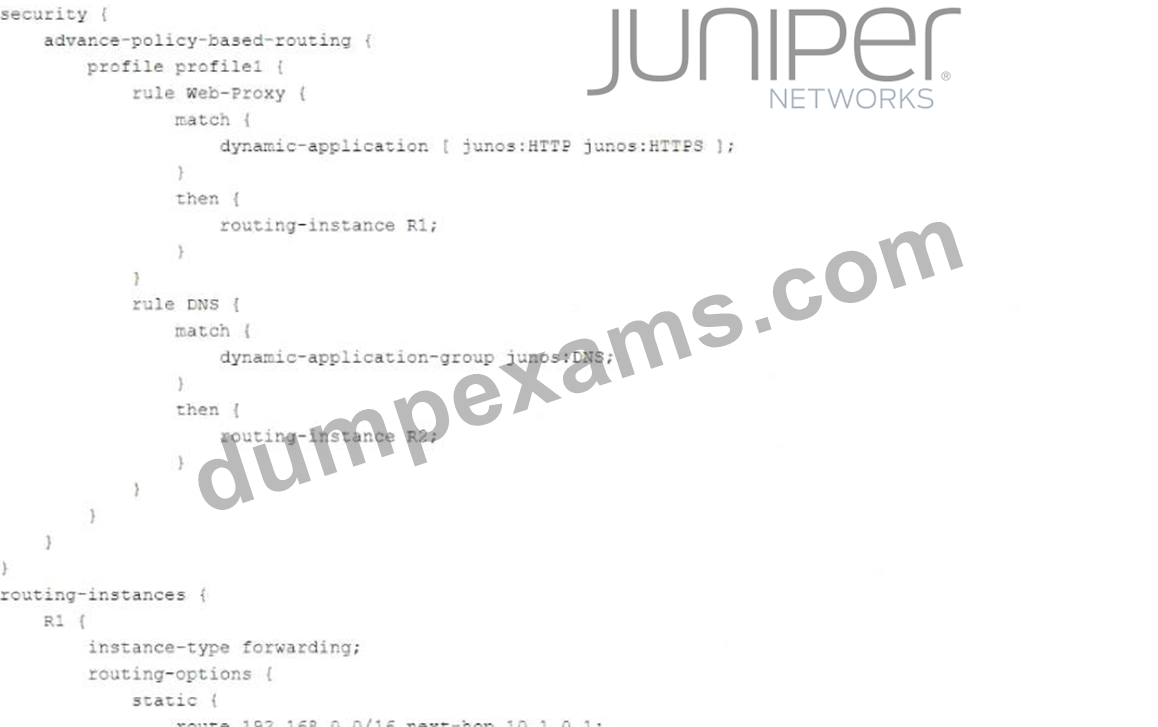
which statement about TLS 1.2 traffic is correct?
- A. TLS 1.2 traffic will be sent to routing instance R1 but not forwarded to the next hop.
- B. TLS 1.2 traffic will be sent to routing instance R1 and forwarded to next hop 10.1.0.1.
- C. TLS 1.2 traffic will be sent to routing instance R2 but not forwarded to the next hop.
- D. TLS 1.2 traffic will be sent to routing instance R2 and forwarded to next hop 10.2.0.1.
Answer: B
Explanation:
The configuration in the exhibit shows an advanced-policy-based-routing (APBR) profile that directs traffic based on application type. Specifically:
* Rule Web-ProxymatchesHTTP and HTTPS (TLS 1.2)traffic and forwards it torouting instance R1.
* The routing-instance R1 has a static route to send traffic to the next hop10.1.0.1.
Given this configuration, TLS 1.2 traffic, which is part of the HTTPS category, will be sent to routing instance R1 and then forwarded to the next hop IP address10.1.0.1.
NEW QUESTION # 73
You are deploying a large-scale VPN spanning six sites. You need to choose a VPN technology that satisfies the following requirements:
All sites must have secure reachability to all other sites. New spoke sites can be added without explicit configuration on the hub site. All spoke-to-spoke communication must traverse the hub site.
Which VPN technology will satisfy these requirements?
- A. AutoVPN
- B. Secure Connect VPN
- C. Group VPN
- D. ADVPN
Answer: A
Explanation:
AutoVPN simplifies deployment by dynamically establishing tunnels from spokes to the hub. This architecture supports easy scaling with minimal configuration changes, ensuring spoke-to-spoke traffic flows through the hub. For more information, see Juniper AutoVPN Overview.
In this scenario, you need a VPN solution that ensures secure, dynamic connectivity between multiple sites, with the following conditions:
All sites must have secure reachability.
New spoke sites can be added without explicit configuration on the hub site.
Spoke-to-spoke communication must traverse the hub.
The correct technology to meet these requirements is AutoVPN. It simplifies VPN configurations by automating the setup between hub and spoke sites. Additionally, AutoVPN automatically establishes secure tunnels for new spoke sites without requiring manual configuration at the hub, and all spoke- to-spoke traffic is routed through the hub.
NEW QUESTION # 74
You are required to deploy a security policy on an SRX Series device that blocks all known Tor network IP addresses.
Which two steps will fulfill this requirement? (Choose two.)
- A. Enroll the devices with Juniper ATP Cloud.
- B. Create a custom feed containing all current known MAC addresses.
- C. Enroll the devices with Juniper ATP Appliance.
- D. Enable a third-party Tor feed.
Answer: C,D
NEW QUESTION # 75
You have an initial setup of ADVPN with two spokes and a hub. A host at partner Spoke-1 is sending traffic to a host at partner Spoke-2.
In this scenario, which statement is true?
- A. Spoke-1 will send the traffic through the hub and not use a direct VPN to Spoke-2.
- B. Spoke-1 will establish the tunnel to Spoke-2 before sending any of the host traffic.
- C. Spoke-1 will send the traffic destined to Spoke-2 through the hub until the VPN is established between the spokes.
- D. Spoke-1 will establish a VPN to Spoke-2 when this is first deployed, so traffic will be sent immediately to Spoke-2.
Answer: D
NEW QUESTION # 76
Exhibit: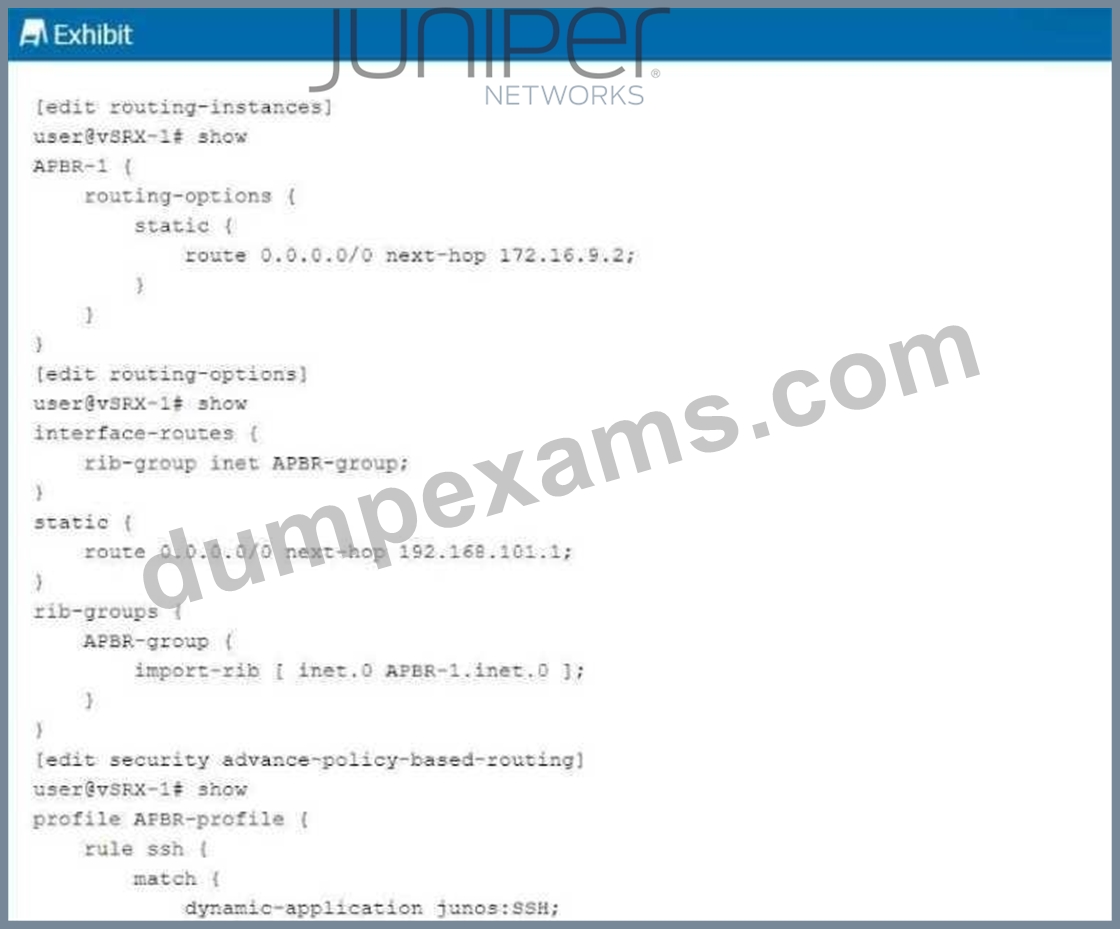
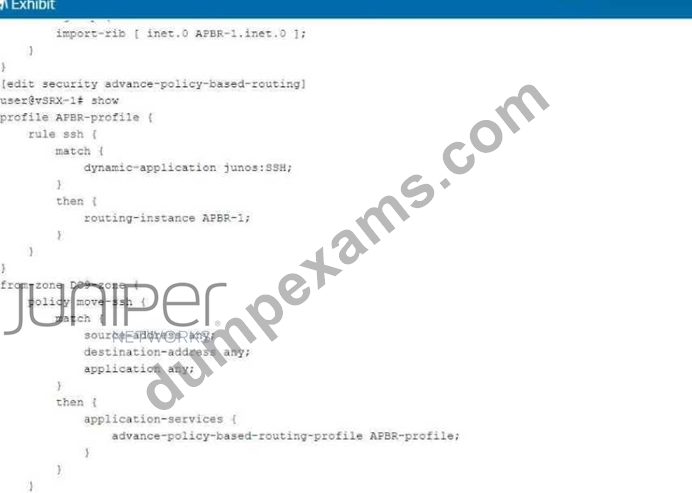
You are having problems configuring advanced policy-based routing.
What should you do to solve the problem?
- A. Change the routing instance to a virtual router instance.
- B. Change the routing instance to a forwarding instance.
- C. Apply a policy to the APBR RIB group to only allow the exact routes you need.
- D. Remove the default static route from the main instance configuration.
Answer: B
NEW QUESTION # 77
You have deployed a new site as shown in the exhibit. Hosts in the 10.10.10.0/24 network must access the DB1 server. The DB1 server must also have internet access the DB1 server encrypted.
Which two configuration statements will be required as part of the configuration on SRX1 to satisfy this requirement? (Choose two)
- A. set protocols 12-learning global mode transparent-bridge
- B. set security macsec interfaces ge-0/0/1 connectivity association access-sw
- C. set security macsec connectivity-association access-sw security-mode static-cak
- D. set security forwarding-options secure-wire access-sw interface ge-0/0/1.0
Answer: B,C
NEW QUESTION # 78
......
Authentic JN0-637 Dumps With 100% Passing Rate Practice Tests Dumps: https://passleader.dumpexams.com/JN0-637-vce-torrent.html