


[Jul 12, 2025] Latest 300-730 PDF Dumps & Real Tests Free Updated Today
300-730 Dumps With 100% Verified Q&As - Pass Guarantee or Full Refund
To pass the Cisco 300-730 certification exam, candidates must have a deep understanding of VPN technologies, including IPsec, SSL, and AnyConnect. They must also be familiar with VPN configuration and management tools such as Cisco Adaptive Security Appliance (ASA), Cisco Firepower Threat Defense (FTD), and Cisco AnyConnect Secure Mobility Client. 300-730 exam also covers best practices for VPN deployment, including VPN tunneling, VPN authentication, and VPN troubleshooting.
The Cisco 300-730 SVPN exam assesses the competence and skills of the specialists in applying secure remote communications utilizing Virtual Private Network solutions. These include secure communications, troubleshooting, and architectures. This test is part of the requirements for obtaining the CCNP Security certification. Moreover, the professionals who pass this exam will also get the Cisco Certified Specialist – Network Security VPN Implementation certificate.
NEW QUESTION # 128
What are two variables for configuring clientless SSL VPN single sign-on? (Choose two.)
- A. CSCO_WEBVPN_INTERNAL_PASSWORD
- B. CSCO_WEBVPN_RADIUS_USER
- C. CSCO_WEBVPN_OTP_PASSWORD
- D. CSCO_WEBVPN_USERNAME
Answer: A,D
NEW QUESTION # 129
While troubleshooting, an engineer finds that the show crypto isakmp sa command indicates that the last state of the tunnel is MM_KEY_EXCH. What is the next step that should be taken to resolve this issue?
- A. Confirm that the pre-shared keys match on both devices.
- B. Correct the peer's IP address on the crypto map.
- C. Verify that the ISAKMP proposals match.
- D. Ensure that UDP 500 is not being blocked between the devices.
Answer: B
NEW QUESTION # 130
Refer to the exhibit.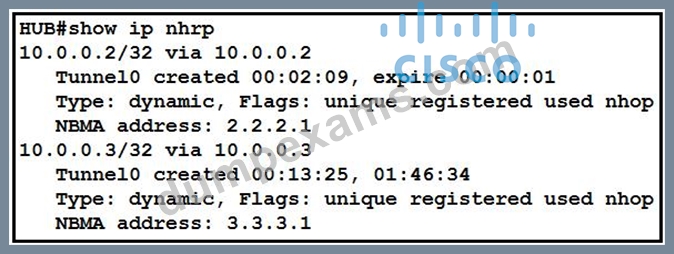
The DMVPN tunnel is dropping randomly and no tunnel protection is configured. Which spoke configuration mitigates tunnel drops?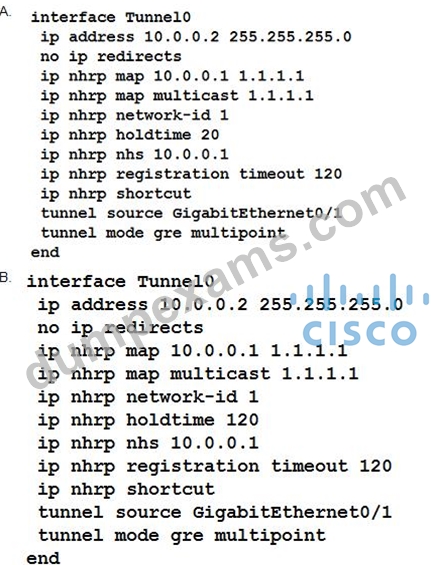
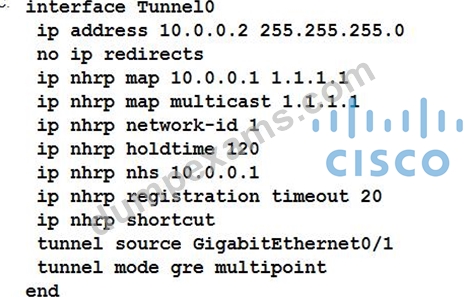
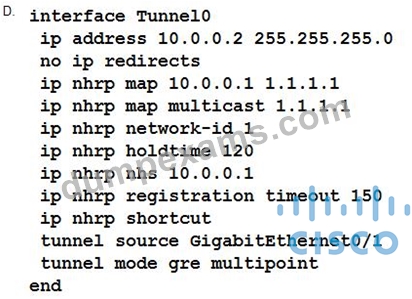
- A. Option C
- B. Option D
- C. Option A
- D. Option B
Answer: A
Explanation:
https://www.globalknowledge.com/us-en/resources/resource-library/articles/understanding-next-hop-resolution-protocol-commands/
NEW QUESTION # 131
Refer to the exhibit.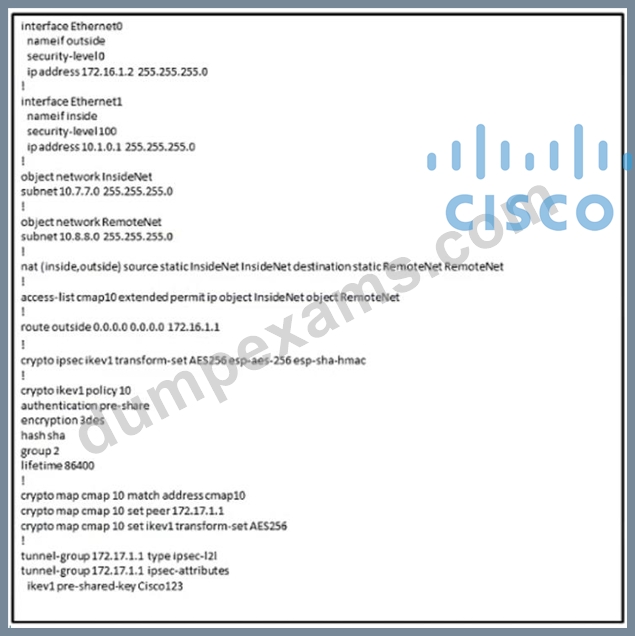
An engineer is building an IKEv1 tunnel to a peer Cisco ASA, but the tunnel is failing. Based on the configuration in the exhibit, which action must be taken to allow the VPN tunnel to come up?
- A. Enable IKEv1 on the outside interface.
- B. Add a route for the 10.7.7.0/24 network to egress the outside interface.
- C. Change the transform set mode to transport.
- D. Change the IKEv1 policy number to be at least 256.
Answer: A
NEW QUESTION # 132
Which two statements about the Cisco ASA Clientless SSL VPN solution are true? (Choose two.)
- A. When a client connects to the Cisco ASA WebVPN portal and tries to access HTTP resources through the URL bar, the client uses the local DNS to perform FQDN resolution.
- B. A Cisco ASA can simultaneously allow Clientless SSL VPN sessions and AnyConnect client sessions.
- C. When a client connects to the Cisco ASA WebVPN portal and tries to access HTTP resources through the URL bar, the ASA uses its configured DNS servers to perform FQDN resolution.
- D. The rewriter enable command under the global webvpn configuration enables the rewriter functionality because that feature is disabled by default.
- E. Clientless SSLVPN provides Layer 3 connectivity into the secured network.
Answer: B,C
NEW QUESTION # 133
A network engineer must implement an SSLVPN Cisco AnyConnect solution that supports 500 concurrent users, ensures all traffic from the client passes through the ASA, and allows users to access all devices on the inside interface subnet (192.168.0.0/24). Assuming all other configuration is set up appropriately, which configuration implements this solution?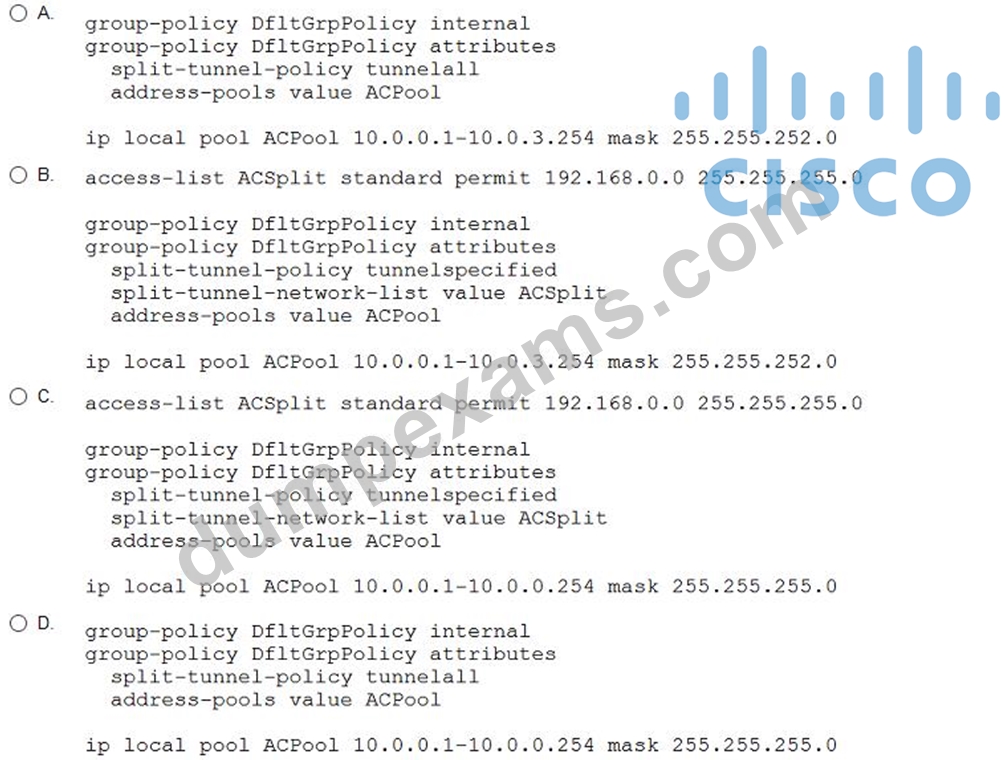
- A. Option D
- B. Option A
- C. Option C
- D. Option B
Answer: B
NEW QUESTION # 134
Over which two transport mediums is FlexVPN deployed? (Choose two.)
- A. DWDM
- B. MPLS
- C. VPLS
- D. internet
- E. 5G
Answer: B,D
Explanation:
Transport network: FlexVPN can be deployed either over a public internet or a private Multiprotocol Label Switching (MPLS) VPN network.
https://www.cisco.com/c/en/us/products/collateral/routers/asr-1000-series-aggregation-services- routers/data_sheet_c78-704277.html
NEW QUESTION # 135
A second set of traffic selectors is negotiated between two peers using IKEv2. Which IKEv2 packet will contain details of the exchange?
- A. IKEv2 IKE_AUTH
- B. IKEv2 INFORMATIONAL
- C. IKEv2 IKE_SA_INIT
- D. IKEv2 CREATE_CHILD_SA
Answer: B
NEW QUESTION # 136
Refer to the exhibit.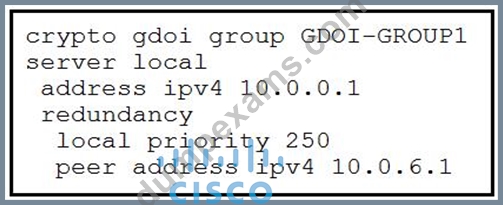
Which type of VPN is being configured, based on the partial configuration snippet?
- A. GET VPN with dual group member
- B. FlexVPN load balancer
- C. GET VPN with COOP key server
- D. FlexVPN backup gateway
Answer: C
NEW QUESTION # 137
Refer to the exhibit. The DMVPN spoke is not establishing a session with the hub. Which two actions resolve this issue? (Choose two.)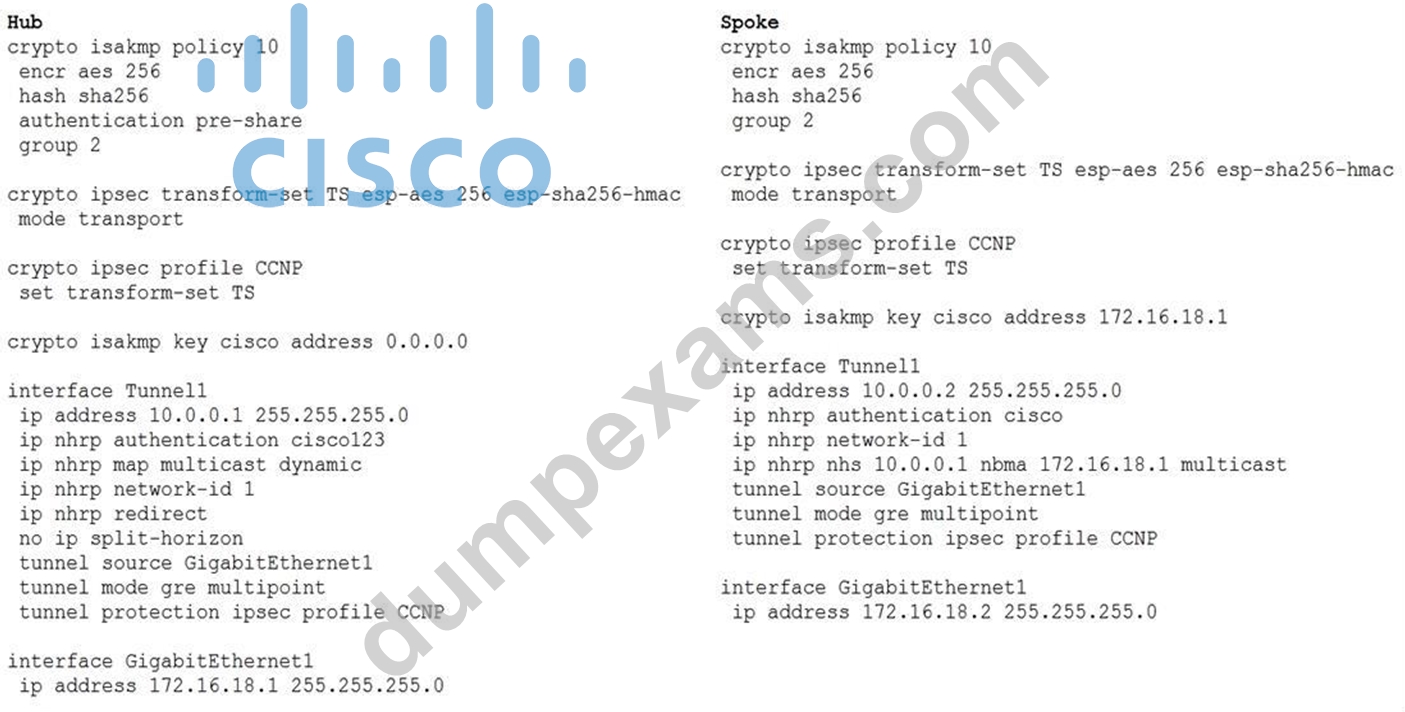
- A. Change the spoke nhs to 172.16.18.1 and the nbma to 10.0.0.1.
- B. Change the transform set to mode tunnel.
- C. Change the ISAKMP policy authentication on the spoke to pre-shared.
- D. Change the ISAKMP key address on the spoke to 0.0.0.0.
- E. Change the nhrp authentication key on the spoke to cisco123.
Answer: C,E
NEW QUESTION # 138
Which method dynamically installs the network routes for remote tunnel endpoints?
- A. policy-based routing
- B. route filtering
- C. CEF
- D. reverse route injection
Answer: D
NEW QUESTION # 139
Which technology is used to send multicast traffic over a site-to-site VPN?
- A. GRE tunnel on ASA
- B. IPsec tunnel on FTD
- C. GRE over IPsec on IOS router
- D. GRE over IPsec on FTD
Answer: C
Explanation:
https://www.cisco.com/c/en/us/support/docs/security-vpn/ipsec-negotiation-ike-protocols/216276-configure-route-based-site-to-site-vpn-t.html#anc6
NEW QUESTION # 140
Refer to the exhibit.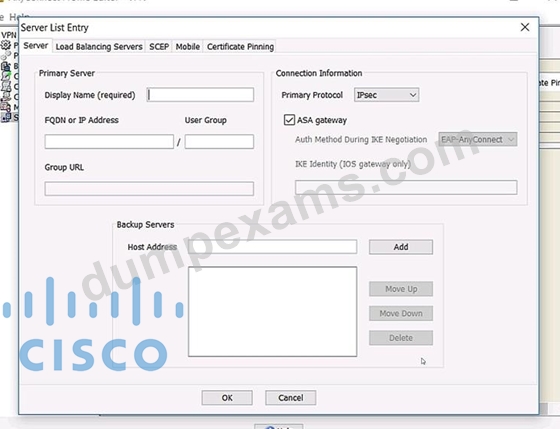
Which value must be configured in the User Group field when the Cisco AnyConnect Profile is created to connect to an ASA headend with IPsec as the primary protocol?
- A. group-policy
- B. tunnel-group
- C. group-alias
- D. address-pool
Answer: B
Explanation:
The user group is used in conjunction with Host Address to form a group-based URL. If you specify the Primary Protocol as IPsec, the User Group must be the exact name of the connection profile (tunnel group). For SSL, the user group is the group-url of the connection profile. https://www.cisco.com/c/en/us/td/docs/security/vpn_client/anyconnect/anyconnect40/administration/guide/b_AnyConnect_Administrator_Guide_4-0/anyconnect-profile-editor.html#ID-1430-0000026c
NEW QUESTION # 141
Refer to the exhibit. A customer has a DMVPN establishment problem between a hub and a spoke router. To troubleshoot this problem, the network administrator checks the traffic counters of the tunnel and notices that return traffic is not coming back from the other end of the tunnel.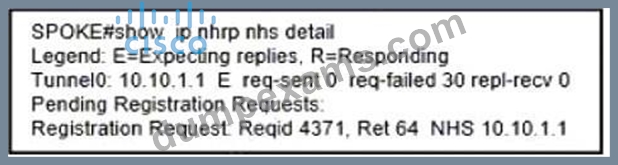
Which solution must be applied on the spoke router?
- A. Replace the network-id.
- B. Configure the correct NHS.
- C. Implement the NHRP shortcut.
- D. Make the tunnel source and destination reachable.
Answer: B
Explanation:
The output from the show ip nhrp nhs detail command on the spoke router indicates that the Next Hop Server (NHS) registration requests are failing (req-failed 30 repl-recv 0). This suggests that the spoke cannot successfully register with the hub, which is a requirement for DMVPN (Dynamic Multipoint VPN) to function correctly.
To resolve this issue, ensure that the correct NHS (Next Hop Server) is configured on the spoke router using the correct IP address of the hub.
NEW QUESTION # 142
Refer to the exhibit.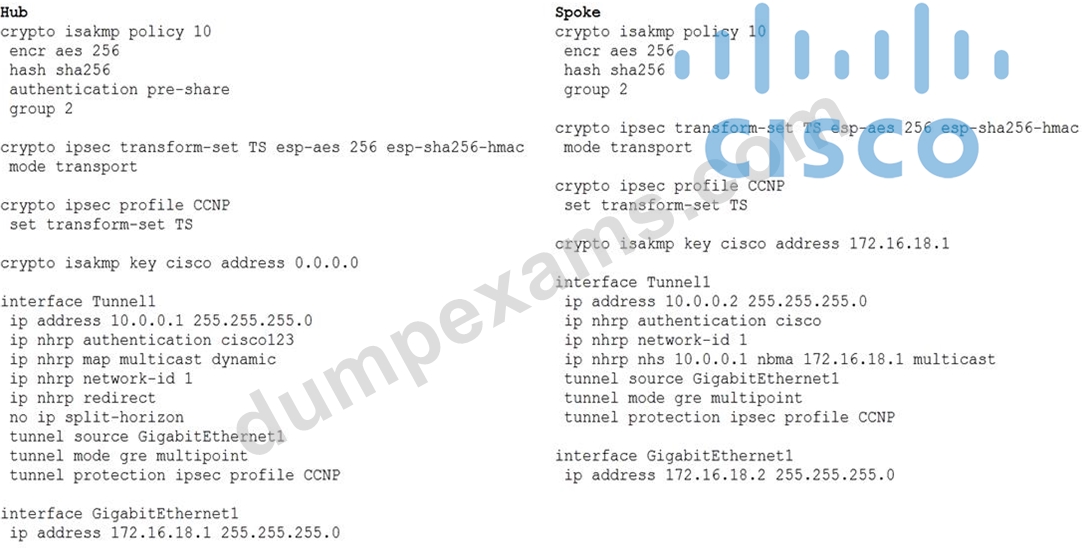
The DMVPN spoke is not establishing a session with the hub. Which two actions resolve this issue? (Choose two.)
- A. Change the ISAKMP key address on the spoke to 0.0.0.0.
- B. Change the spoke nhs to 172.16.18.1 and the nbma to 10.0.0.1.
- C. Change the ISAKMP policy authentication on the spoke to pre-shared.
- D. Change the transform set to mode tunnel.
- E. Change the nhrp authentication key on the spoke to cisco123.
Answer: A,E
NEW QUESTION # 143
Refer to the exhibit.
Which type of mismatch is causing the problem with the IPsec VPN tunnel?
- A. Phase 1 policy
- B. crypto access list
- C. transform set
- D. preshared key
Answer: D
NEW QUESTION # 144
Refer to the exhibit. A network engineer is configuring a remote access SSLVPN and is unable to complete the connection using local credentials. What must be done to remediate this problem?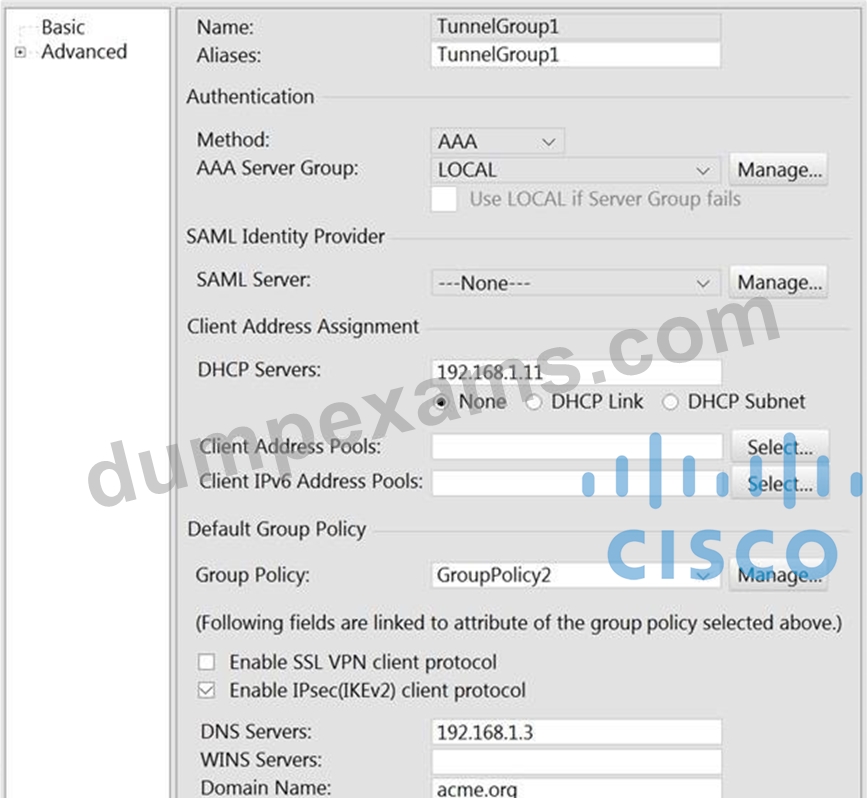
- A. Configure a AAA server group to authenticate the client.
- B. Enable the client protocol in the Cisco AnyConnect profile.
- C. Change the authentication method to local.
- D. Configure the group policy to force local authentication.
Answer: B
NEW QUESTION # 145
Refer to the exhibit.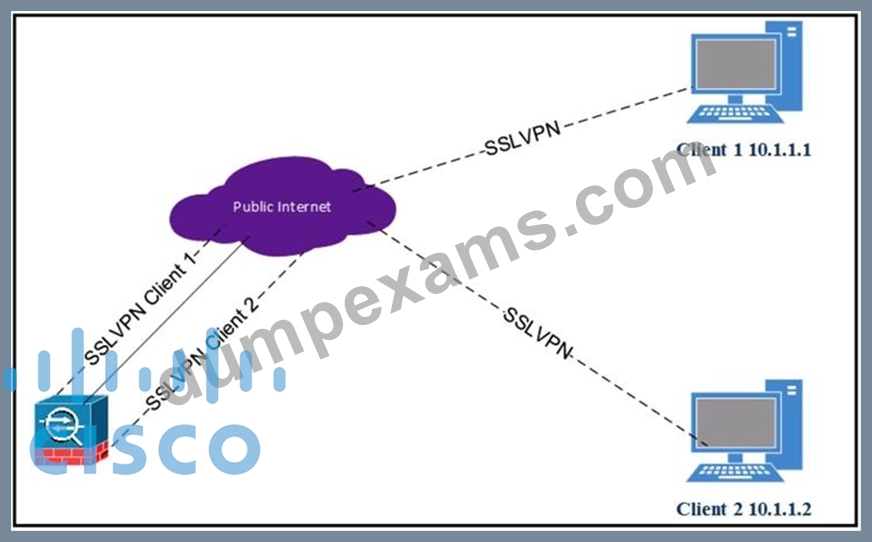
Client 1 cannot communicate with client 2. Both clients are using Cisco AnyConnect and have established a successful SSL VPN connection to the hub ASA. Which command on the ASA is missing?
- A. same-security-traffic permit inter-interface
- B. dns-server value 10.1.1.3
- C. same-security-traffic permit intra-interface
- D. dns-server value 10.1.1.2
Answer: C
Explanation:
The same-security-traffic intra-interface command lets traffic enter and exit the same interface, which is normally not allowed. This feature might be useful for VPN traffic that enters an interface, but is then routed out the same interface. The VPN traffic might be unencrypted in this case, or it might be reencrypted for another VPN connection. For example, if you have a hub and spoke VPN network, where the security appliance is the hub, and remote VPN networks are spokes, for one spoke to communicate with another spoke, traffic must go into the security appliance and then out again to the other spoke.
NEW QUESTION # 146
A user is trying to log in to a Cisco ASA using the clientless SSLVPN feature and receives the error message "clientless (browser) SSLVPN access is not allowed". Which step should the Cisco ASA administrator take to resolve this issue?
- A. Increase the number of simultaneous logins allowed on the group policy.
- B. Enable the clientless VPN protocol on the group policy.
- C. Verify that a user account exists in the local AAA database for the user.
- D. Validate that the correct license is in use on the ASA for WebVPN.
Answer: D
Explanation:
https://www.cisco.com/c/en/us/support/docs/security-vpn/webvpn-ssl-vpn/119417-config-asa-
00.html#anc12
NEW QUESTION # 147
Which two Secure Client Advantage and Premier models are available for Cisco Secure Client Remote Access VPN? (Choose two.)
- A. Secure Client Essentials
- B. Secure Client Plus
- C. Secure Client Premium
- D. Secure Client Apex
- E. Secure Client Shared
Answer: A,D
Explanation:
Cisco Secure Client (formerly Cisco AnyConnect) offers different licensing models for Remote Access VPN under the Advantage and Premier tiers:
1. Secure Client Essentials (Basic License)
Supports SSL VPN and IPsec IKEv2 remote access VPN
Allows full-tunnel and split-tunnel configurations
Typically used for basic VPN-only access
2. Secure Client Apex (Advanced License)
Includes all Secure Client Essentials features
Adds support for advanced security features like posture assessment, network visibility, and endpoint compliance Required for advanced remote access VPN capabilities
NEW QUESTION # 148
Which VPN solution uses TBAR?
- A. Cisco AnyConnect
- B. DMVPN
- C. GETVPN
- D. VTI
Answer: C
Explanation:
Reference:
https://www.cisco.com/c/en/us/td/docs/ios-xml/ios/sec_conn_getvpn/configuration/xe-3s/sec-get- vpn-xe-3s-book/sec-get-vpn.html
NEW QUESTION # 149
Refer to the exhibit. The network security engineer identified that the hub router cannot send traffic to the spoke router. Based on the provided output, which action resolves the issue?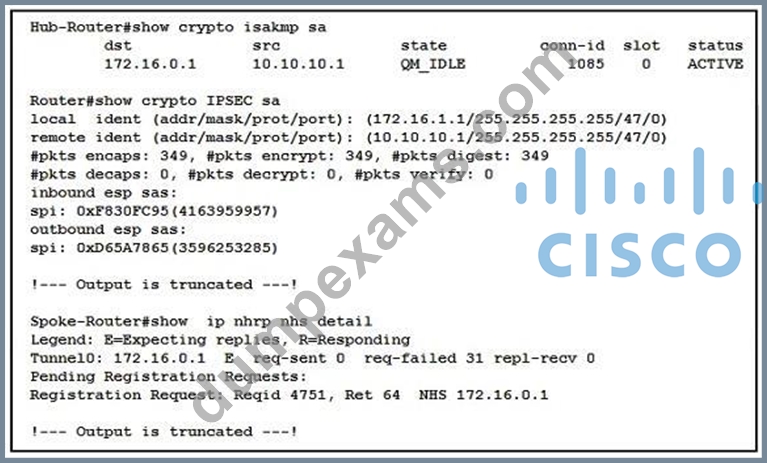
- A. Correct the next hop server IP address on the spoke router.
- B. Ensure the preshared key on the hub-and-spoke router matches.
- C. Adjust the ip nhrp network-id command on the hub router.
- D. Permit UDP ports 500 and 4500 between the hub and spoke.
Answer: A
NEW QUESTION # 150
An engineer is troubleshooting a new DMVPN setup on a Cisco IOS router. After the show crypto isakmp sa command is issued, a response is returned of "MM_NO_STATE." Why does this failure occur?
- A. The Phase 1 policy does not match on both devices.
- B. The ISAKMP policy priority values are invalid.
- C. ESP traffic is being dropped.
- D. Tunnel protection is not applied to the DMVPN tunnel.
Answer: C
NEW QUESTION # 151
Which technology works with IPsec stateful failover?
- A. GLBR
- B. VRRP
- C. HSRP
- D. GRE
Answer: C
Explanation:
https://www.cisco.com/c/en/us/td/docs/ios/12_2/12_2y/12_2yx11/feature/guide/ft_vpnha.html#wp
1122512
NEW QUESTION # 152
......
2025 Valid 300-730 test answers & Cisco Exam PDF: https://passleader.dumpexams.com/300-730-vce-torrent.html