


Latest Sep-2025 CWNP CWAP-404 Dumps Updated 184 Questions
PDF Download Free of CWAP-404 Valid Practice Test Questions
CWNP CWAP-404 Exam Topics:
| Section | Objectives |
|---|---|
Protocol Analysis - 15% | |
| Capture 802.11 frames using the appropriate methods | - Select capture devices
- Install monitor mode drivers |
| Understand and apply the common capture configuration parameters available in protocol analysis tools | - Save to disk - Packet slicing - Event triggers - Buffer options - Channels and channel widths - Capture filters - Channel scanning and dwell time |
| Analyze 802.11 frame captures to discover problems and find solutions | - Use appropriate display filters to view relevant frames and packets - Use colorization to highlight important frames and packets - Configure and display columns for analysis purposes - View frame and packet decodes while understanding the information shown and applying it to the analysis process - Use multiple adapters and channel aggregation to view captures from multiple channels - Implement protocol analyzer decryption procedures - View and use a capture’s statistical information for analysis - Use expert mode for analysis - View and understand peer maps as they relate to communications analysis |
| Utilize additional tools that capture 802.11 frames for analysis and troubleshooting | - WLAN scanners and discovery tools - Protocol capture visualization and analysis tools - Centralized monitoring, alerting, and forensic tools |
| Ensure appropriate troubleshooting methods are used with all analysis types | - Define the problem - Determine the scale of the problem - Identify probable causes - Capture and analyze the data - Observe the problem - Choose appropriate remediation steps - Document the problem and resolution |
Spectrum Analysis - 10% | |
| Capture RF spectrum data and understand the common views available in spectrum analyzers | - Install, configure, and use spectrum analysis software and hardware - Capture RF spectrum data using handheld, laptop-based, and infrastructure spectrum capture solutions - Understand and use spectrum analyzer views
|
| Analyze spectrum captures to identify relevant RF information and issues | - RF noise floor in an environment - Signal-to-Noise Ratio (SNR) for a given signal - Sources of RF interference and their locations - RF channel utilization - Non-Wi-Fi transmitters and their impact on WLAN communications - Overlapping and non-overlapping adjacent channel interference - Poor performing or faulty radios |
| Analyze spectrum captures to identify various device signatures | - Identify various 802.11 PHYs
- Identify non-802.11 devices based on RF behaviors and signatures
|
| Use centralized spectrum analysis solutions | - AP-based spectrum analysis - Sensor-based spectrum analysis |
PHY Layers and Technologies - 10% | |
| Understand and describe the functions of the PHY layer and the PHY protocol data units (PPDUs) | - DSSS (Direct Sequence Spread Spectrum) - HR/DSSS (High Rate/Direct Sequence Spread Spectrum) - OFDM (Orthogonal Frequency Division Multiplexing) - ERP (Extended Rate PHY) - HT (High Throughput) - VHT (Very High Throughput) - HE (High Efficiency)
|
| Apply the understanding of PHY technologies, including PHY headers, preambles, training fields, frame aggregation, and data rates, to captured data | |
| Identify and use PHY information provided within pseudo-headers in protocol analyzers | - Pseudo-Header formats
- Key pseudo-header content
|
| Recognize the limits of protocol analyzers to capture PHY information including NULL data packets and PHY headers | |
| Use appropriate capture devices based on proper understanding of PHY types | - Supported PHYs - Supported spatial streams |
MAC Sublayer and Functions - 25% | |
| Understand frame encapsulation and frame aggregation | - Frame aggregation (A-MSDU and A-MPDU) |
| Identify and use MAC information in captured data for analysis | - Management, Control, and Data frames - MAC frame formats and contents
- 802.11 Management frame formats
- Data and QoS Data frame formats
|
| Validate BSS configuration through protocol analysis | - Country code - Minimum basic rate - Supported rates and coding schemes - Beacon interval - WMM settings - RSN settings - HT/VHT/HE operations - Channel width - Primary channel - Hidden or non-broadcast SSIDs |
CWNP CWAP-404 Exam Certification Details:
| Passing Score | 70% |
| Exam Code | CWAP-404 CWAP |
| Duration | 90 minutes |
| Sample Questions | CWNP CWAP-404 Sample Questions |
| Exam Price | $275 USD |
| Exam Registration | PEARSON VUE |
| Recommended Training | CWAP self-paced training kit, Training Class |
| Number of Questions | 60 |
NEW QUESTION # 59
A manager at a retail outlet has complained that an incident occurred allowing a STA to launch an attack against another STA connected to their public Wi-Fi hotspot. He has asked you to troubleshoot the situation and verify that all possible measured are being taken to prevent this.
What configuration should you check in the AP?
- A. Inter-VAP filtering
- B. Captive portal Internet gateway
- C. DNS settings
- D. Client-to-client direct communications
Answer: A
NEW QUESTION # 60
Which parameters accurately describe the Beacon Interval field in the Beacon frame? (Choose 2)
- A. Indicates the exact time interval between Beacon transmissions
- B. 4-octet length
- C. Value can range from 0 to 2007
- D. easured in time units of 1024 µs
- E. Indicates the desired time interval between TBTTs
Answer: D,E
NEW QUESTION # 61
Which one of the following statements describes the function of WMM Admission Control?
- A. APs guarantee Voice and Video access categories priority over the WLAN medium
- B. APs control access to the wireless medium by polling STAs for data packets
- C. APs regulate the available bandwidth in an attempt to provide a guarantee of the amount of time that a STA has available to access the channel
- D. Provides a new 802.11 Authentication method for Voice devices
Answer: A
NEW QUESTION # 62
When evaluating modulation and coding schemes, you must determine the best coding rate available.
In 802.11 MCS tables, what is the best coding rate from the perspective of highest data rates?
- A. 1/2
- B. 5/6
- C. 3/4
- D. 2/3
Answer: B
NEW QUESTION # 63
As shown in the exhibit, a spectrum analyzer has measured both 802.11 and non-802.11 RF transmissions in the 2.4 GHz band. The exhibit shows a continuous video transmitter near channel 5.
Based upon the exhibit, what impact does the video transmitter have on WLAN operations throughout the band?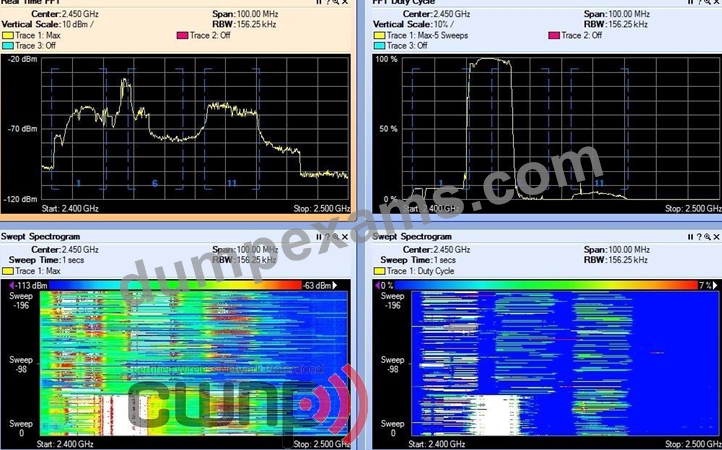
- A. The video transmitter is preventing all WLAN transmissions on channel 6, and its impact on channels 1 and 11 is severe.
- B. The video transmitter is preventing WLAN operation on channel 6, and has only a minor impact on channels 1 and 11.
- C. The video transmitter is preventing all WLAN transmissions in the band.
- D. The video transmitter has made no impact on WLAN operation in the band.
Answer: B
NEW QUESTION # 64
As the WLAN administrator in your organization you are responsible for troubleshooting connection issues. Several STAs are connecting to the network, but are unable to communicate after connection. You suspect a DHCP problem. After capturing traffic on the wired-side of the AP, you want to view only DHCP traffic. What filter in Wireshark can be used for this purpose?
- A. DHCPv4
- B. DHCPv6
- C. DHCP
- D. BOOTP
Answer: D
NEW QUESTION # 65
What is the difference between a Data frame and a QoS-Data frame?
- A. QoS Data frames include a DSCP control field
- B. QoS Data frames include a QoS control field
- C. QoS Data frames include a QoS information element
- D. QoS Data frames include an 802.1Q VLAN tag
Answer: B
Explanation:
The difference between a Data frame and a QoS-Data frame is that QoS Data frames include a QoS control field. A Data frame is a type of data frame that is used to carry user data or upper layer protocol data between STAs and APs. A QoS Data frame is a type of data frame that is used to carry user data or upper layer protocol data between STAs and APs that support QoS (Quality of Service) features. QoS features allow different types of traffic to be prioritized and handled differently according to their QoS requirements, such as delay, jitter, throughput, etc.
QoS Data frames include a QoS control field in their MAC header, which contains information such as traffic identifier (TID), queue size (TXOP), acknowledgment policy (ACK), etc., that are used for QoS purposes. The other options are not correct, as they do not describe the difference between Data and QoS Data frames.
QoS Data frames do not include a DSCP (Differentiated Services Code Point) control field, which is part of the IP header in the network layer, not the MAC header in the data link layer. QoS Data frames do not include a QoS information element (IE), which is part of some management frames that indicate QoS capabilities or parameters, not data frames. QoS Data frames do not include an
802.1Q VLAN tag, which is part of some Ethernet frames that indicate VLAN membership or priority, not wireless frames.
NEW QUESTION # 66
What does the value of the Listen Interval field in an Association Request frame indicate?
- A. How long a STA performing active scanning will listen for Probe Responses before changing channels
- B. How often a STA will go off channel to look for other BSSs
- C. How often a STA in power save mode wakes up to listen to Beacon frames
- D. How long a STA waits for an Ack before retransmitting the frame
Answer: C
Explanation:
Explanation
The value of the Listen Interval field in an Association Request frame indicates how often a STA in power save mode wakes up to listen to Beacon frames. The Listen Interval is expressed in units of Beacon Intervals (typically 100 TU or 102.4 ms). For example, if the Listen Interval is set to 10, it means that the STA will wake up every 10 Beacon Intervals (or about 1 second) to check for buffered frames at the AP. The Listen Interval is used by the AP to determine how long it can hold frames for a STA in power save mode before discarding them . References: CWAP-404 Certified Wireless Analysis Professional Study and Reference Guide, Chapter 6: MAC Sublayer Frame Exchanges, page 197; CWAP-404 Certified Wireless Analysis Professional Study and Reference Guide, Chapter 6: MAC Sublayer Frame Exchanges, page 198.
NEW QUESTION # 67
In the frame decode shown, there are two sets of supported data rates. 1, 2, 5.5, and 11 Mbps are all shown as "basic" data rates, and 6, 9, 12, 18, 24, 36, 48, and 54 Mbps are shown simply as supported data rates.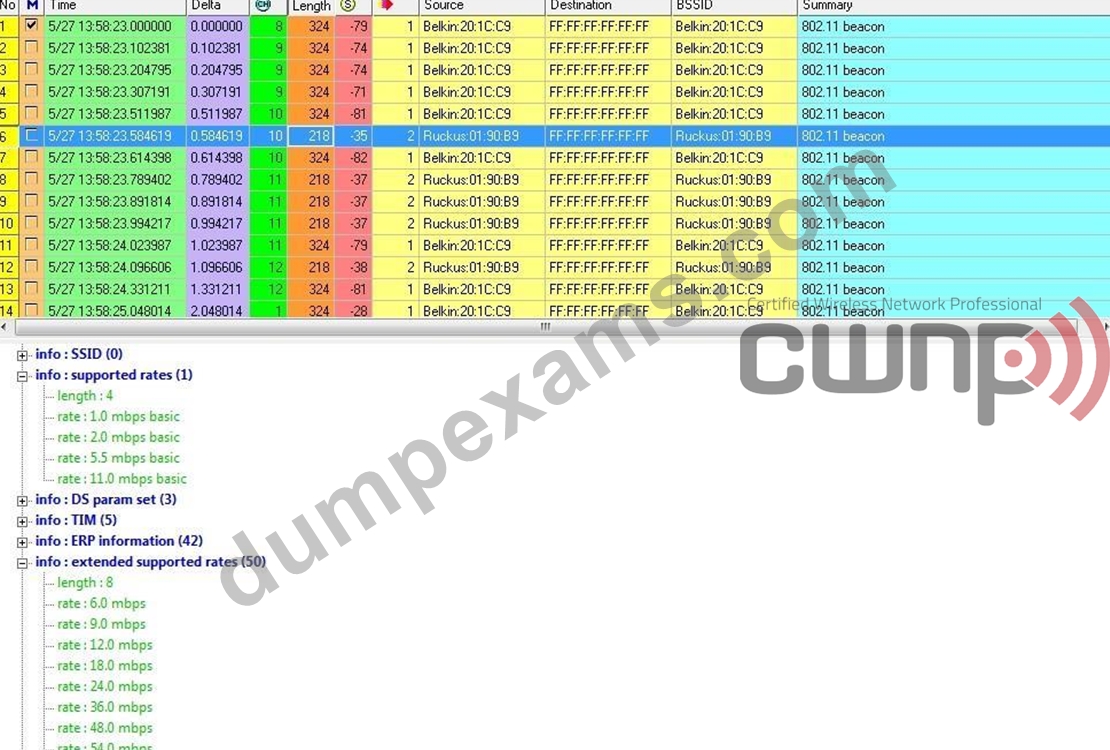
What is true of "basic" data rates in this context?
- A. Basic rates are optional data rates for the BSS, often used for assuring connectivity for legacy stations.
- B. Basic rates are defined in an AP's service set to specify mandatory data rates for all retry frames.
- C. Basic rates are only used for multicast traffic, and do not affect unicast traffic.
- D. The highest data rate set to Basic is automatically used to send broadcast traffic such as Beacon frames.
- E. The AP requires all client stations to support Basic rates in order to associate to its BSS.
Answer: E
NEW QUESTION # 68
What is the function of the PHY layer?
- A. Convert PPDUs to PSDUs for transmissions and PSDUs to PPDUs for receptions
- B. Convert PPDUs to MSDUs for transmissions and MSDUs to PPDUs for receptions
- C. Convert PSDUs to PPDUs for transmissions and PPDUs to PSDUs for receptions
- D. Convert MSDUs to PPDUs for transmissions and PPDUs to MSDUs for receptions
Answer: C
Explanation:
The function of the PHY layer is to convert PSDUs to PPDUs for transmissions and PPDUs to PSDUs for receptions. A PSDU (PHY Service Data Unit) is the data unit that is passed from the MAC layer to the PHY layer for transmission, or from the PHY layer to the MAC layer for reception. A PPDU (PHY Protocol Data Unit) is the data unit that is transmitted or received over the wireless medium by the PHY layer. A PPDU consists of a PSDU and a PHY header, which contains information such as modulation, coding, and data rate. The PHY layer adds or removes the PHY header to or from the PSDU during the conversion process.
NEW QUESTION # 69
As the WLAN administrator in your organization you are responsible for troubleshooting connection issues. Several STAs are connecting to the network, but are unable to communicate after connection. You suspect a DHCP problem. After capturing traffic on the wired-side of the AP, you want to view only DHCP traffic. What filter in Wireshark can be used for this purpose?
- A. BOOTP
- B. DHCP
- C. DHCPv4
- D. DHCPv6
Answer: B
NEW QUESTION # 70
A manufacturing facility has installed a new automation system which incorporates an 802.11 wireless network. The automation system is controlled from tablet computers connected via the WLAN. However, the automation system has not gone live due to problem with the tablets connecting to the WLAN. The WLAN vendor has been onsite to perform a survey and confirmed good primary and secondary coverage across the facility. As a CWAP you are called in to perform Spectrum Analysis to identify any interference sources. From the spectrum analysis, you did not identify any interference sources but were able to correctly identify the issue. Which of the following issues did you identify from the spectrum analysis?
- A. There is a power mismatch between the APs and the clients
- B. The tablets are entering power save mode and failing to wake up to receive the access points transmissions
- C. The tablets are connecting to the wrong SSID
- D. A high noise floor has resulted in a SNR of less than 20%
Answer: A
Explanation:
The most likely issue that can be identified from the spectrum analysis is a power mismatch between the APs and the clients. A power mismatch occurs when the APs transmit at a higher power level than the clients, or vice versa. This can cause asymmetric communication, where one side can hear the other, but not vice versa. This can result in poor performance, disconnections, or packet loss. A spectrum analysis can reveal a power mismatch by showing different signal amplitudes or RSSI values for the APs and the clients on the same channel or frequency. The other options are not correct, as they cannot be identified from the spectrum analysis alone. The tablets' SSID, power save mode, and noise floor can be determined by using other tools or methods, such as protocol analysis, site survey, or device configuration.
NEW QUESTION # 71
What is used to respond with an uplink transmission to an MU-RTS trigger frame in the 802.11ax PHY?
- A. HE MU PPDU
- B. HE TB PPDU
- C. VHT PPDU
- D. HE SU PPDU
Answer: B
Explanation:
An HE TB PPDU (High Efficiency Trigger-Based Packet Data Unit) is used to respond with an uplink transmission to an MU-RTS trigger frame in the 802.11ax PHY (Physical Layer). An MU- RTS trigger frame is a frame that initiates a multi-user transmission opportunity (MU-TXOP) by requesting multiple stations (STAs) to send clear-to-send (CTS) frames on different spatial streams or resource units (RUs). An HE TB PPDU is a frame that contains data from multiple STAs that have been allocated RUs by an MU-RTS trigger frame or another type of trigger frame.
An HE SU PPDU (High Efficiency Single User Packet Data Unit) is a frame that contains data from a single STA using all available spatial streams or RUs. An HE MU PPDU (High Efficiency Multi User Packet Data Unit) is a frame that contains data from multiple STAs using different spatial streams or RUs without being triggered by another frame. A VHT PPDU (Very High Throughput Packet Data Unit) is a frame that uses the 802.11ac PHY and does not support multi- user transmissions.
NEW QUESTION # 72
What is the function of 802.11 Management frames?
- A. Prioritize network administration traffic
- B. Manage the BSS
- C. Manage the flow of data
- D. Communicate configuration changes between WLAN controller and APs
Answer: B
Explanation:
Explanation
The function of 802.11 management frames is to manage the BSS. A BSS (Basic Service Set) is a group of STAs (stations) that share a common SSID (Service Set Identifier) and communicate with each other through an AP (access point) or directly in an ad hoc mode. Management frames are one of the three types of 802.11 frames, along with control and data frames. Management frames are used to establish, maintain, and terminate associations between STAs and APs, as well as to advertise and discover BSSs, exchange security information, report errors, and perform other management functions. The other options are not correct, as they are not functions of 802.11 management frames. Prioritizing network administration traffic, communicating configuration changes between WLAN controller and APs, and managing the flow of data are functions of other types of frames or protocols. References: [Wireless Analysis Professional Study Guide CWAP-404], Chapter 5: 802.11 MAC Sublayer, page 120-121
NEW QUESTION # 73
What is the difference between a Data frame and a QoS-Data frame?
- A. QoS Data frames include a DSCP control field
- B. QoS Data frames include a QoS control field
- C. QoS Data frames include a QoS information element
- D. QoS Data frames include an 802.1Q VLAN tag
Answer: B
Explanation:
Explanation
The difference between a Data frame and a QoS-Data frame is that QoS Data frames include a QoS control field. A Data frame is a type of data frame that is used to carry user data or upper layer protocol data between STAs and APs. A QoS Data frame is a type of data frame that is used to carry user data or upper layer protocol data between STAs and APs that support QoS (Quality of Service) features. QoS features allow different types of traffic to be prioritized and handled differently according to their QoS requirements, such as delay, jitter, throughput, etc. QoS Data frames include a QoS control field in their MAC header, which contains information such as traffic identifier (TID), queue size (TXOP), acknowledgment policy (ACK), etc., that are used for QoS purposes. The other options are not correct, as they do not describe the difference between Data and QoS Data frames. QoS Data frames do not include a DSCP (Differentiated Services Code Point) control field, which is part of the IP header in the network layer, not the MAC header in the data link layer. QoS Data frames do not include a QoS information element (IE), which is part of some management frames that indicate QoS capabilities or parameters, not data frames. QoS Data frames do not include an 802.1Q VLAN tag, which is part of some Ethernet frames that indicate VLAN membership or priority, not wireless frames. References: [Wireless Analysis Professional Study Guide CWAP-404], Chapter 5: 802.11 MAC Sublayer, page 118-119
NEW QUESTION # 74
Which one of the following is not a valid acknowledgement frame?
- A. Block Ack
- B. Ack
- C. RTS
- D. CTS
Answer: C
Explanation:
Explanation
RTS is not a valid acknowledgement frame. RTS stands for Request To Send, and it is a control frame that is used to initiate an RTS/CTS exchange before sending a data frame. The purpose of an RTS/CTS exchange is to reserve the medium for a data transmission and avoid collisions with hidden nodes. An acknowledgement frame is a control frame that is used to confirm the successful reception of a data frame or a block of data frames. The valid acknowledgement frames are CTS (Clear To Send), Ack (Acknowledgement), and Block Ack (Block Acknowledgement) . References: CWAP-404 Certified Wireless Analysis Professional Study and Reference Guide, Chapter 6: MAC Sublayer Frame Exchanges, page 186; CWAP-404 Certified Wireless Analysis Professional Study and Reference Guide, Chapter 6: MAC Sublayer Frame Exchanges, page 187; CWAP-404 Certified Wireless Analysis Professional Study and Reference Guide, Chapter 6: MAC Sublayer Frame Exchanges, page 189; CWAP-404 Certified Wireless Analysis Professional Study and Reference Guide, Chapter 6: MAC Sublayer Frame Exchanges, page 190.
NEW QUESTION # 75
Which parameters accurately describe the Beacon Interval field in the Beacon frame? (Choose 2)
- A. Indicates the exact time interval between Beacon transmissions
- B. Measured in time units of 1024 ms
- C. 4-octet length
- D. Value can range from 0 to 2007
- E. Indicates the desired time interval between TBTTs
Answer: B,E
NEW QUESTION # 76
As a wireless network consultant you have been called in to troubleshoot a high-priority issue for one of your customers. The customer's office is based on two floors within a multi-tenant office block. On one of these floors (floor 5) users cannot connect to the wireless network. During their own testing the customer has discovered that users can connect on floor 6 but not when they move to the floor 5. This issue is affecting all users on floor 5 and having a negative effect on productivity.
To troubleshoot this issue, you perform both Spectrum and Protocol Analysis. The Spectrum Analysis shows the presence of Bluetooth signals which you have identified as coming from wireless mice. In the protocol analyzer you see the top frame on the network is Deauthentication frames. On closer investigation you see that the Deauthentication frames' source addresses match the BSSIDs of your customers APs and the destination address is FF:FF:FF:FF:FF:FF:FF.
What do you conclude from this troubleshooting exercise?
- A. The customers APs are misbehaving and a technical support case should be open with the vendor
- B. The CCI from the APs on the floor 4 is the problem and you need to ask the tenant below to turn down their APs Tx power
- C. The users on floor 5 are being subjected to a denial of service attack, as this is happening across the entire floor it is likely to be a misconfigured WIPS solution belonging to the tenants on the floor below
- D. The customer should replace all their Bluetooth wireless mice as they are stopping the users on floor 5 from connecting to the wireless network
Answer: C
Explanation:
Explanation
The users on floor 5 are being subjected to a denial of service attack, as this is happening across the entire floor it is likely to be a misconfigured WIPS solution belonging to the tenants on the floor below. This is because the Deauthentication frames have a source address that matches the BSSIDs of the customer's APs and a destination address that is a broadcast address (FF:FF:FF:FF:FF:FF). This indicates that someone is sending spoofed Deauthentication frames to all STAs associated with the customer's APs, causing them to disconnect from the wireless network. This is a common type of DoS attack on wireless networks, and it could be caused by a rogue device or a WIPS solution that is configured to protect the wireless network of another tenant on the floor below12. References: CWAP-404 Certified Wireless Analysis Professional Study and Reference Guide, Chapter 13: Troubleshooting Common Wi-Fi Issues, page 4961; CWAP-404 Certified Wireless Analysis Professional Study and Reference Guide, Chapter 14: Troubleshooting Tools, page 5272.
NEW QUESTION # 77
You are performing a multiple adapter channel aggregation capture to troubleshoot a VoIP roaming problem and would like to measure the roaming time from the last VoIP packet sent on the old AP's channel to the first VoIP packet sent on the new AP's channel. Which timing column in the packet view would measure this for you?
- A. Absolute
- B. Relative
- C. Delta
- D. Roaming
Answer: C
Explanation:
Explanation
Delta is the timing column in the packet view that measures the time difference between two consecutive packets in a capture file. Delta can be used to measure the roaming time from the last VoIP packet sent on the old AP's channel to the first VoIP packet sent on the new AP's channel by selecting these two packets and looking at their delta values. The other timing columns are not suitable for this measurement because they do not show the time difference between two specific packets. Roaming is a column that shows whether a packet belongs to a roaming event or not. Relative is a column that shows the time elapsed since the beginning of the capture file. Absolute is a column that shows the date and time when a packet was captured5 References:
CWAP-404 Study Guide, Chapter 2: Protocol Analysis, page 57
CWAP-404 Objectives, Section 2.4: Analyze timing values
NEW QUESTION # 78
In a Spectrum Analyzer the Swept Spectrogram plot displays what information?
- A. RF power present at a particular frequency over the course of time
- B. The RF time domain
- C. Duty cycle in the frequency domain
- D. Wi-Fi Device information
Answer: A
Explanation:
The Swept Spectrogram plot is a spectrum analysis plot that shows the RF power present at a particular frequency over the course of time. It can help identify trends and patterns in the RF spectrum over a longer period of time. It can also show how the RF environment changes over time and how different sources of RF signals affect each other. The other options are not correct, as they describe different types of plots or information that are not related to the Swept Spectrogram plot.
NEW QUESTION # 79
......
CWAP-404 Test Engine files, CWAP-404 Dumps PDF: https://passleader.dumpexams.com/CWAP-404-vce-torrent.html