


NSE5_FMG-6.2 Actual Questions Answers PDF 100% Cover Real Exam Questions
NSE5_FMG-6.2 Exam questions and answers
The Fortinet NSE5_FMG-6.2 exam covers a range of topics, including the architecture and components of FortiManager, device registration, policy management, user authentication, log management, and troubleshooting. NSE5_FMG-6.2 exam is conducted online and comprises of 60 multiple-choice questions to be answered in 90 minutes. A passing score of 60% is required to earn the Fortinet NSE 5 - FortiManager 6.2 certification, which is valid for two years. Fortinet NSE 5 - FortiManager 6.2 certification is recognized globally and is a valuable asset for network security professionals looking to advance their career.
NEW QUESTION # 47
Refer to the exhibit. Given the configurations shown in the exhibit, what can you conclude from the installation targets in the Install On column?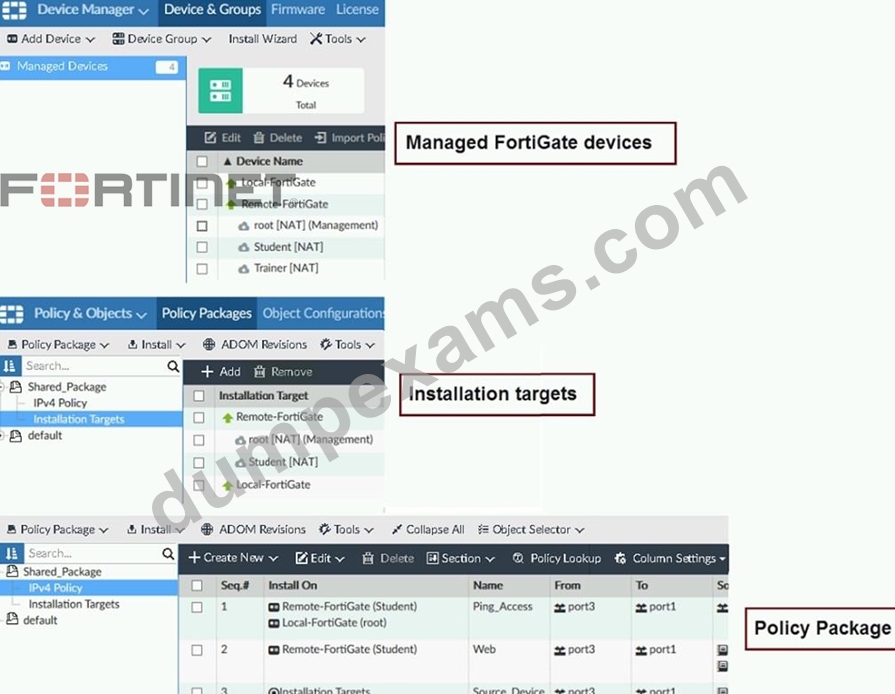
- A. Policy seq.# 3 will be installed on all managed devices and VDOMs that are listed under Installation Targets.
- B. Policy seq.# 3 will not be installed on any managed device.
- C. The Install On column value represents successful installations on the managed devices.
- D. Policy seq.# 3 will be installed on the Trainer[NAT] VDOM only.
Answer: A
NEW QUESTION # 48
Which two statements regarding device management on FortiManager are true? (Choose two.)
- A. The maximum number of managed devices for each ADOM is 500.
- B. FortiGate in transparent mode configurations are not counted toward the device count on FortiManager.
- C. FortiGate devices in HA cluster devices are counted as a single device.
- D. FortiGate devices in an HA cluster that has five VDOMs are counted as five separate devices.
Answer: C,D
NEW QUESTION # 49
An administrator would like to create an SD-WAN default static route for a newly created SD-WAN using the FortiManager GUI. Both port1 and port2 are part of the SD-WAN member interfaces.
Which interface must the administrator select in the static route device drop-down list?
- A. virtual-wan-link
- B. auto-discovery
- C. port1
- D. port2
Answer: A
NEW QUESTION # 50
What type of access is automatically enabled on an interface after it is added to FortiClient Manager?
- A. FortiTelemetry
- B. CAPWAP
- C. Device Detection
- D. FMG-Access
Answer: A
NEW QUESTION # 51
Refer to the exhibit. Given the configuration shown in the exhibit, which two statements are true? (Choose two.)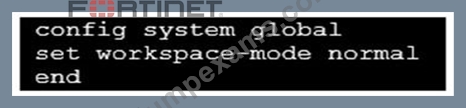
- A. It disables concurrent read-write access to an ADOM.
- B. It is used to validate administrator login attempts through external servers.
- C. It allows the same administrator to lock more than one ADOM at the same time.
- D. It allows two or more administrators to make configuration changes at the same time, in the same ADOM.
Answer: A,C
NEW QUESTION # 52
An administrator would like to create an SD-WAN default static route for a newly created SD-WAN using the FortiManager GUI.
Both port1 and port2 are part of the SD-WAN member interfaces. Which interface must the administrator select in the static route device drop-down list?
- A. virtual-wan-link
- B. auto-discovery
- C. port1
- D. port2
Answer: A
NEW QUESTION # 53
The service access settings for a FortiManager network interface relate to which product feature?
- A. Policy & Objects
- B. Device Manger
- C. FortiView
- D. FortiGuard
Answer: D
NEW QUESTION # 54
View the following exhibit.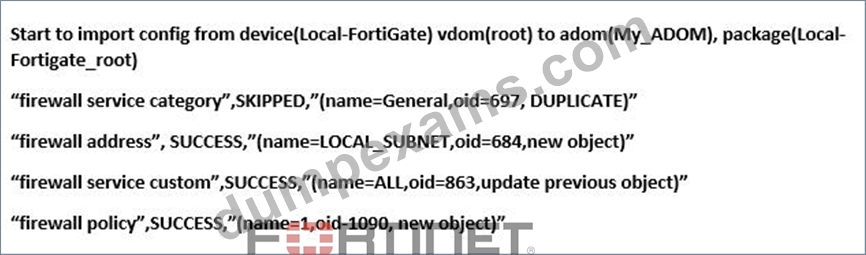
Which one of the following statements is true regarding the object named ALL?
- A. FortiManager installed the object ALL with the updated value.
- B. FortiManager updated the object ALL using FortiGate's value in its database
- C. FortiManager created the object ALL as a unique entity in its database, which can be only used by this managed FortiGate.
- D. FortiManager updated the object ALL using FortiManager's value in its database
Answer: B
NEW QUESTION # 55
Refer to the exhibit.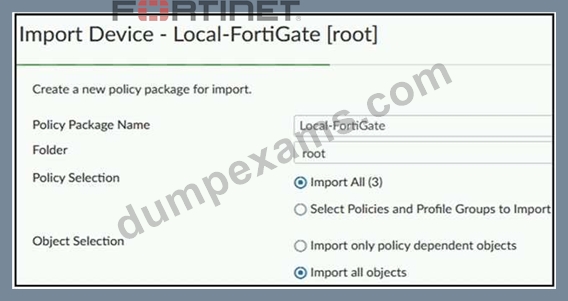
An administrator is importing a new device to FortiManager and has selected the options shown in the exhibit.
What will happen if the administrator makes the changes and installs the modified policy package on this managed FortiGate?
- A. The unused objects that are not tied to the firewall policies locally on FortiGate will be deleted.
- B. The unused objects that are not tied to the firewall policies in the policy package will be deleted from the FortiManager database.
- C. The unused objects that are not tied to the firewall policies will remain as read-only locally on FortiGate.
- D. The unused objects that are not tied to the firewall policies will be installed on FortiGate.
Answer: A
NEW QUESTION # 56
An administrator, Trainer, who is assigned the Super_User profile, is trying to approve a workflow session that was submitted by another administrator, Student. However, Trainer is unable to approve the approving a workflow session?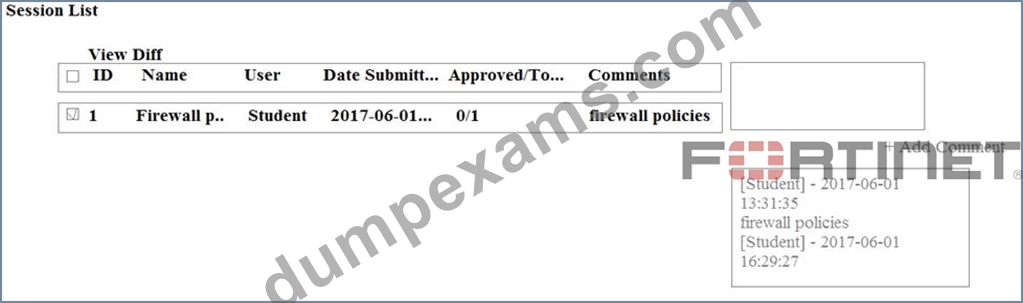
- A. Trainer does not have full rights over this ADOM
- B. Student, who submitted the workflow session, must first self-approve the request
- C. Trainer must close Student's workflow session before approving the request
- D. Trainer is not a part of workflow approval group
Answer: D
NEW QUESTION # 57
Which two statements are correct regarding the import al Objects?setting h the import policy wizard? (Choose two)
- A. All used and unused objects will be imported into the ADOM object database.
- B. Only used objects will be imported into the ADOM object database.
- C. Any unused object on the FortiGate device will be deleted with the first policy install from FortiManager.
- D. FortiManager allows only policy dependent objects to be imported into an ADOM object database.
Answer: A,C
NEW QUESTION # 58
An administrator would like to authorize a newly-installed AP using AP Manager. What steps does the administrator need to perform to authorize an AP?
- A. Authorize the new AP using AP Manager and install the policy package changes on the managed FortiGate.
- B. Changes to the AP's state must be performed directly on the managed FortiGate.
- C. Authorize the new AP using AP Manager and wait until the change is updated on the FortiAP.
Changes to the AP's state do not require installation. - D. Authorize the new AP using AP Manager and install the device level settings on the managed FortiGate.
Answer: D
NEW QUESTION # 59
Refer to the exhibit.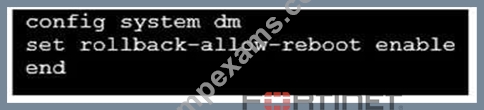
An administrator has configured the command shown in the exhibit on FortiManager. A configuration change has been installed from FortiManager to the managed FortiGate that causes the FGFM tunnel to go down for more than 15 minutes.
What is the purpose of this command?
- A. It allows FortiGate to reboot and restore a previously working firmware image.
- B. It allows the FortiManager to revert and install a previous configuration revision on the managed FortiGate.
- C. It allows FortiGate to unset central management settings.
- D. It allows FortiGate to reboot and recover the previous configuration from its configuration file.
Answer: D
Explanation:
Explanation/Reference:
Reference: https://docs.fortinet.com/document/fortimanager/6.2.0/fortigate-fortimanager-communications- protocol-guide/141304/fgfm-recovery-logic
NEW QUESTION # 60
Refer to the following exhibit: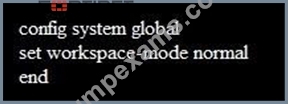
Which of the following statements are true based on this configuration? (Choose two.)
- A. The same administrator can lock more than one ADOM at the same time
- B. Unlocking an ADOM will install configuration automatically on managed devices
- C. Unlocking an ADOM will submit configuration changes automatically to the approval administrator
- D. Ungraceful closed sessions will keep the ADOM in a locked state until the administrator session times out
Answer: A,D
Explanation:
To enable ADOM locking and disable concurrent ADOM access:
config system global
set workspace-mode normal
end
Reference: http://help.fortinet.com/fmgr/cli/5-6-2/Document/0800_ADOMs/200_Configuring+.htm
NEW QUESTION # 61
Refer to the exhibits. An administrator created a new system template named Training with two new DNS addresses on FortiManager. During the installation preview stage, the administrator notices that many unset commands need to be pushed.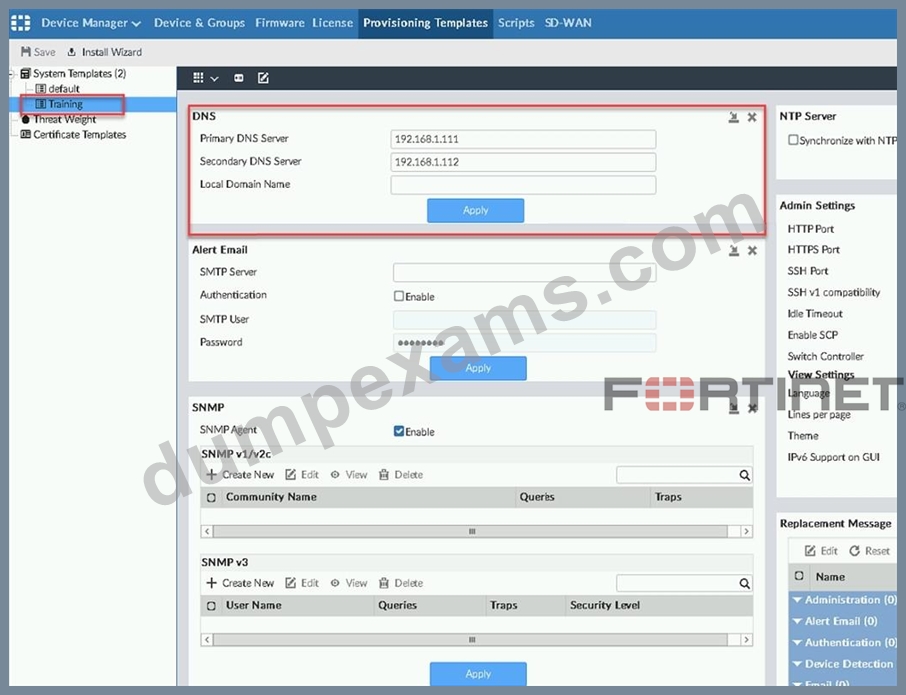
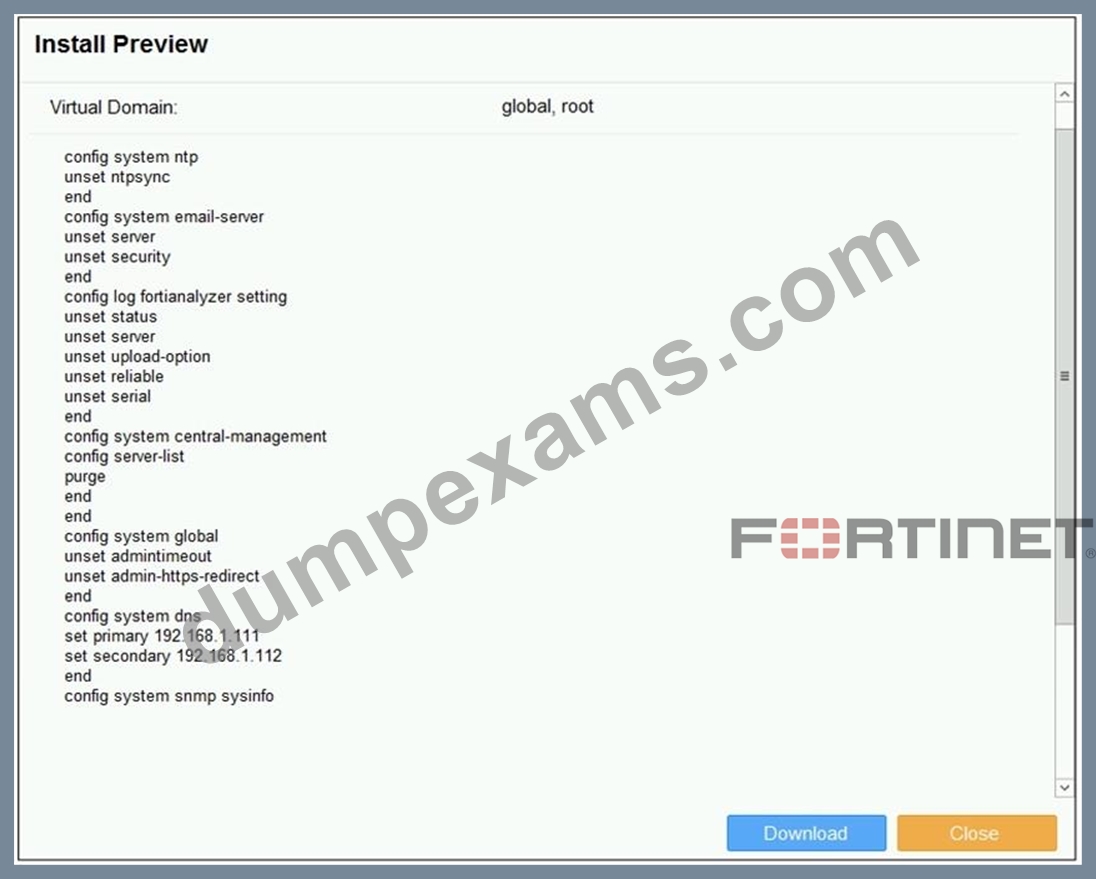
What can be the main reason for these unset commands?
- A. The DNS addresses in the default system settings are the same as the Training system template
- B. The Training system template does not have assigned devices
- C. The Training system template has other default settings
- D. The ADOM is locked by another administrator
Answer: C
NEW QUESTION # 62
Which two statements are correct for configuration changes made by FortiManager scripts? (Choose two)
- A. When run on the device database, changes are automatically installed to the managed FortiGate devices.
- B. When run on managed devices directly, you can install changes to the managed FortiGate devices using the installation wizard.
- C. When run on the device database, you can install changes to the managed FortiGate devices using the installation wizard.
- D. When run on managed devices directly, changes are automatically installed to the managed FortiGate devices.
Answer: C,D
Explanation:
A script can make many changes to a managed device and are useful for bulk configuration changes and consistency across multiple managed devices. Scripts can be run in three different ways:
Device Database: By default, a script can be executed on the device database. It is recommended you run the changes on the device database (default setting), as this allows you to check what configuration changes you will send to the managed device. Once scripts are run on the device database you can then install these changes to a managed device using the installation wizard.
Policy Package, ADOM database: A script can be run here to create ADOM level objects that will be applied to your managed devices and can then be installed using the installation wizard.
Remote FortiGate Directly (via CLI): A script can be executed directly on the device and you don't need to install these changes using the installation wizard. As the changes are directly installed on the managed device, no option is provided to verify and check the configuration changes through FortiManager.
NEW QUESTION # 63
Refer to the exhibit.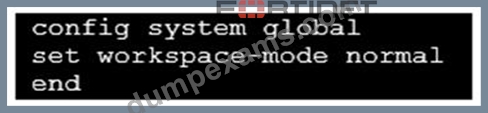
Given the configuration shown in the exhibit, which two statements are true? (Choose two.)
- A. It disables concurrent read-write access to an ADOM.
- B. It is used to validate administrator login attempts through external servers.
- C. It allows the same administrator to lock more than one ADOM at the same time.
- D. It allows two or more administrators to make configuration changes at the same time, in the same ADOM.
Answer: A,C
Explanation:
Reference:
https://docs.fortinet.com/document/fortimanager/6.0.4/administration-guide/86456/concurrentadom-access
NEW QUESTION # 64
When configuring FortiGuard on FortiManger. Which two statements are correct regarding Allow Push Update settings configured in the FortiGuard. Antivirus and IPS Settings? (Choose two)
- A. FortiManager's built-in FDS service does not allow an administrator to override the default FortiManger IP address and port used by the FDN to send update messages.
- B. If an urgent or critical FortiGuard Antivirus and/or IPS update becomes available, the FortiManger bult-in FDS will send push update notifications.
- C. FortiManager's built-in FDS service may not correctly receive push updates if the external facing IP address of any intermediary NAT device is dynamic.
- D. If an urgent or critical FortiGuard Antivirus and/or IPS update becomes available, the FortiManger bult-in FDS will send push update notifications to each managed device.
Answer: B,C
NEW QUESTION # 65
What does a policy package status of Modified indicate?
- A. The policy package was never imported after a device was registered on FortiManager
- B. FortiManager is unable to determine the policy package status
- C. Policy configuration has been changed on a managed device and changes have not yet been imported into FortiManager
- D. Policy package configuration has been changed on FortiManager and changes have not yet been installed on the managed device.
Answer: D
Explanation:
http://help.fortinet.com/fmgr/50hlp/56/5-6-1/FortiManager_Admin_Guide/1200_Policy%20and%20Objects/0800_Managing%20policy%20packages/2200_Policy%
20Package%20Installation%20targets.htm
NEW QUESTION # 66
Refer to the exhibit.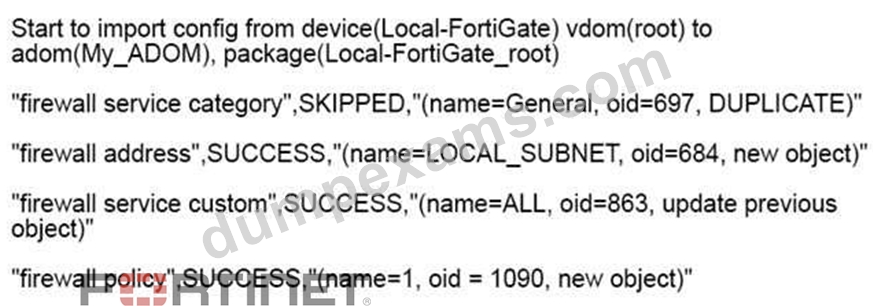
Which statement about the object named ALL is true?
- A. FortiManager installed the object ALL with the updated value.
- B. FortiManager created the object ALL as a unique entity in its database, which can be only used by this managed FortiGate.
- C. FortiManager updated the object ALL using the FortiGate value in its database.
- D. FortiManager updated the object ALL using the FortiManager value in its database.
Answer: C
NEW QUESTION # 67
View the following exhibit, which shows the Download Import Report: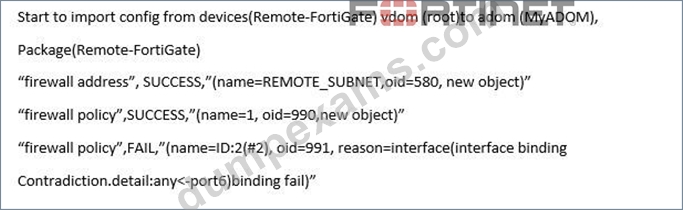
Why it is failing to import firewall policy ID 2?
- A. Policy ID 2 does not have ADOM Interface mapping configured on FortiManager
- B. The address object used in policy ID 2 already exist in ADON database with any as interface association and conflicts with address object interface association locally on the FortiGate
- C. Policy ID 2 is configured from interface any to port6 FortiManager rejects to import this policy because any interface does not exist on FortiManager
- D. Policy ID 2 for this managed FortiGate already exists on FortiManager in policy package named Remote-FortiGate.
Answer: B
Explanation:
FortiManager can create a dynamic mapping for an address object, if the address object name is the same, but contains a different value locally. However, there is one restriction - the associated interface cannot be different. This is because, at the ADOM level, this address object might be used by other policy packages, which might not have same interfaces." Address object name in this case is "REMOTE_SUBNET". The interface binding has 2 different interfaces 'ANY' and
'Port6'. They cannot be different.
NEW QUESTION # 68
......
Fortinet NSE5_FMG-6.2 certification exam is a valuable credential for IT professionals who want to validate their knowledge and skills in using FortiManager 6.2 to manage Fortinet security devices. Fortinet NSE 5 - FortiManager 6.2 certification demonstrates that the IT professional has the expertise to manage and configure Fortinet security devices in a complex network environment. To prepare for NSE5_FMG-6.2 exam, IT professionals can take advantage of a wide range of study materials and training programs offered by Fortinet.
Dumpexams NSE5_FMG-6.2 Exam Practice Test Questions: https://passleader.dumpexams.com/NSE5_FMG-6.2-vce-torrent.html