


Oct 03, 2025 Detailed New 1Z0-1059-24 Exam Questions for Concept Clearance
1Z0-1059-24 Exam Preparation Material with New 1Z0-1059-24 Dumps Questions.
Oracle 1Z0-1059-24 Exam Syllabus Topics:
| Topic | Details |
|---|---|
| Topic 1 |
|
| Topic 2 |
|
| Topic 3 |
|
| Topic 4 |
|
| Topic 5 |
|
NEW QUESTION # 15
Oracle Revenue Management is part of_____________________predefined offering.
- A. Financials
- B. Enterprise Contracts
- C. Incentive Compensation
- D. Fusion Accounting Hub
Answer: A
NEW QUESTION # 16
Which three statements describe how Revenue Management creates accounting contracts to meet the new ASC 606 / IFRS 15 revenue recognition standards?
- A. by calculating Total Transaction Price for contracts
- B. by only creating contracts that are source system specific
- C. by allowing manual allocation of Total Transaction Price across performance obligations
- D. by identifying and creating one or more performance obligations for a given accounting contract
- E. by grouping source document lines intro contracts for each identified customer
- F. by restricting users from excluding contract lines
Answer: B,C,E
NEW QUESTION # 17
Given Oracle Revenue Management Cloud has predefined integration with Oracle E-Business Suite Financials, which two steps are NOT part of the steps to configure EBS for integration with Revenue Management Cloud?
- A. Map the EBS Chart of Accounts to the Cloud General Ledger.
- B. Apply appropriate patches to EBS.
- C. Set the System Options in EBS Receivables on the Revenue Management tab.
- D. Set the Profile Option AR: Source System Value for Revenue Management.
- E. Run the Deploy System Options process.
Answer: A,E
NEW QUESTION # 18
You define a Performance Obligation Identification Rule that uses the following matching attribute to group source document lines:
Extensible Line Character Attribute 7
Based on the data displayed: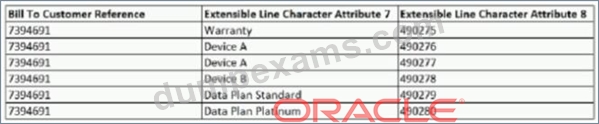
How many performance obligations will be created In Revenue Management?
- A. 0
- B. 1
- C. 2
- D. 3
Answer: C
NEW QUESTION # 19
When deciding how to set up the system to recognize revenue, it is important to understand the extent of revenue deferral and the subsequent timing of revenue recognition. Which two statements are true when you consider that recognition depends on the nature of the contingency? (Choose two)
- A. Pre-billing customer acceptance clauses require the recording of customer acceptance in the feeder system, or its expiration, before importing into Receivables for invoicing. Customer acceptance or its expiration
- B. Time-based contingencies can expire, but the contingency will have to be removed manually before the revenue is recognized if payment is not due yet
- C. Time-based contingencies must not expire before the contingency can be removed and revenue recognized
- D. Payment-based contingencies do not always require payment before the contingency can be removed and revenue recognized
- E. Post-billing customer acceptance clauses must expire (implicit acceptance), or be manually accepted (explicit acceptance), before the contingency can be removed and revenue recognized.
Answer: A,E
NEW QUESTION # 20
A corporation does not have historical Standalone Selling Prices stored in Revenue Management. Which two options are available to help the corporation establish Standalone Selling Prices?
- A. Load estimated process to table VRM_SOURCE_DOCUMENTS using SQL script.
- B. Use the Revenue Basis Data Import FBDI template to load unit standalone selling prices.
- C. Run the Calculate Observed Standalone Selling Prices program to derive prices.
- D. Navigate to the "Manage Standalone Selling Profiles" page and enter estimated prices manually for a given profile In the browser user Interface.
- E. Navigate to the "Manage Standalone Selling Profiles" page and download spreadsheet template to enter estimated prices manually.
- F. Navigate to the Revenue Management Work Area and enter estimated prices manually for a specific customer contract in the browser user Interface.
Answer: C,E
NEW QUESTION # 21
Which method is used to allocate total transaction price across performance obligations in Revenue Management?
- A. Alternative Allocation Method
- B. Inverted Allocation Method
- C. Two Step Allocation Method
- D. Relative Allocation Method
- E. Residual Allocation Method
Answer: C
NEW QUESTION # 22
Which is a term under ASC 606 or IFRS 15?
- A. requires complete
- B. initial performance event
- C. transaction price
- D. promise detail
Answer: C
NEW QUESTION # 23
Your customer ships machines, and can recognize revenue for each machine after the machine has been delivered to a customer without waiting for complete satisfaction of an entire performance obligation. How would you configure Satisfaction Method (SM) and Satisfaction Measurement Model (SMM) in Revenue Management to recognize revenue for these performance obligations at a point in time?
- A. by setting SM to "Allow Partial" and SMM to "Quantity"
- B. by setting SM to "Requires Complete" and SMM to "Period"
- C. by setting SM to "Requires Complete" and SMM to "Quantity"
- D. by setting SM to "Requires Complete" and SMM to "Percent"
- E. by setting SM to "Allow Partial" and SMM to "Period"
Answer: B
NEW QUESTION # 24
Which two are intended uses for the Standalone Selling Price Report Dashboard?
- A. Drill down to data used to derive standalone selling prices.
- B. Review performance obligations by effective period.
- C. Diagnose revenue price profile.
- D. Monitor transaction price calculation and allocation.
- E. Analyze standalone selling prices for one or multiple effective periods.
Answer: C,E
NEW QUESTION # 25
Which three tasks can be performed In the Revenue Management Work Area?
- A. Manage contracts in "Pending Allocation" status.
- B. Review Performance Satisfaction Plans.
- C. Review Revenue Price Profiles.
- D. Edit Contract Identification Rules.
- E. Review Observed Standalone Selling Prices.
- F. Manage contracts in "Pending Review" status.
Answer: A,E,F
NEW QUESTION # 26
Using the two delivered Oracle Transactional Business Intelligence (OTBI) subject areas for Revenue Management, which two reporting objects can users build In the BI catalog?
- A. Infotile
- B. Dashboards
- C. Analysis
- D. Infolets
Answer: B,C
NEW QUESTION # 27
Which three types of reference data critical to the Integration of a source system need to be synchronized between an external system and Revenue Management?
- A. Receivables configurations
- B. Banks, branches and bank accounts
- C. Business Units
- D. Suppliers
- E. Customers
- F. Inventory items
Answer: C,E,F
NEW QUESTION # 28
Why Is Satisfaction Method a key element of a Performance Obligation?
- A. because it calculates the amount of Total Transaction Price allocated to date
- B. because it determines whether revenue for a good or service is recognized Over Time or Point in Time
- C. because it calculates the percentage of Total Transaction Price allocated to date
- D. because it specifies whether revenue has been fully or partially recognized for a good or service
Answer: B
NEW QUESTION # 29
Which statement is true regarding natural accounts: Contract Liability, Contract Asset, Price Variance, and Contract Discount?
- A. These accounts are optional in Revenue Management.
- B. These accounts are not relevant to Revenue Management.
- C. If nonexistent, these accounts are added automatically to the chart of accounts.
- D. If nonexistent, these accounts need to be added to the chart of accounts.
Answer: C
NEW QUESTION # 30
Which is NOT a required piece of information when importing contract header Information from a source file?
- A. Currency code of source document
- B. Source System
- C. Date of Source Document
- D. Source Document Unique Identifier Number 1
- E. Source Document Type code
- F. Record Type
Answer: D
NEW QUESTION # 31
After defining a pricing dimension structure for a customer, you must define a pricing dimension structure instance.
Which two attributes on the structure instance are inherited from the structure definition?
- A. the Displayed option
- B. the Query Required option
- C. whether Dynamic Combination Creation Allowed is enabled
- D. the shape: Same number of segments and order
- E. the value sets
Answer: C,D
NEW QUESTION # 32
Which, when transferred to a customer, allows you to recognize revenue?
- A. promise detail
- B. an invoice
- C. a performance obligation
- D. a shipment
Answer: C
NEW QUESTION # 33
Given the Standalone Selling Price Profile combines all the key setup attributes of pricing Into one place, you create all standalone selling prices from the Standalone Selling Price Profiles for all Items or groups of items.
Which three setup attributes are part of a Standalone Selling Price Profile?
- A. Pricing Dimension Assignment
- B. Observed Standalone Selling Prices
- C. Items
- D. Estimated Standalone Selling Prices
- E. SSP Tolerance Usage
Answer: A,B,D
NEW QUESTION # 34
Which three statements about Effective Periods are true?
- A. If effective periods are not defined, Revenue Management uses the General Ledger calendar.
- B. Effective Periods only define the rage where standalone selling prices of an item should be effective.
- C. You cannot have overlapping periods.
- D. Gaps between periods are not allowed.
- E. Effective Periods are used for standalone selling prices and for creating journal entries.
Answer: B,C,D
NEW QUESTION # 35
Given the Identify Customer Contracts Job set performs many different processes, which action Is NOT performed by this job set?
- A. allocates the SSP to various performance obligations
- B. allocates the SSP to various satisfaction events
- C. creates customer contracts and performance obligations
- D. recognizes revenue if any satisfaction events exist
- E. creates the accounting for the stages in the process
Answer: E
NEW QUESTION # 36
Revenue Management creates journal entries from a contract In order to recognize revenue properly. Which three event types are used by Revenue Management to create these journal entries?
- A. Performance Obligation Billed
- B. Initial Performance
- C. Performance Obligation Satisfied
- D. Standalone Selling Prices Allocated
- E. Revenue Recognized
Answer: B,C,E
NEW QUESTION # 37
In order to have Revenue Management calculate Observed Standalone Selling Prices, four steps must be completed.
Which two are NOT included in the four step process?
- A. Review the calculated OSSP.
- B. Categorize standalone sales by performance obligation.
- C. Run Create Accounting.
- D. Run the Calculate Observed Standalone Selling Prices program.
- E. Close the previous period.
- F. Approve the OSSP by establishing it.
Answer: B,D
NEW QUESTION # 38
When is it required to populate a value for Performance Satisfaction Plan In a Source Document Type?
- A. when the Satisfaction Measurement Model is set to Amount
- B. when the Satisfaction Measurement Model Is set to Percentage
- C. when the Satisfaction Measurement Model is set to Quantity
- D. when the Satisfaction Measurement Model is set to Period
Answer: D
NEW QUESTION # 39
The predefined Revenue Contract Account Activities report originally had only one output option of spreadsheet.
Which output option can you now also choose to assist In handling a large number of records?
- A. HTML
- B. PDF
- C. PowerPoint
- D. Flat File
Answer: D
NEW QUESTION # 40
......
1Z0-1059-24 2025 Training With 85 QA's: https://passleader.dumpexams.com/1Z0-1059-24-vce-torrent.html