


Pass CHFM Exam Latest Practice Questions Updated on Oct 27, 2025
Medical Professional CHFM Study Guide Archives
NEW QUESTION # 11 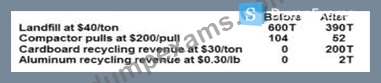
A facility has the following changes in annual operations because of a recycling program:
Landfill at $40/ton: Before 600T # After 390T
Compactor pulls at $200/pull: Before 104 # After 52
Cardboard recycling revenue at $30/ton: Before 0 # After 200T
Aluminum recycling revenue at $0.30/lb: Before 0 # After 2T
What was the gross revenue from the recycling effort?
- A. $7,200
- B. $18,000
Step-by-Step Calculation:
Cardboard recycling revenue:
200 tons × $30/ton = $6,000
Aluminum recycling revenue:
2 tons × 2,000 lbs/ton = 4,000 lbs
4,000 lbs × $0.30/lb = $1,200
Total Gross Revenue:
$6,000 + $1,200 = $7,200 - C. $6,000
- D. $6,600
Answer: A
Explanation:
The CHFM exam Financial Management domain requires knowledge of cost savings and revenue generation calculations from operational changes such as recycling initiatives. In this example, gross revenue is calculated by summing the total recycling income streams (cardboard and aluminum).
Correct Answer (C. $7,200): Derived from combining $6,000 (cardboard) and $1,200 (aluminum) revenue.
Other options are incorrect because:
A ($6,000): Considers cardboard only.
B ($6,600): Misapplies aluminum tonnage conversion.
D ($18,000): Exaggerates revenue beyond calculated amounts.
References:
American Hospital Association (AHA), CHFM Candidate Handbook - Financial Management domain includes evaluating cost savings and revenue streams in facility operations.
Environmental Protection Agency (EPA), Waste Management and Recycling Revenue Guidance - Defines commodity values for recyclable materials.
NEW QUESTION # 12
A diesel emergency generator is rated at 500 KVA. When the generator is tested, the load on it is 220 KVA.
According to the NFPA, the MINIMUM testing requirements are to run the unit
- A. annually with supplemental loads for 2 hours.
- B. monthly until the water temperature and oil pressure have stabilized.
- C. annually with supplemental loads for 30 minutes.
- D. monthly under load for 30 minutes.
Answer: B
Explanation:
NFPA 110 (Standard for Emergency and Standby Power Systems) requires that emergency generators be tested monthly under load. If the available load is less than 30% of the generator's nameplate rating, the test may be conducted until operating parameters (water temperature, oil pressure) stabilize. For longer durations, supplemental loading or load bank testing applies, but the minimum standard is monthly operation until systems stabilize.
Reference: NFPA 110 (2010), Section 8.4.2.
NEW QUESTION # 13
Regulated medical waste should be handled in which of the following ways?
- A. incinerated within 10 days of collection
- B. separated from other types of waste
- C. refrigerated at 40° F
- D. labeled with specific content
Answer: B
Explanation:
According to federal and state healthcare waste management standards, regulated medical waste must always be separated from general waste streams at the point of generation. Proper segregation ensures compliance with OSHA's Bloodborne Pathogens Standard, EPA's Resource Conservation and Recovery Act (RCRA), and The Joint Commission's Environment of Care standards. Containers for regulated waste must be red, leak- resistant, and labeled with the universal biohazard symbol.
Correct Answer (D. separated from other types of waste): CHFM compliance and Environment of Care standards require that infectious or hazardous medical waste be physically separated to prevent cross- contamination and maintain compliance with infection control protocols.
A (labeled with specific content): While containers must be labeled, they do not list specific contents; only the biohazard designation is required.
B (refrigerated at 40°F): Refrigeration applies only in specific storage conditions, not universally required for all regulated medical waste.
C (incinerated within 10 days): Time requirements vary by jurisdiction; incineration within 10 days is not a universal federal mandate.
References:
American Hospital Association, CHFM Candidate Handbook - Compliance domain, safety, and waste handling requirements.
OSHA Bloodborne Pathogens Standard (29 CFR 1910.1030).
EPA RCRA Medical Waste Tracking Act guidance.
The Joint Commission, Environment of Care Standards.
NEW QUESTION # 14 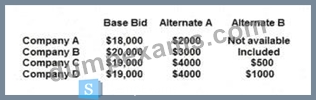
(Base Bid / Alternate A / Alternate B)
Company A: $18,000 / $2,000 / Not available
Company B: $20,000 / $3,000 / Included
Company C: $19,000 / $4,000 / $500
Company D: $19,000 / $4,000 / $1,000
Which company has the LOWEST cost if alternate B is chosen?
- A. $20,000 + Included ($0) = $20,000.
- B. $19,000 + $500 = $19,500.
- C. $19,000 + $1,000 = $20,000.
- D. Not available # cannot be selected.
Answer: B
Explanation:
When Alternate B is chosen, total price = Base Bid + price for Alternate B (or zero if "Included").
Lowest total = $19,500 (Company C).
References:
AHA/CHFM Exam Content Outline - Planning, Design, and Construction domain (procurement/bid evaluations and alternates).
ASHE Project Management guidance - Evaluating base bids with alternates.
NEW QUESTION # 15
At the end of an 8-hour electrical shutdown, after the maintenance work is completed but before the cabinets are closed up or the system re-energized, a final inspection should be completed by individuals who have
- A. working knowledge of the generators and switch gear.
- B. "fresh eyes" and go/no go authority.
- C. been involved since the beginning of the shutdown.
- D. gathered feedback and attended the lessons learned debriefing.
Answer: B
Explanation:
Best practice in safety and risk management is to have a final inspection performed by individuals with "fresh eyes" and go/no-go authority. Those directly involved may overlook issues due to task familiarity.
Independent inspection reduces risk before re-energization.
References: NFPA 70E (Electrical Safety in the Workplace); AHA/ASHE recommended practices; CHFM Handbook - Administration and Compliance domains.
NEW QUESTION # 16
Which of the following would a facility health manager consult to determine the required number of medical gas outlets for a specific location, such as patient rooms or ICU rooms?
- A. FGI Guidelines for the Design and Construction of Hospitals and Outpatient Facilities
- B. ADA Guidelines
- C. The Joint Commission Environment of Care (EOC) Standards
- D. NFPA 101 Life Safety Code
Answer: A
Explanation:
The Facility Guidelines Institute (FGI) Guidelines are the authoritative source that specifies requirements for the design and construction of healthcare facilities. Within these guidelines, the number and type of medical gas outlets required in patient care areas such as intensive care units, operating rooms, and patient rooms are detailed. NFPA 99 governs installation and performance standards for medical gas systems, but the quantities of outlets are determined by the FGI Guidelines, which CHFM candidates are expected to know.
Incorrect Options:
A). NFPA 101 Life Safety Code - Addresses fire and life safety, not medical gas outlet quantities.
C). ADA Guidelines - Focus on accessibility, not medical gas systems.
D). The Joint Commission EOC Standards - Require safe use of systems but do not prescribe outlet numbers.
References:
FGI: Guidelines for Design and Construction of Hospitals and Outpatient Facilities - Medical gas outlet requirements per room type.
NFPA 99: Health Care Facilities Code - Technical standards for installation and testing.
CHFM Candidate Handbook - Planning, Design, and Construction domain.
NEW QUESTION # 17
According to Appendix A for CMS 482.41(c)(2), a facility manager can meet the regulatory requirements for elevator equipment management by documenting inspection, testing, and
- A. repairs.
- B. recalls.
- C. cleaning.
- D. maintenance.
Answer: D
Explanation:
CMS Condition of Participation 482.41(c)(2) requires hospitals to ensure that elevator equipment is routinely inspected, tested, and maintained. Appendix A to this regulation clarifies that documentation of these three elements demonstrates compliance.
Correct (C): Maintenance - Inspections and testing alone are insufficient; ongoing maintenance must be documented.
Incorrect:
A). recalls: Not part of CMS 482.41(c)(2).
B). cleaning: While important, cleaning is not listed as a compliance requirement.
D). repairs: Only performed when problems are found; maintenance is the proactive required element.
References:
CMS State Operations Manual, Appendix A - Interpretive Guidelines for 42 CFR 482.41(c)(2).
AHA/CHFM Candidate Handbook - Compliance domain references to CMS physical environment regulations.
NEW QUESTION # 18
Which of the following are used to establish a salary range for a new job category?
market salary analysis
candidate qualifications
review of internal equity
job description
- A. 2, 3, and 4 only
- B. 1, 3, and 4 only
- C. 1, 2, and 3 only
- D. 1, 2, and 4 only
Answer: B
Explanation:
Salary ranges are determined by job requirements and market benchmarks, not individual candidate qualifications. Key factors are:
Market salary analysis (1).
Internal equity review (3).
Job description (4).
Candidate qualifications (2) affect where within the salary range an individual may be placed, but not the establishment of the range itself.
References:
AHA/CHFM Candidate Handbook - Administration domain (Human Resources).
ASHE Management Guidelines.
________________________________________
NEW QUESTION # 19
The minimum clearance required below a sprinkler head is how many inches?
- A. 0
- B. 1
- C. 2
- D. 3
Answer: D
Explanation:
Per NFPA 13: Standard for the Installation of Sprinkler Systems, 18 inches of clearance must be maintained below sprinkler deflectors to ensure proper spray pattern and fire suppression coverage.
C). 18 (Correct).
Less than 18 inches (12 or 15) is insufficient clearance.
More than 18 (24 inches) exceeds the standard, not required.
References:
NFPA 13: Standard for Installation of Sprinkler Systems, Section on Obstructions and Clearances.
CHFM Candidate Handbook - Compliance domain.
________________________________________
NEW QUESTION # 20
A visual indication that an electrical receptacle is hospital grade is that the receptacle
- A. has a green dot.
- B. is red.
- C. has a label.
- D. is tamper-resistant.
Answer: A
Explanation:
Hospital-grade receptacles, as defined in UL 498 and required under NFPA 99 Health Care Facilities Code, must be marked with a green dot. This identifies receptacles tested for durability, grounding reliability, and retention force.
Red outlets are often tied to emergency power, but that is separate from the "hospital grade" designation.
References: NFPA 99, Chapter 6 (Electrical Systems); UL 498; CHFM Compliance domain.
NEW QUESTION # 21
Where a required fire alarm system is out of service for more than 4 hours in a 24-hour period, which of the following is required according to NFPA Life Safety Codes?
Notify the authority having jurisdiction.
Provide an approved fire watch for all parties left unprotected by the shutdown.
Notify the building administrator.
Notify the fire alarm service company for repair.
- A. 3 and 4 only
- B. 1 and 3 only
- C. 2 and 4 only
- D. 1 and 2 only
Answer: D
Explanation:
NFPA 101 (Life Safety Code, Section 9.6.1.6) requires that when a fire alarm system is out of service for more than 4 hours in a 24-hour period, the facility must (1) notify the authority having jurisdiction (AHJ) and (2) provide an approved fire watch until the system is restored. Internal notifications such as to administrators or vendors may occur, but the code specifically mandates AHJ notification and fire watch.
References: NFPA 101, Section 9.6.1.6; CHFM Candidate Handbook - Compliance domain.
NEW QUESTION # 22
Fire doors used within a means of egress shall be
- A. magnetically held open and labeled.
- B. self-closing and smoke tight.
- C. self-closing and positive latching.
- D. metal with vision panels.
Answer: C
Explanation:
NFPA 80 (Standard for Fire Doors and Other Opening Protectives) and NFPA 101 (Life Safety Code) both require that fire doors in a means of egress must be self-closing and equipped with a positive-latching device.
This ensures that the door will automatically return to the closed position and latch securely to prevent fire and smoke from spreading through the egress path.
A: Doors can be held open magnetically only when connected to the fire alarm system, but the essential code requirement is positive latching.
B: Materials and vision panels are not universal requirements.
D: Smoke-tight doors are required in smoke barriers, not all egress fire doors.
References: NFPA 80; NFPA 101, Section 7.2.1.8.
NEW QUESTION # 23
As part of developing a HVA, which of the following elements should be considered?
events affecting demand for hospital services
cost of addressing the events
consequences of the events
likelihood of the events occurring
- A. 2, 3, and 4 only
- B. 1, 3, and 4 only
- C. 1, 2, and 3 only
- D. 1, 2, and 4 only
Answer: B
Explanation:
A Hazard Vulnerability Analysis (HVA) evaluates probability/likelihood of events, impact/consequences on operations and safety, and surge/demand effects on services to prioritize preparedness and mitigation. While cost considerations inform later planning, the core HVA scoring focuses on likelihood, consequences, and demand effects.
References:
The Joint Commission, Emergency Management standards (HVA requirement).
ASHE HVA Tool and Guidance - Likelihood, impact, and surge/demand parameters.
AHA/ASHE CHFM Study Resources - Administration domain (emergency management planning).
NEW QUESTION # 24
According to NFPA 80, the maximum undercut allowed for rated fire doors is how many inches?
- A. 3/4
- B. 1/2
- C. 0
- D. 5/8
Answer: A
Explanation:
NFPA 80 (Standard for Fire Doors and Other Opening Protectives) sets requirements for fire door construction and installation. It specifies that the maximum undercut clearance is 3/4 inch unless otherwise tested and listed. Greater clearances compromise the integrity of the fire barrier.
References: NFPA 80, Section 4.8.4 (2010 edition and later); CHFM Candidate Handbook - Compliance domain.
NEW QUESTION # 25
Which of the following items are allowed to remain in the corridor in an inpatient care area?
- A. recycle bins
- B. crash carts
- C. laundry hampers
- D. work stations on wheels (WOWs)
Answer: B
Explanation:
According to NFPA 101 Life Safety Code and CMS/TJC corridor obstruction guidance, only certain items deemed essential for immediate patient care may be left unattended in inpatient care corridors. Crash carts are specifically allowed because they are emergency life-saving equipment. Other items, such as hampers, WOWs, and bins, are considered obstructions and must be removed when not in active use.
References:
NFPA 101: Life Safety Code (2012, 2018 editions) - Corridor width and obstruction allowances.
The Joint Commission: Environment of Care Standards - Corridor equipment restrictions.
________________________________________
NEW QUESTION # 26
For a facility to apply the NFPA 101 (2012 edition) standards correctly, which of the following must first be defined?
- A. building deficiencies
- B. occupancy
- C. type of construction
- D. location
Answer: B
Explanation:
NFPA 101 (Life Safety Code) is structured around occupancy classifications (healthcare, business, assembly, residential, etc.). Determining the correct occupancy type is the first step because all subsequent requirements-such as egress, fire protection features, and construction criteria-are based on occupancy classification. Construction type, deficiencies, and location are important, but they are addressed only after occupancy is defined.
References: NFPA 101 (2012), Chapters 18/19 (Healthcare Occupancies); CHFM Candidate Handbook - Compliance domain.
NEW QUESTION # 27
Which of the following types of duct-mounted humidifiers is recommended by the FGI Guidelines for Design and Construction of Hospitals and Outpatient Facilities?
- A. water spray
- B. reservoir
- C. evaporative pan
- D. steam
Answer: D
Explanation:
The FGI Guidelines and ASHRAE healthcare design standards recommend steam humidifiers for duct- mounted systems in hospitals, since they minimize microbial growth. Reservoirs, spray, and pan humidifiers pose contamination risks and are not permitted for patient care areas.
References: FGI Guidelines (Hospitals), ASHRAE 170 Ventilation Standard; NFPA 99.
NEW QUESTION # 28
A "WAGD" outlet would typically be found in the
- A. laundry room.
- B. boiler room.
- C. operating room.
- D. electrical closet.
Answer: C
Explanation:
"WAGD" stands for Waste Anesthetic Gas Disposal. These outlets are installed in operating rooms to remove excess anesthetic gases exhaled by patients or escaping from anesthesia equipment. The purpose is to maintain staff safety and compliance with NFPA 99 (Health Care Facilities Code), which requires WAGD systems in anesthetizing locations.
Correct (D): Operating rooms require WAGD outlets as part of medical gas and vacuum systems.
Incorrect:
A). boiler room: No patient care; WAGD outlets are not relevant.
B). electrical closet: For electrical equipment only, no medical gases.
C). laundry room: Handles linens, not anesthetic gas removal.
References:
NFPA 99: Health Care Facilities Code - Requirements for WAGD systems in anesthetizing locations.
AHA/CHFM Study Outline - Maintenance and Operations domain covering utility and gas systems.
NEW QUESTION # 29
When preparing to open up a newly constructed wing, who is required to survey the new area?
- A. utility department
- B. police department
- C. fire department
- D. engineering department
Answer: C
Explanation:
Prior to occupancy of newly constructed healthcare space, the local fire department (or fire marshal) must perform a survey/inspection to ensure compliance with life safety requirements, fire alarm functionality, sprinkler coverage, and egress standards. This is part of code compliance and occupancy approval.
References: NFPA 101 Life Safety Code; The Joint Commission Environment of Care standards.
NEW QUESTION # 30
Child abduction system evaluation is best accomplished by
- A. security professionals.
- B. risk managers.
- C. administration.
- D. the safety committee.
Answer: A
Explanation:
The evaluation of child abduction systems-such as infant security alarms, electronic tagging devices, and controlled access systems-falls under the expertise of security professionals. These professionals are trained to test, monitor, and validate the effectiveness of electronic security and surveillance systems. Their role ensures that abduction-prevention technology is properly installed, maintained, and capable of responding effectively in an emergency.
* Correct Answer (B. security professionals): According to the CHFM exam content outline under Compliance, healthcare facilities are expected to implement and evaluate security measures that meet regulatory and safety requirements. The responsibility for the technical and functional evaluation of systems like infant abduction alarms lies with trained security staff.
* Incorrect Options:
* A. administration: While hospital administration sets policy and allocates resources, they are not directly responsible for evaluating technical systems.
* C. the safety committee: Safety committees review incidents and provide oversight but do not conduct system-level technical evaluations.
* D. risk managers: Risk managers focus on identifying potential liability and compliance issues but rely on security professionals to conduct the detailed evaluation of child abduction systems.
Relevance to CHFM Compliance Domain:
Within the Compliance domain of the CHFM exam, managers must demonstrate knowledge of regulatory standards for security in healthcare facilities, particularly in sensitive areas such as maternity wards.
Evaluation of abduction-prevention systems aligns directly with security operations, which are managed and verified by trained security professionals to ensure compliance with The Joint Commission (TJC), CMS, and industry best practices.
References:
American Hospital Association (AHA), CHFM Candidate Handbook - Exam Content Outline, "Compliance" domain: includes responsibilities for security and safety system evaluation.
The Joint Commission (TJC), Environment of Care Standards - Requirements for infant and pediatric abduction prevention measures.
NFPA 99: Health Care Facilities Code - Security system integration into patient safety measures.
NEW QUESTION # 31
An electrical transformer has 254 turns in the primary winding and 127 turns in the secondary winding. If a source emf of 220 volts is applied to the primary coil, the value of the voltage available in the secondary coil is
- A. 220.
- B. 440.
- C. 110.
- D. 127.
Answer: C
Explanation:
The transformer voltage ratio is determined by the turns ratio:
#
#
#
#
=
#
#
#
#
V
p
V
s
=
N
p
N
s
#
#
=
#
#
×
127
254
=
220
×
0.5
=
110
volts
V
s
=V
p
×
254
127
=220×0.5=110volts
A). 110 (Correct): Secondary voltage is half of the primary because turns ratio = 0.5.
B). 127: Incorrect, not consistent with ratio.
C). 220: Would occur only if turns ratio = 1.
D). 440: Would occur if secondary had twice as many turns as primary.
References:
NFPA 70: National Electrical Code - Transformer basics.
CHFM Candidate Handbook - Maintenance and Operations (Electrical Systems).
NEW QUESTION # 32
"Guidelines for Preventing the Transmission of Mycobacterium Tuberculosis in Healthcare Facilities" is a document produced by the
- A. OSHA.
- B. EPA.
- C. FDA.
- D. CDC.
Answer: D
Explanation:
The Centers for Disease Control and Prevention (CDC) published the document "Guidelines for Preventing the Transmission of Mycobacterium Tuberculosis in Healthcare Facilities". These guidelines provide infection control practices for healthcare facilities, including engineering controls, ventilation requirements, and personal protective equipment (PPE) to minimize the risk of TB transmission.
Correct: CDC (B) - Responsible for publishing this guideline.
Incorrect:
A). FDA - Regulates drugs and medical devices.
C). EPA - Oversees environmental protection and pollutants, not healthcare infection prevention.
D). OSHA - Issues workplace safety standards, but this TB guideline is from CDC.
References:
CDC: Guidelines for Preventing the Transmission of Mycobacterium Tuberculosis in Healthcare Facilities.
CHFM Candidate Handbook - Compliance domain: infection prevention and regulatory guidance.
NEW QUESTION # 33
Which of the following is the best description of the purpose of an Environmental Tour as required by TJC?
- A. ensures compliance with TJC standards
- B. establishes failures in building systems
- C. categorizes risk assessments
- D. identifies hazards
Answer: D
Explanation:
The Joint Commission (TJC) requires hospitals to conduct environmental tours (also called Environment of Care rounds) with the primary purpose of identifying hazards to patients, staff, and visitors. While compliance, risk categorization, and system failures may be evaluated, the main focus is proactive hazard identification to reduce safety risks.
References: The Joint Commission, Environment of Care Standards, EC.04.01.01.
NEW QUESTION # 34
If a boiler combustion efficiency test indicates 22% excess oxygen at mid-firing rate, which of the following adjustments should be made?
- A. Shift to steam atomization.
- B. Increase the nozzle air pressure.
- C. Increase the fuel pressure.
- D. No adjustment is necessary.
Answer: C
Explanation:
22% excess oxygen is far higher than normal (typical excess O# is 3-6%). This means there is too much air compared to fuel, causing inefficiency.
The corrective action is to increase fuel pressure, which reduces excess oxygen by balancing the air-fuel ratio.
D). Increase the fuel pressure (Correct): Restores optimal combustion balance.
A). Steam atomization: Not relevant unless using certain oil burners.
B). Increase nozzle air pressure: Would worsen the excess O# condition.
C). No adjustment necessary: Incorrect because efficiency is compromised.
References:
ASME Boiler and Pressure Vessel Code.
ASHE/CHFM Study Guide - Boiler efficiency and combustion control.
NFPA 85: Boiler and Combustion Systems Hazards Code.
NEW QUESTION # 35
According to The Joint Commission Emergency Management Standards, a facility must
- A. provide utilities, equipment, and supplies in order to maintain operations for 96 hours.
- B. evaluate capabilities and response efforts for the organization to maintain operations for 96 hours.
- C. establish agreements with utility, equipment, and supply vendors to provide support in order to maintain operations for 96 hours.
- D. maintain inventories of critical supplies in sufficient quantities to maintain operations for 96 hours.
Answer: B
Explanation:
The Joint Commission Emergency Management Standards require organizations to evaluate their capabilities and plan for how they would maintain operations during an emergency for up to 96 hours. This does not mandate stockpiling or guaranteeing resources for that duration, but rather ensuring that the facility has assessed its resources, strategies, and agreements to maintain patient care and safety during prolonged emergency conditions.
Incorrect Options:
A and B: Maintaining actual supplies/utilities for 96 hours is not specifically required.
C: Agreements with vendors may be part of the plan but are not the mandated standard.
References:
The Joint Commission: Emergency Management (EM) Standards - 96-hour sustainment requirement.
AHA/ASHE CHFM Review Materials - Compliance domain: Emergency preparedness and response.
CHFM Candidate Handbook - Compliance domain outlines emergency management as a tested area.
NEW QUESTION # 36
......
CHFM Questions Prepare with Learning Information: https://passleader.dumpexams.com/CHFM-vce-torrent.html