


Updated Nov-2025 Official licence for SMI300XS Certified by SMI300XS Dumps PDF
Grab latest Amazon SMI300XS Dumps as PDF Updated on 2025
NEW QUESTION # 20
Why is there a yellow warning label on the flat panel/ribbon cable?
- A. To warn you that you can optionally remove the flat panel cable before removing the midplane from the chassis or you will damage the cable.
- B. To warn you that you must remove the flat panel cable after removing the midplane from the chassis or you will damage the cable.
- C. To warn you that you must remove the flat panel/ribbon cable before removing the midplane from the chassis or you will damage the cable.
- D. To warn you that the cable is hot.
Answer: C
NEW QUESTION # 21
When securing the PCIe tray, why must it be screwed in at one end of the chassis first before installing another tray at the opposite end?
- A. Because the tray will get pushed out
- B. Because the cables in the tray will get in the way
- C. Because the tray will break
- D. Because the tray will not function
Answer: A
Explanation:
Why Secure One End of the PCIe Tray First?
* TheSupermicro MI300X chassis is designed for modular tray installation, meaningsecuring one end firstensures:
* Proper alignment of PCIe slots and connectors
* Stable mountingto prevent unwanted movement
* Prevention of unnecessary strain on installed expansion cards
What Happens If Both Ends Are Handled at the Same Time?
* ThePCIe tray may shift out of alignment, making it difficult to properly install other components.
* Misalignment can cause:
* PCIe devices to not seat properly
* Power or data cables to be obstructed
* Increased risk of mechanical damage during reinstallation
Step-by-Step Correct Installation Process:
#Step 1:Align the PCIe tray with its designated mounting slots.#Step 2:Secure screws onone end firstto hold the tray in place.#Step 3:Adjust the other end and ensureproper seatingbefore fully tightening all screws.# Step 4:Reconnect all PCIe cables and verify system connectivity.
Why Other Options Are Incorrect?
* B (Cables getting in the way)# While cable management is important, the main issue istray movement
, not cable obstruction.
* C (Tray will not function)# The tray will functiononce properly seated, butincorrect installation can lead to PCIe misalignment.
* D (Tray will break)# The tray is designed for durability; it will not break unlessexcessive force is applied.
Official Documentation Reference:
* Supermicro AS-8125GS-TNMR2 Service Guideconfirms thattrays must be secured at one end first to ensure proper alignment.
NEW QUESTION # 22
What equipment is required in order to remove the heatsink from the motherboard tray?
- A. PH2 Phillips screwdriver
- B. T30 Torx bit
- C. T40 Torx bit
- D. T20 Torx bit
Answer: B
Explanation:
To remove theheatsink from the motherboard tray,a T30 Torx bit is required. This tool ensuresproper torque applicationandprevents damageto both the heatsink and the motherboard.
Why a T30 Torx bit is necessary?
* Supermicro MI300X GPU systems use precision heatsink retention mechanisms.
* Theheatsink screws are secured with factory torque settingsand require aT30 Torx bitfor safe removal.
* Using an incorrect tool (Phillips screwdriver, T20, or T40) can strip the screw heads, making it difficult to remove the heatsink without causing damage.
Incorrect Answers Explained:
* A (PH2 Phillips screwdriver)# Not strong enough for heatsink screws, which requirehigh torquefor proper seating.
* C (T20 Torx bit)# Toosmall, risksstrippingthe screws.
* D (T40 Torx bit)# Toolarge, does not fit the heatsink screws.
Official Documentation Reference:
* Supermicro MI300X Service Manualspecifies that aT30 Torx bitmust be used to remove the heatsink without damaging the motherboard.
NEW QUESTION # 23
Exhibit: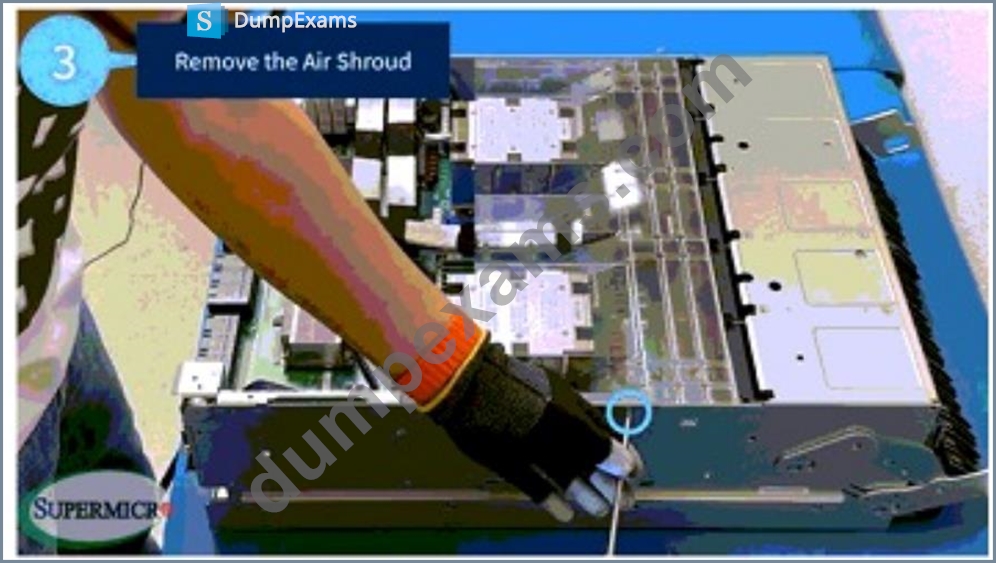
Where are the 2 screws located before you can remove the air shroud?
- A. On both sides of the PCIe tray
- B. On top of the motherboard tray
- C. On both sides of the motherboard tray
- D. On both sides of the GPU tray
Answer: C
Explanation:
Theair shroudis a crucial component in theSupermicro MI300X GPU system, designed todirect airflow efficientlyover high-performance GPUs and CPUs.Before removing the air shroud, two screws must be removed, and they are located on both sides of the motherboard tray.
Why are these screws important?
* They secure the air shroud to the chassis, preventing unwanted movement.
* Removing them ensures the air shroud can be lifted safely, without damaging cooling pathways.
* They prevent vibrations from GPU cooling fans from dislodging the shroud over time.
Incorrect Answers Explained:
* A (On top of the motherboard tray)# Incorrect, as the screws are not mounted on top but on thesides of the motherboard tray.
* C (On both sides of the PCIe tray)# The PCIe tray does not secure the air shroud.
* D (On both sides of the GPU tray)# The GPU tray does not directly hold the air shroud in place.
Official Documentation Reference:
* Supermicro AS-8125GS-TNMR2 Cooling System Guidestates that theair shroud is secured by two screws on both sides of the motherboard tray.
NEW QUESTION # 24
Exhibit: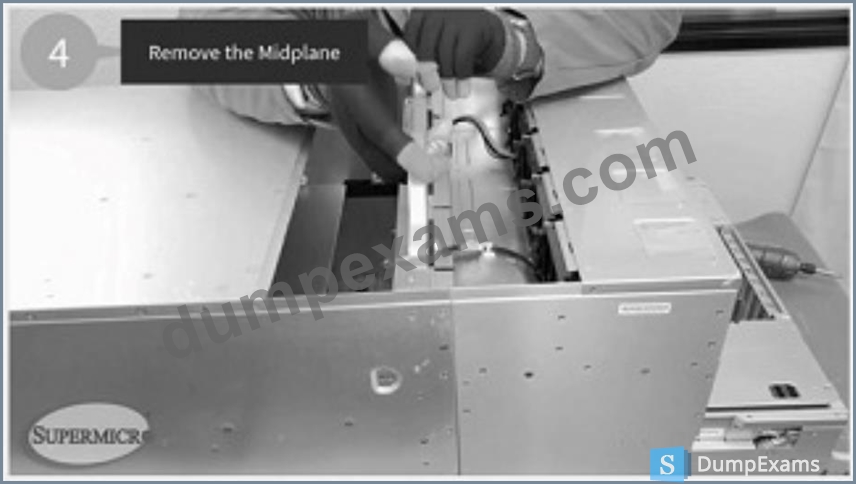
The 2 cables attached to the midplane on the side closest to the PCIe tray that need to be removed are the I2C cable and power cable. True or False?
- A. True
- B. False
Answer: A
Explanation:
Themidplane in Supermicro MI300X GPU systemsis responsible for interconnecting several system components. The twoprimary cablesthat must be removed before handling themidplaneare:
* I2C Cable (Inter-Integrated Circuit Cable)
* This cable is used forsensor data, system monitoring, and thermal control.
* If not disconnected, it couldsnap or cause sensor miscommunicationbetween the motherboard and the backplane.
* Power Cable
* This cablesupplies powerto the midplane andmust be disconnected before removalto avoid electrical damage.
* Removing the midplanewhile power cables are still attachedcould short-circuit the system.
Why is this step necessary?
* Supermicro's official documentation states that both the I2C and power cables must be disconnected before handling the midplane.
* Failure to remove these cables properly can cause permanent damage to connectors and the system board.
Official Documentation Reference:
* Supermicro AS-8125GS-TNMR2 Maintenance Manualconfirms thatdisconnecting the I2C and power cables is mandatory before midplane removal.
NEW QUESTION # 25
You must remove the motherboard tray from the chassis before you can access the NVMe backplane.
True or False?
- A. True
- B. False
Answer: A
Explanation:
InSupermicro MI300X GPU systems, theNVMe backplane is located behind the motherboard tray, meaning the tray must be removed first.
Why is this step necessary?
* The NVMe backplane is physically secured behind the motherboard trayto support high-speed PCIe connectivity.
* Removing the motherboard tray provides clear accessto NVMe connectors and MCIO cables.
* Skipping this step may cause unnecessary strain on cables, leading to potential connector damage.
Official Documentation Reference:
* Supermicro Service Guide for NVMe Systemsconfirms that themotherboard tray must be removed firstbefore working on the NVMe backplane.
NEW QUESTION # 26
Why is there a yellow warning label on the flat panel/ribbon cable?
- A. To warn you that you can optionally remove the flat panel cable before removing the midplane from the chassis or you will damage the cable.
- B. To warn you that you must remove the flat panel cable after removing the midplane from the chassis or you will damage the cable.
- C. To warn you that you must remove the flat panel/ribbon cable before removing the midplane from the chassis or you will damage the cable.
- D. To warn you that the cable is hot.
Answer: C
Explanation:
Theyellow warning labelis a critical indicator toprevent damagewhen servicing themidplane and ribbon cable connections.
Reason for Warning Label:
* Theflat panel/ribbon cable is delicateand isconnected between multiple system components.
* If themidplane is removed first, itstretches and applies force on the ribbon cable, leading to:
* Broken cable connectors
* Torn ribbon cable
* System interface failure(front panel controls, LED indicators, or data communication) Why other options are incorrect?
* A (Cable is hot)# Ribbon cablesdo not generate heatand thisis not the purpose of the warning label.
* B (Remove after midplane)# Thecable must be removed BEFORE the midplane, not after.
* C (Optional removal)#It is mandatory, not optional, to prevent damage.
Official Documentation Reference:
* Supermicro AS-8125GS-TNMR2 Maintenance Manualstates thatremoving the flat panel/ribbon cable firstisa required stepbefore handling the midplane.
NEW QUESTION # 27
Before you can remove the NVMe backplane (BPN-NVME5-HS219N-S24) from the motherboard tray, what should you do with the hard drives in the system?
- A. Disengage (but don't remove) all the drives
- B. Disengage the field engineer
- C. Disengage the power supply units (PSUs)
- D. Disengage the fans
Answer: A
Explanation:
Before removing theNVMe backplanein aSupermicro MI300X GPU system,all NVMe drives must be disengaged but not fully removed.
Why is this necessary?
* Ensures safe backplane removal
* NVMe drives are directly connected to the backplane viaMCIO or U.2 connectors.
* Keeping them engaged couldput stress on the connectors, causing damage.
* Prevents accidental disconnects
* Removing the drives completely isnot necessary, butdisengaging them ensures they do not obstruct removal.
* Avoids power damage
* If the drives remain engaged during backplane removal, they may still haveresidual power, which can causeconnector damage or electrical failure.
Why other options are incorrect?
* B (Disengage PSUs)# While power should be off,removing PSUs is not required for NVMe backplane removal.
* C (Disengage fans)# Fans are independent components anddo not interfere with the NVMe backplane.
* D (Disengage the field engineer)# Not a valid answer; field engineers are not system components.
Official Documentation Reference:
* Supermicro NVMe Storage Disassembly Guiderecommendsdisengaging NVMe drives but not fully removing thembefore backplane removal.
NEW QUESTION # 28
Exhibit: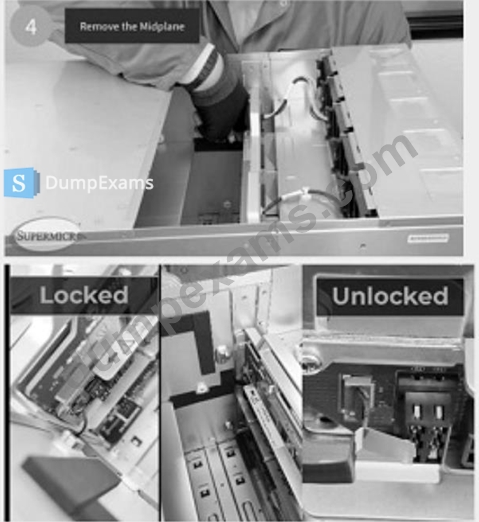
There is a flap door over the ribbon cable connection. To open it, use your finger to press down on the top of the flap door and pop it open. True or False?
- A. True
- B. False
Answer: A
Explanation:
Theflap door mechanismis a protective feature inSupermicro MI300X systemsdesigned tosecure ribbon cable connections.
How to open it correctly?
* Press down on the top of the flap door# This disengages the locking mechanism.
* The flap door will "pop open" safelywithout damaging the ribbon cable.
* Forcing the flap without pressing down properly may break the connector.
Official Documentation Reference:
* Supermicro AS-8125GS-TNMR2 Maintenance Manualprovidesspecific instructionsonpressing down the flap door before opening it.
NEW QUESTION # 29
Which cables need to be reconnected after installing the NVMe backplane?
- A. Only the i2C Cable
- B. i2C Cable, SAS Cable, Power Cable
- C. Only the SAS Cable
- D. Only the Power Cable
Answer: B
Explanation:
NVMe Backplane Connection Requirements in Supermicro MI300X Systems
Afterinstalling the NVMe backplane, the following cablesmust be reconnectedfor proper system functionality:
* i2C Cable(Inter-Integrated Circuit Cable)
* Responsible fordata communication, sensor monitoring, and system management functions.
* Ensures thatstorage devices are properly detectedby the motherboard.
* SAS Cable(Serial Attached SCSI)
* Used forhigh-speed storage connectivityin hybrid NVMe/SAS systems.
* Ensuresdata integrity and fast data transfers between SSDs and the system controller.
* Power Cable
* Supplies power to the NVMe backplaneandconnected drives.
* Without this,NVMe drives will not receive power and will not be detected by the system.
Why Other Options Are Incorrect?
* B (Only the SAS Cable)# While the SAS cable is important,the power cable and i2C cable are also required.
* C (Only the i2C Cable)# The i2C cable isnot sufficient by itself; the NVMe backplaneneeds both power and data connections.
* D (Only the Power Cable)# Power is needed, butdata connectivity through SAS and i2C is essential for full functionality.
Official Documentation Reference:
* Supermicro NVMe Storage System Guideconfirms thati2C, SAS, and power cables must all be reconnected after NVMe backplane installation.
NEW QUESTION # 30
Where is the one screw that needs to be removed in order to remove the AOM bracket?
- A. On top of the fan tray
- B. On the side of the motherboard tray
- C. On the rear of the power supply
- D. On top of the hard drive tray
Answer: B
Explanation:
Understanding the AOM Bracket in Supermicro MI300X Systems
TheAOM (Add-On Module) bracketis used to holdoptional expansion cards, such as:
* RAID controllers
* Additional network interface cards (NICs)
* BMC/IPMI modules for system management
Why is the Screw Located on the Side of the Motherboard Tray?
* The AOM bracket is secured to the chassis via a single screwthat is located on theside of the motherboard tray.
* This designkeeps the bracket firmly in placewhile still allowing foreasy removal when needed.
* Removing the screw first prevents unnecessary strain on the bracketand ensuressafe removal of the AOM card.
Why Other Options Are Incorrect?
* A (On top of the hard drive tray)# The hard drive tray does not secure the AOM bracket.
* B (On top of the fan tray)# Fans do not hold down the AOM bracket.
* D (On the rear of the power supply)# The power supplyis not directly connected to the AOM bracket.
Official Documentation Reference:
* Supermicro AS-8125GS-TNMR2 Expansion Module Guidespecifies that theAOM bracket is secured by a single screw located on the side of the motherboard tray.
NEW QUESTION # 31
How many screws need to be loosened across the bracket in the bottom of the motherboard tray in front of the backplane?
- A. 0
- B. 1
- C. 2
- D. 3
Answer: B
Explanation:
When servicing theSupermicro MI300X GPU system, there are3 screwssecuring thebracket at the bottom of the motherboard trayin front of the backplane.
Purpose of these screws:
* They secure the backplane's structural integrityto prevent vibration-related failures.
* Loosening them allows the removal or replacement of backplane componentssafely.
* They prevent accidental disconnectionscaused by handling or system movement.
Why other options are incorrect?
* A (13 screws)# This number istoo highfor just the bottom bracket.
* B (21 screws) & C (30 screws)# These numbersapply to entire system disassembly, not just the bottom bracket.
Official Documentation Reference:
* Supermicro AS-8125GS-TNMR2 Disassembly Guidespecifies thatonly 3 screwsneed to be loosened to access thebottom bracket securing the backplane.
NEW QUESTION # 32
Once you remove the midplane lid from the AS-8125GS-TNMR2 system, how many total screws must be removed from the sides of the chassis in order to remove the midplane bracket?
- A. 8 screws total (4 on each side of the chassis)
- B. 2 screws total (1 on each side of the chassis)
- C. 6 screws total (3 on each side of the chassis)
- D. 4 screws total (2 on each side of the chassis)
Answer: D
Explanation:
To remove themidplane bracketin theAS-8125GS-TNMR2 system, you must remove4 screws total(2 on each side of the chassis).
Why 4 screws?
* The midplane bracket is secured by 2 screws per sideto maintain its structural integrity.
* Loosening all 4 screws allows safe removal without excessive force.
* Forcing the bracket without removing the screws risks damaging the mounting points.
Incorrect Answers Explained:
* A (2 screws total)# Not enough, as screws on both sides must be removed.
* C (8 screws total)# More than necessary;only 4 screws hold the midplane bracket.
* D (6 screws total)# Incorrect count;only 2 screws per side are required.
Official Documentation Reference:
* Supermicro AS-8125GS-TNMR2 Installation Guideexplicitly states thattwo screws on each side (4 total) must be removed to release the midplane bracket.
NEW QUESTION # 33
Exhibit: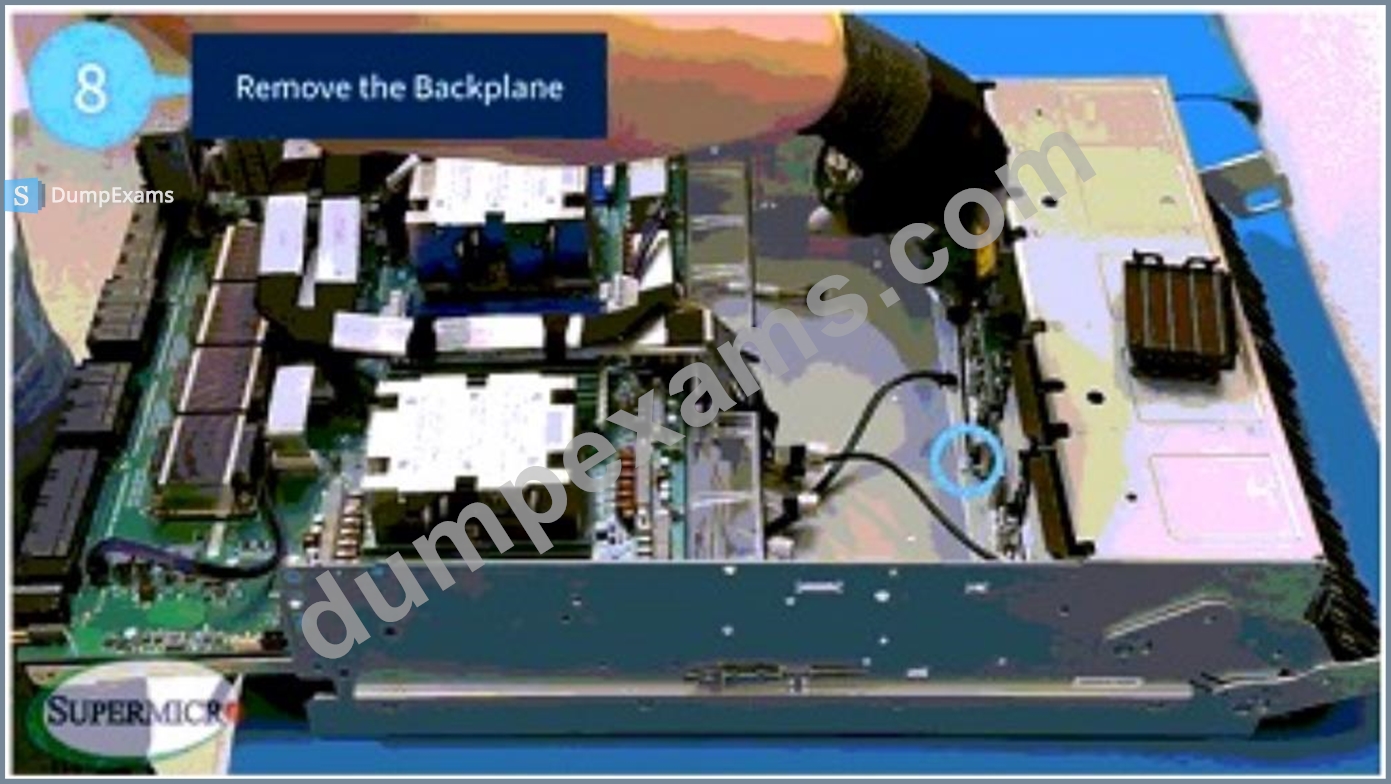
4 screws secure the backplane to the motherboard tray that you will need to remove, and they are spaced equidistant across the backplane. True or False?
- A. True
- B. False
Answer: A
Explanation:
Why Are the Screws Equidistant?
* Thebackplane in Supermicro MI300X systemsis alarge PCB (printed circuit board) that connects NVMe SSDs and PCIe devices to the motherboard.
* It is secured byfour screws placed equidistantlyto:
* Distribute mechanical stress evenly
* Ensure stability against vibrations
* Prevent warping or misalignment of connectors
Proper Removal of the Backplane Screws:
#Step 1:Identify and locate the4 securing screws on the backplane.#Step 2:Loosen them in across-pattern (diagonal pairs) to prevent stress buildup.#Step 3:Carefully lift the backplanestraight upto avoid bending connector pins.
Why This Layout Is Important?
#Equidistant screw spacing ensures even pressure distribution, preventing PCB flexing or cracking.# Improper screw removal (one side first) can cause misalignment or undue stress on connectors.
Why False Is Incorrect?
* IfFalse were correct, it would imply that screws are placedrandomly or unevenly, which isnot the case in Supermicro MI300X systems.
Official Documentation Reference:
* Supermicro AS-8125GS-TNMR2 Installation Manualconfirms thatthe backplane is secured with 4 evenly spaced screws for structural integrity.
NEW QUESTION # 34
In the motherboard tray, the AOM bracket is partially covered by the support bar. So, you'll need to remove the support bar first before you can remove the AOM bracket. True or False?
- A. True
- B. False
Answer: A
Explanation:
Why Must the Support Bar Be Removed First?
* Thesupport baris areinforcement structureinside the chassis that providesmechanical stabilityto components, including theAOM bracket.
* Since the AOM bracket is partially covered by the support bar, you mustremove the bar firstto gain full access.
Step-by-Step Removal Process:
#Step 1:Remove the screws securing the support bar.#Step 2:Carefully lift and remove the support bar without tilting it.#Step 3:Now, unscrew and remove the AOM bracket.
Why is False Incorrect?
* IfFalse were correct, it would suggest that the AOM bracket can be removedwithout touching the support bar, which isnot possibledue to obstruction.
Official Documentation Reference:
* Supermicro AS-8125GS-TNMR2 Disassembly Manualconfirms that thesupport bar must be removed first before accessing the AOM bracket.
NEW QUESTION # 35
Before disconnecting the cables from the NVMe backplane, what precaution should be taken?
- A. Randomly disconnect cables and reconnect them later.
- B. Disconnect the power supply first.
- C. Map the cables so that you can reconnect them to the proper port location later on.
- D. Shake the system to loosen cables before disconnecting them.
Answer: C
Explanation:
Importance of Mapping Cables Before Disconnection
TheNVMe backplaneinSupermicro MI300X systemsuseshigh-speed PCIe lanesandpower distribution linesthat must beproperly mapped before disconnection.
Why Should Cables Be Mapped?
* Prevents misconnection during reassembly
* The system usesmultiple identical-looking cables(MCIO, NVMe, and power cables).
* Misplacing a cable in the wrong portcan causeboot failures, drive detection issues, and system instability.
* Reduces downtime for troubleshooting
* Without a mapped diagram or a picture, technicians may spendhours debugging misconnected cables, leading todelays in system restoration.
* Ensures proper airflow and cable management
* Incorrectly routed cablescanblock airflow, leading tooverheating and thermal throttling of GPUs or storage devices.
Correct Process for Cable Mapping
* Take high-resolution picturesbefore disconnecting cables.
* Label each cable and its corresponding portusing numbered stickers or colored tags.
* Create a simple mapping diagramshowing which cable connects to which port.
* Double-check the mapping before removal.
Why Other Options Are Incorrect?
* B (Disconnect the power supply first)# While powering down is important,mapping cables is the primary precaution before disconnection.
* C (Randomly disconnect cables)# Leads to confusion and potential system failures due to incorrect reconnections.
* D (Shake the system to loosen cables)#NEVER shake a server, as this can damage internal components and misalign connectors.
Official Documentation Reference:
* Supermicro NVMe Installation Guidestates thatproper cable mapping is required before NVMe backplane disconnectionto avoid misplacement.
NEW QUESTION # 36
......
Latest SMI300XS Exam Dumps Supermicro Exam from Training: https://passleader.dumpexams.com/SMI300XS-vce-torrent.html